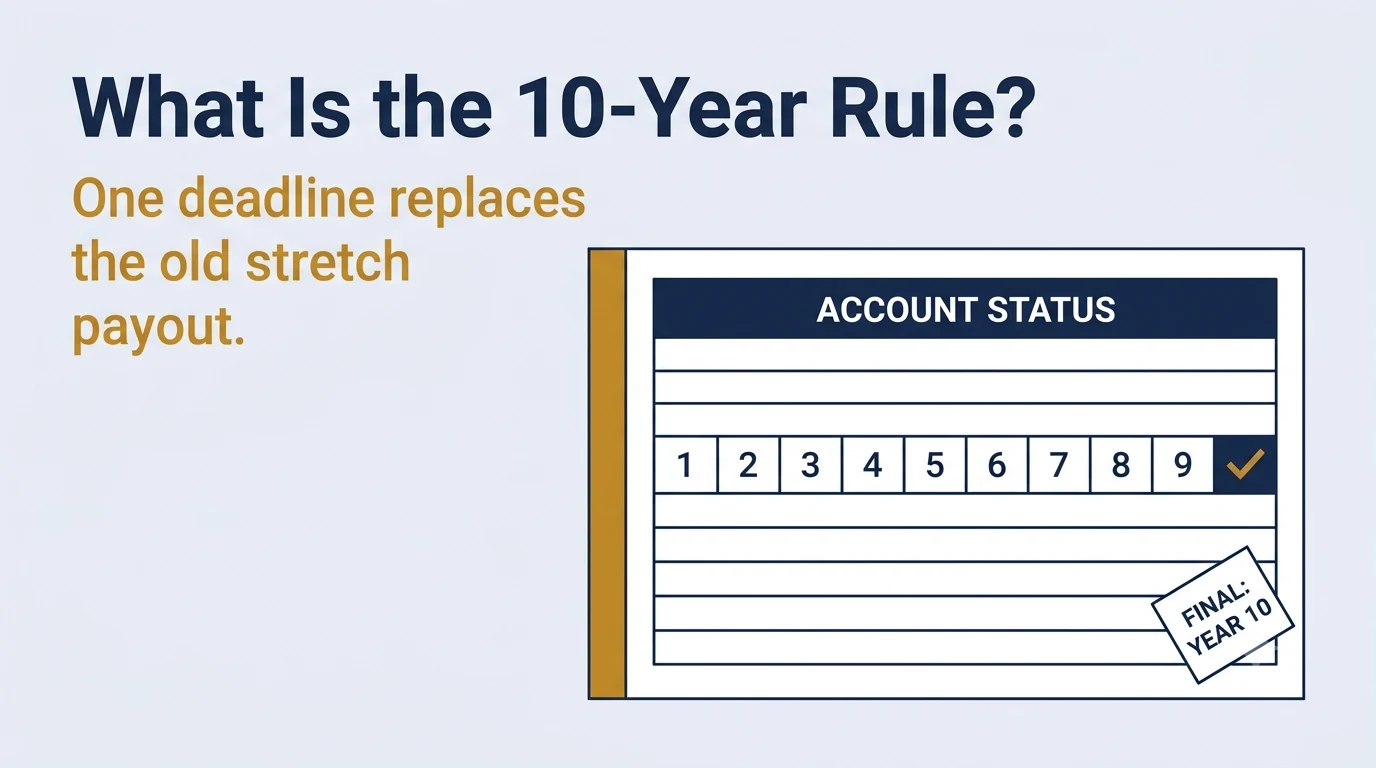
Inherited IRA 10-Year Rule: The Practical Starting Point
How the 10-year deadline works for most non-spouse beneficiaries, and the two questions that determine whether annual RMDs may also be required.
↗Research library
Each guide is scoped to one beneficiary rule or decision point and links to the IRS material used to support it.
How the 10-year deadline works for most non-spouse beneficiaries, and the two questions that determine whether annual RMDs may also be required.
↗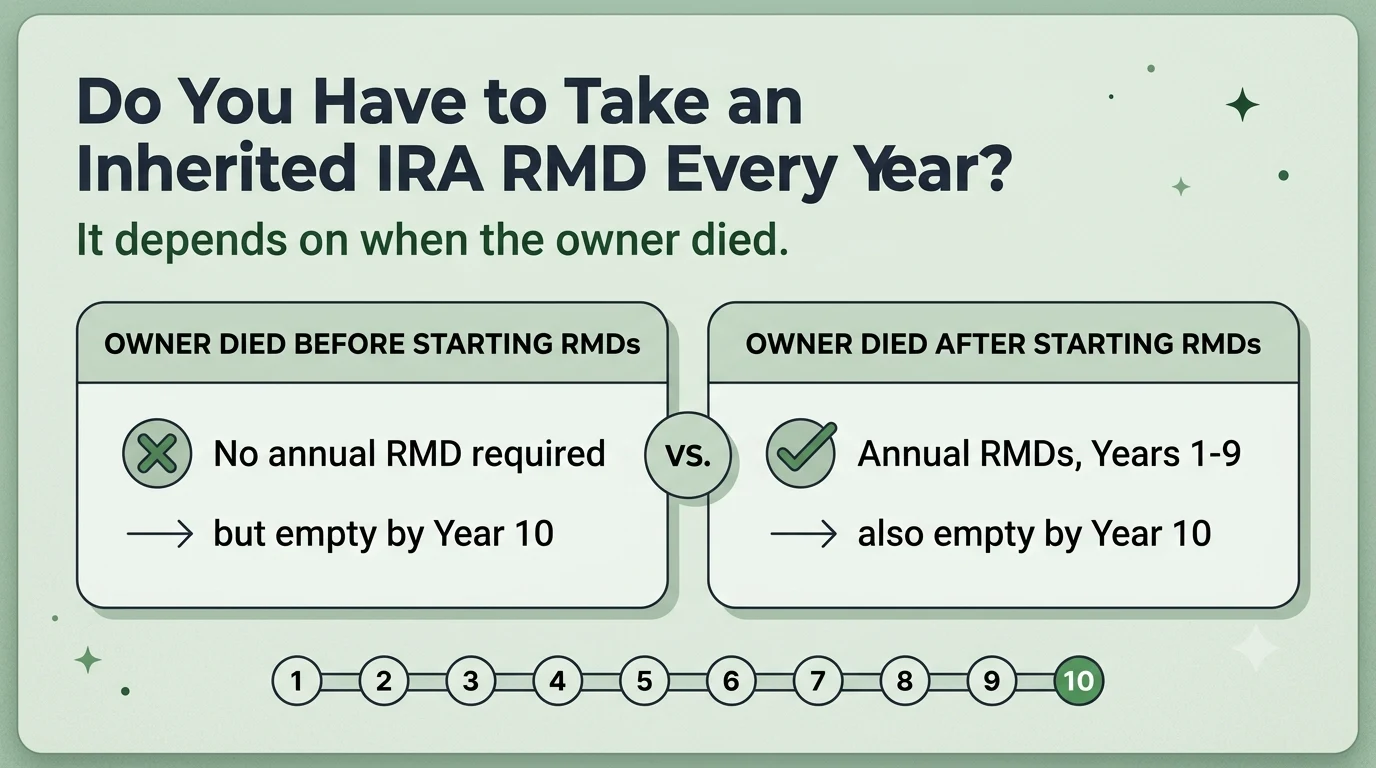
The annual-RMD question depends on whether the deceased owner died before or after the required beginning date.
↗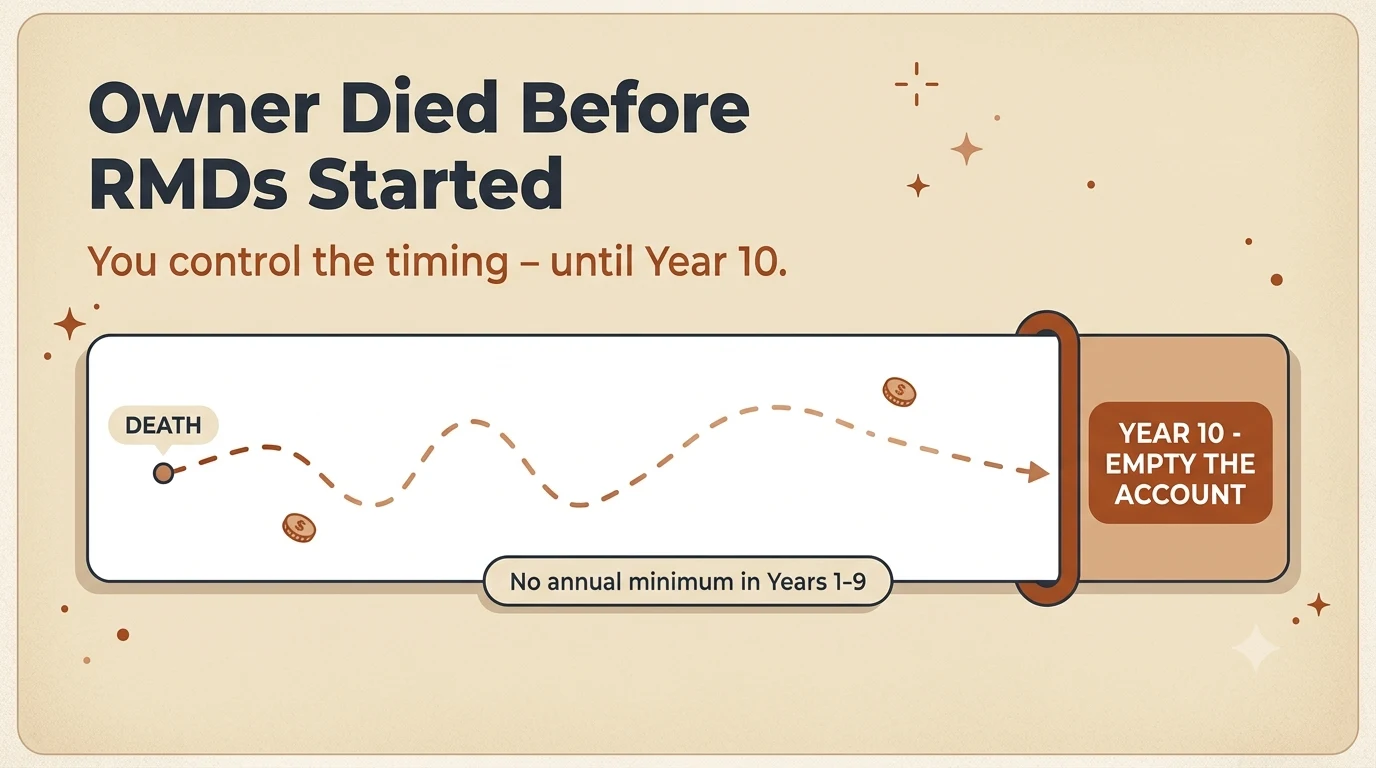
What changes when the original owner had not yet reached the point where lifetime RMDs were required.
↗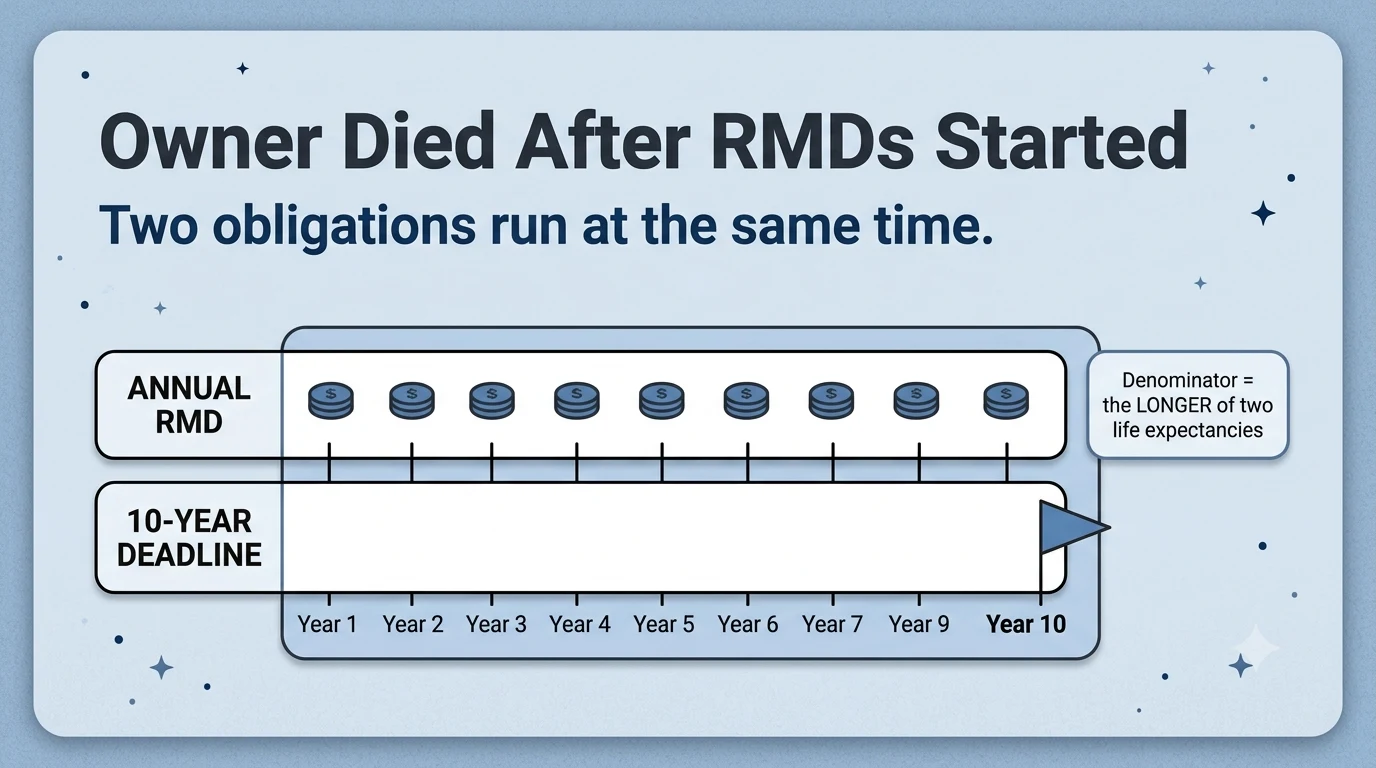
How the annual beneficiary RMD is calculated under the longer-of life-expectancy rule while the separate 10-year deadline still runs.
↗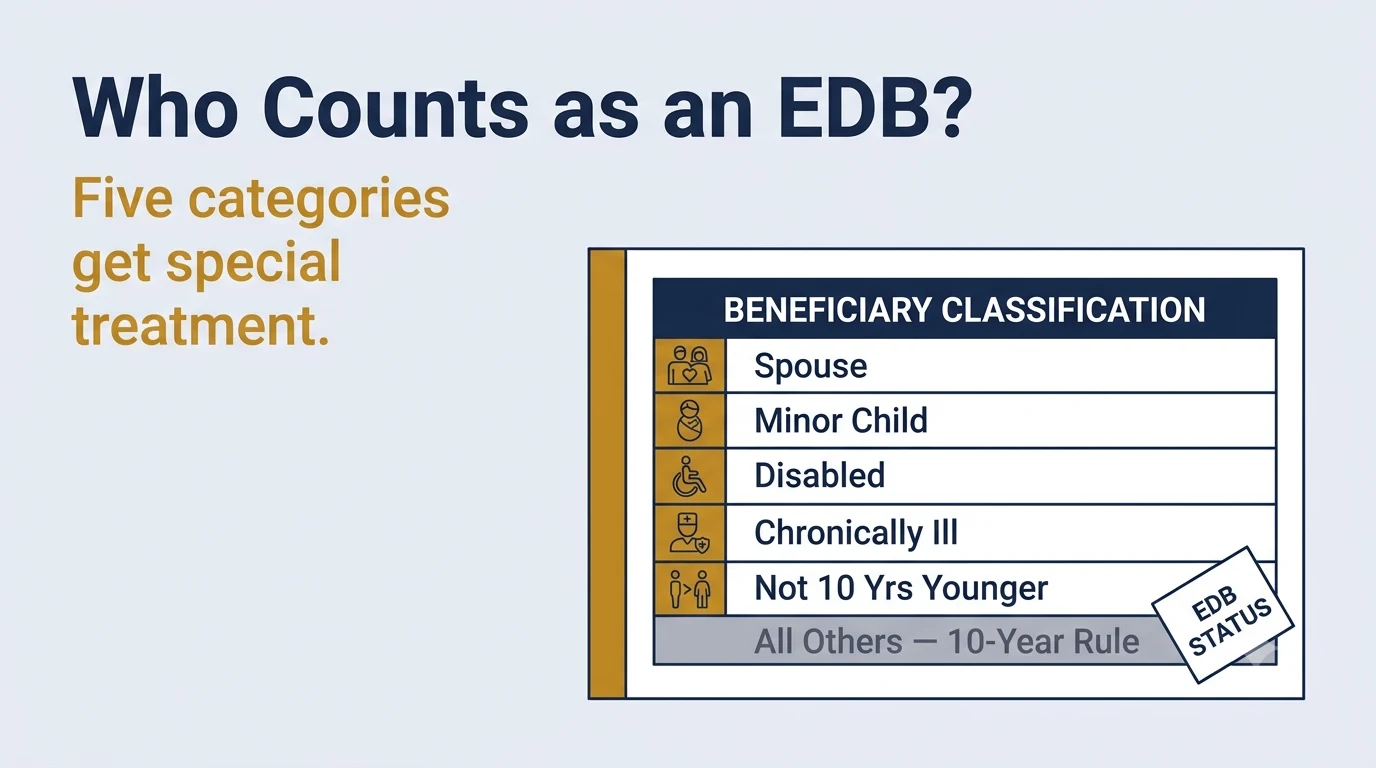
The five EDB categories, the age-21 rule for a deceased owner’s child, and the disability, chronic-illness, and documentation details that change the RMD path.
↗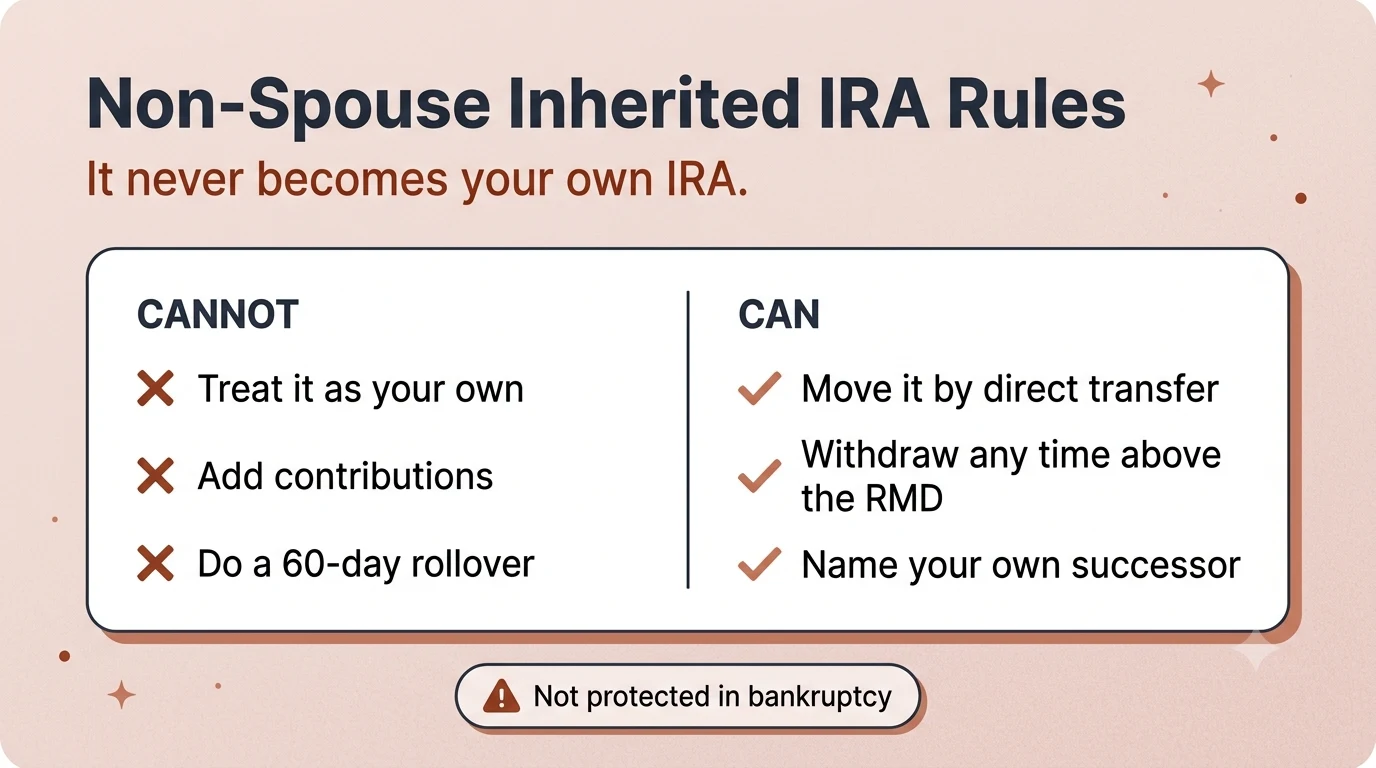
Key operational differences for someone inheriting an IRA from a parent, sibling, friend, or other non-spouse owner.
↗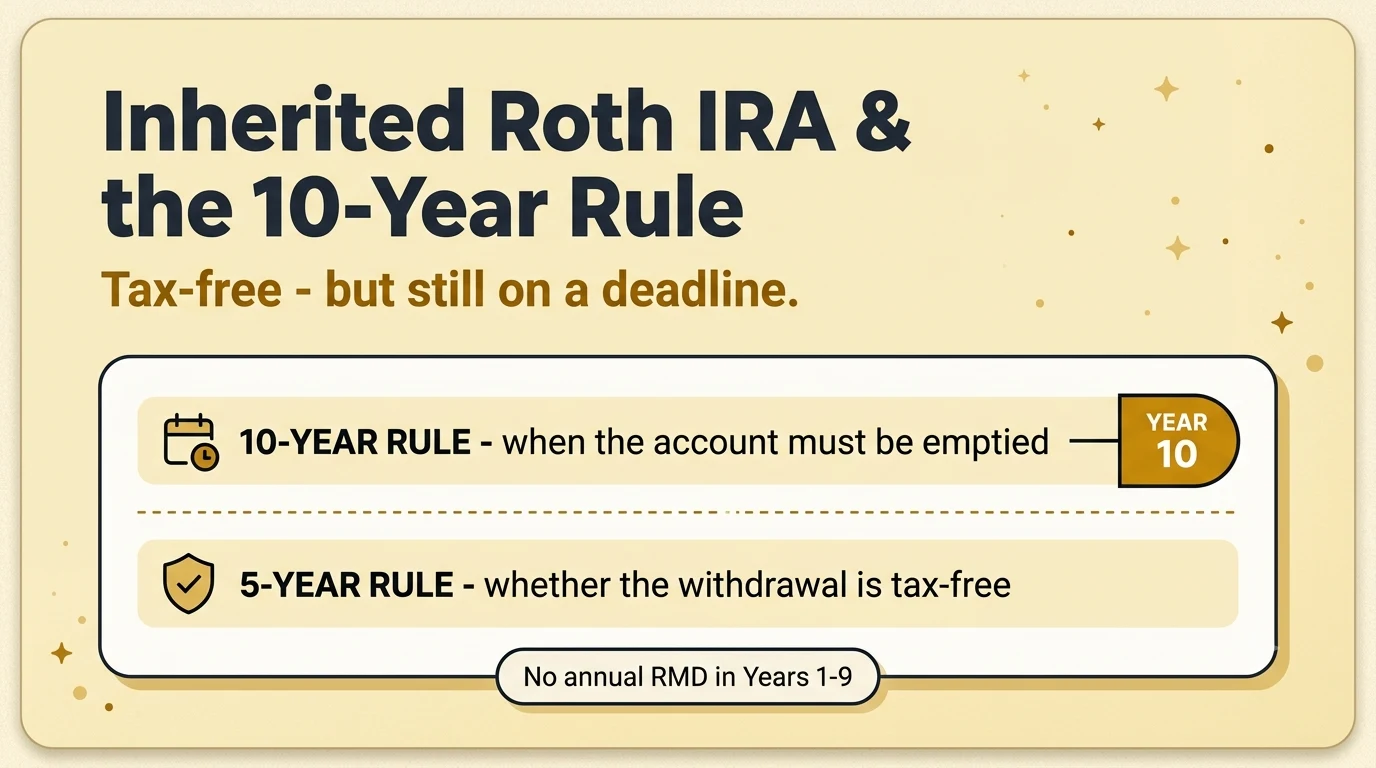
How the Roth 10-year distribution deadline differs from the owner’s five-tax-year qualification period, including earnings, Form 8606, and death-related tax treatment.
↗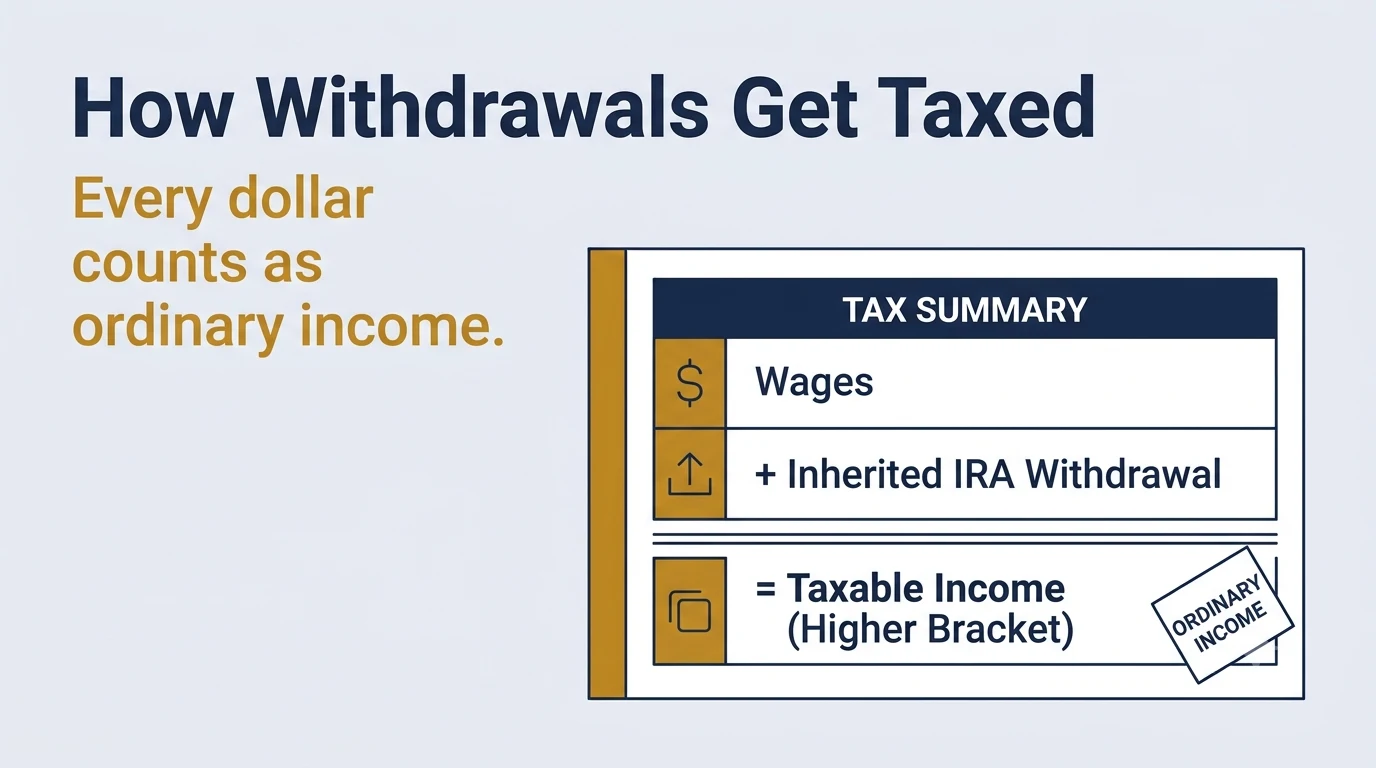
How taxable income, inherited nondeductible basis, Form 8606, and separate decedent-by-decedent basis records work for a traditional inherited IRA.
↗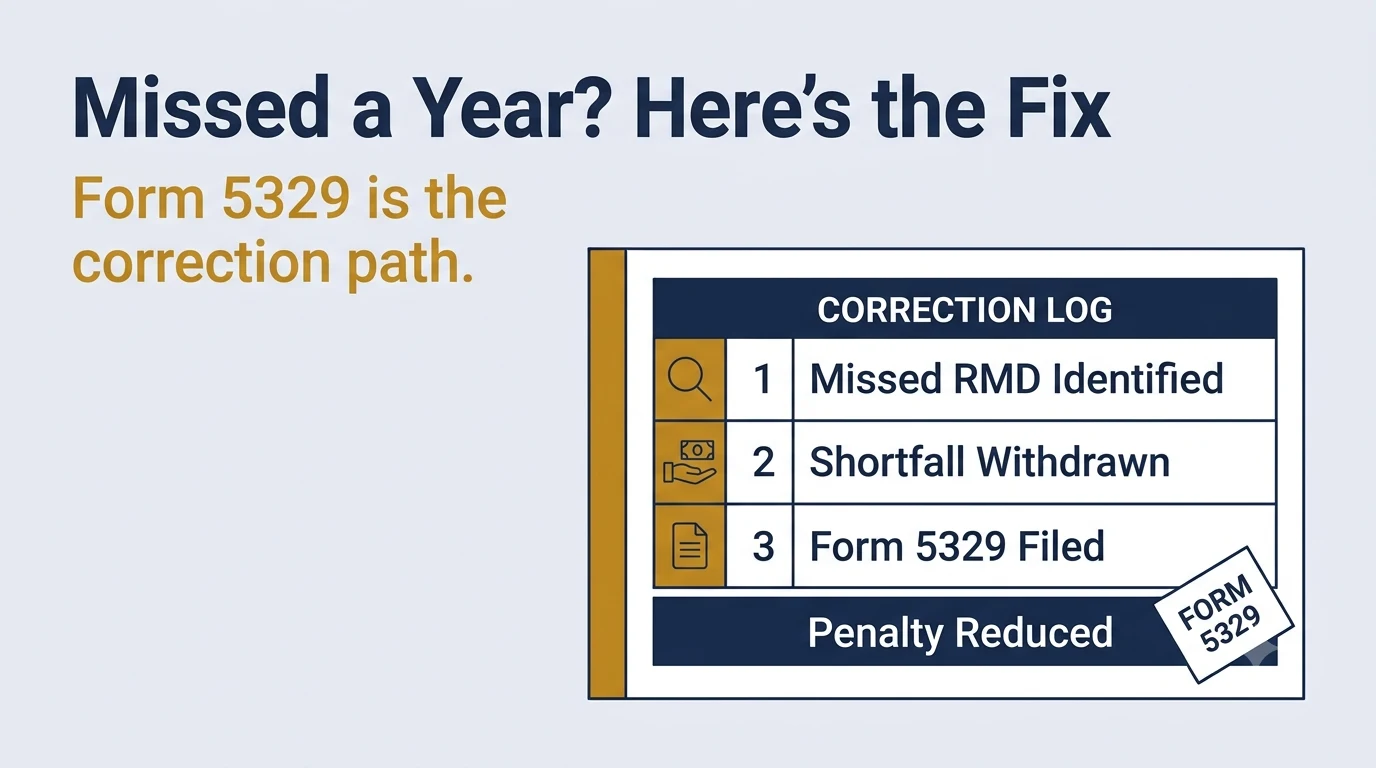
A process-oriented explanation of the excise tax, correction window, and reasonable-cause waiver procedure.
↗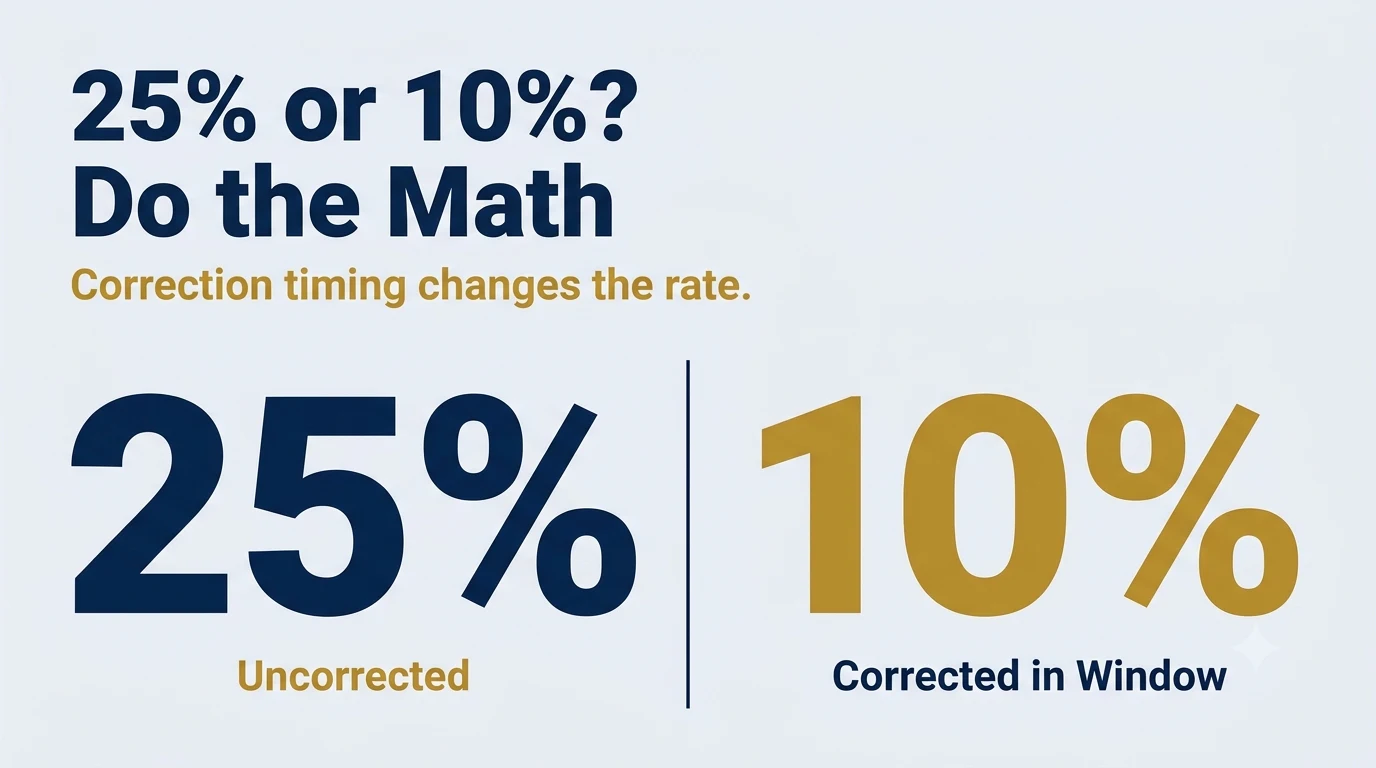
A calculation-first guide to the RMD shortfall, the 25% general rate, the 10% reduced rate, and the correction window—separate from Form 5329 filing procedure.
↗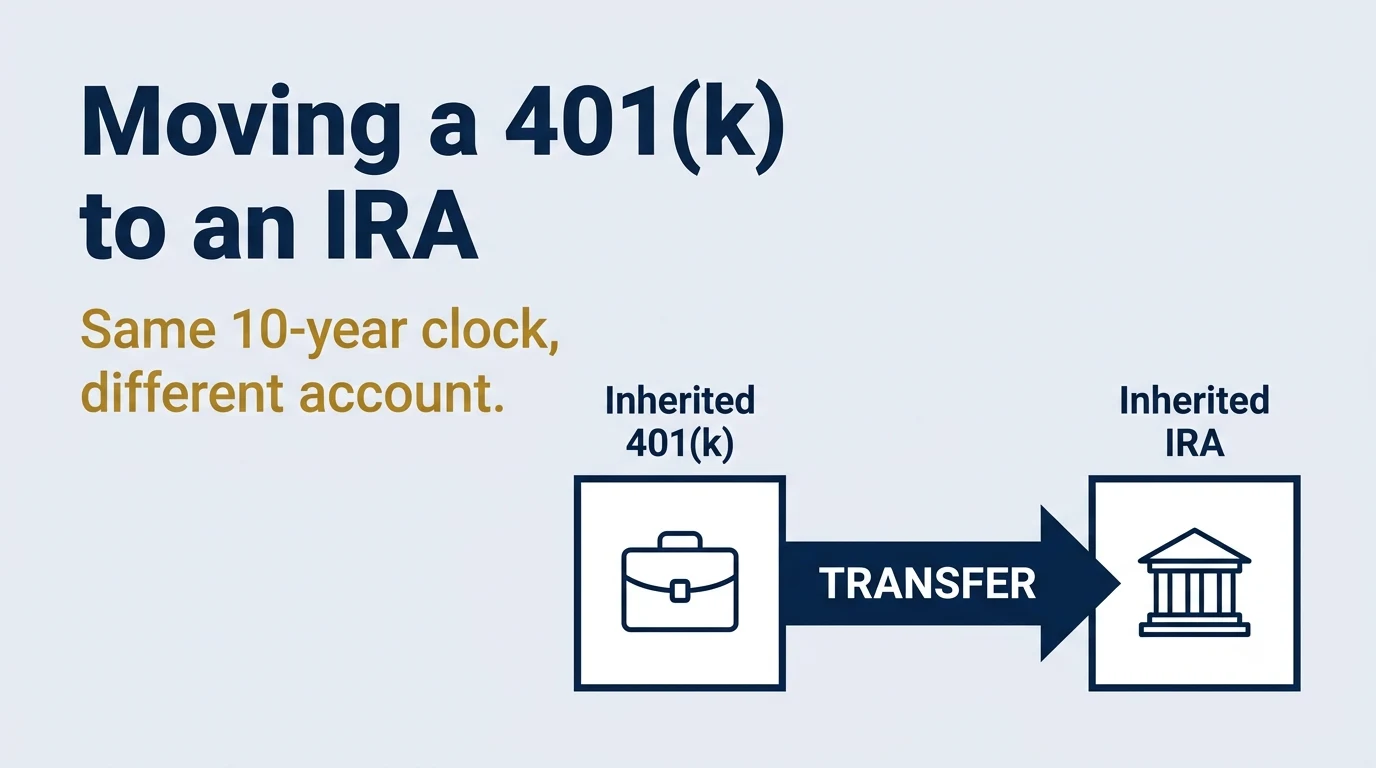
How direct trustee-to-trustee transfers can work, and why the employer plan document still controls the options available inside the plan.
↗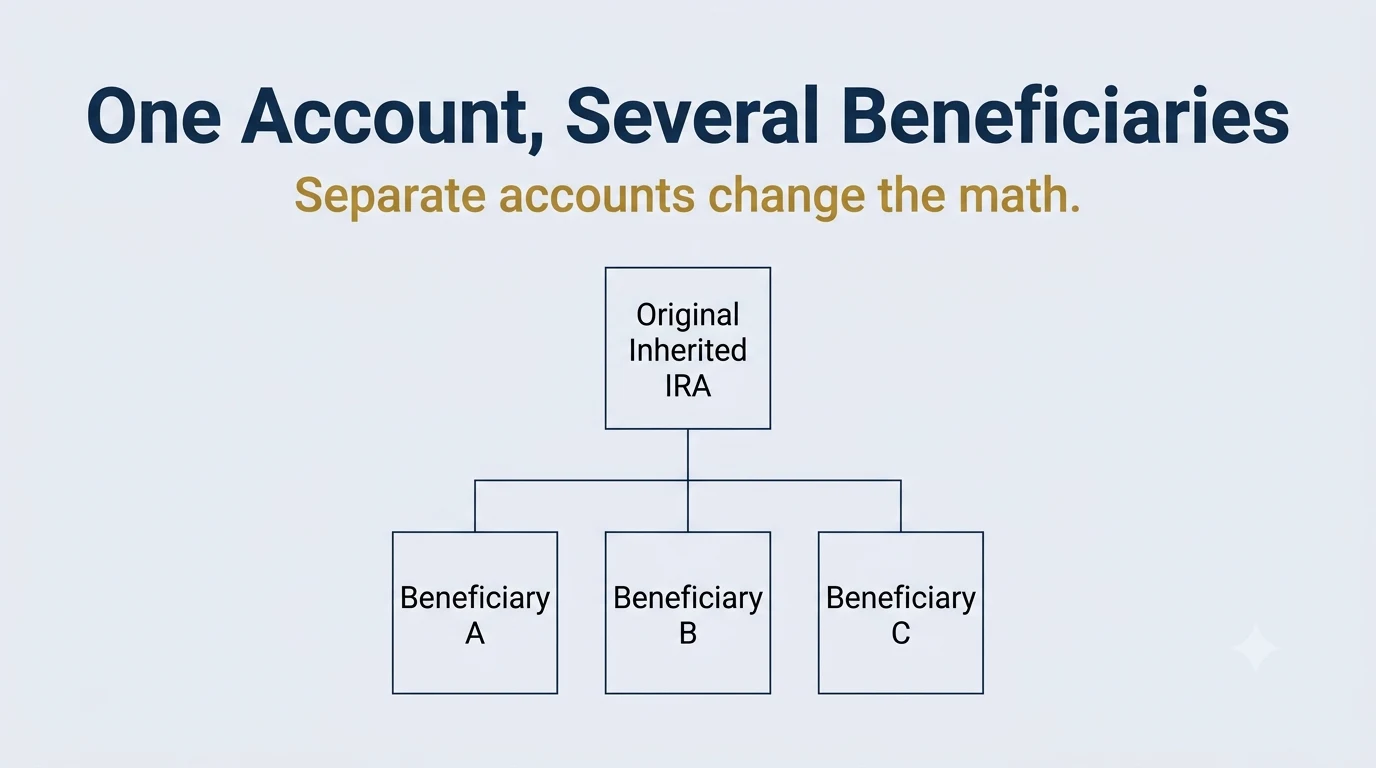
Why splitting inherited interests can make each beneficiary’s administration clearer, and the deadline mentioned in Publication 590-B.
↗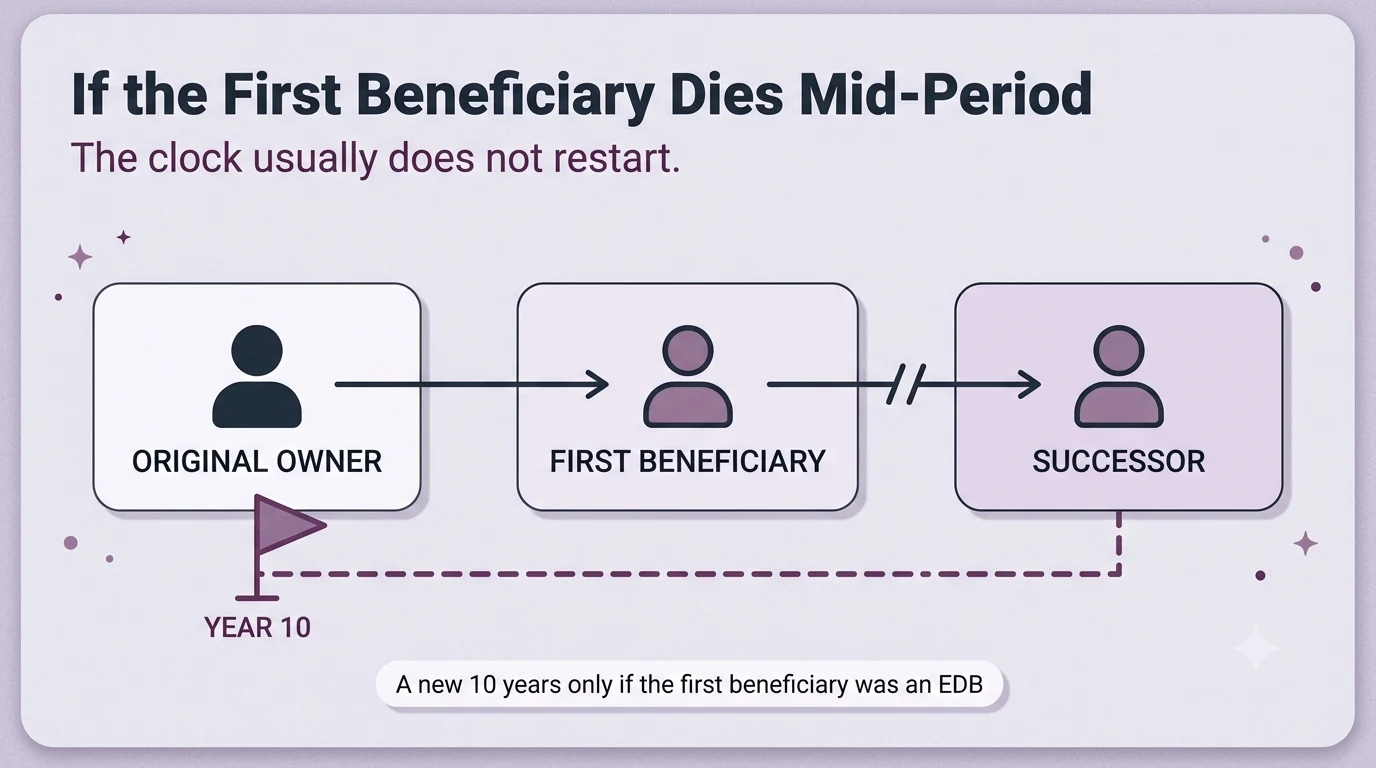
When a successor beneficiary must keep the original owner’s 10-year deadline, when a new 10-year period starts after an EDB’s death, and how annual RMDs continue.
↗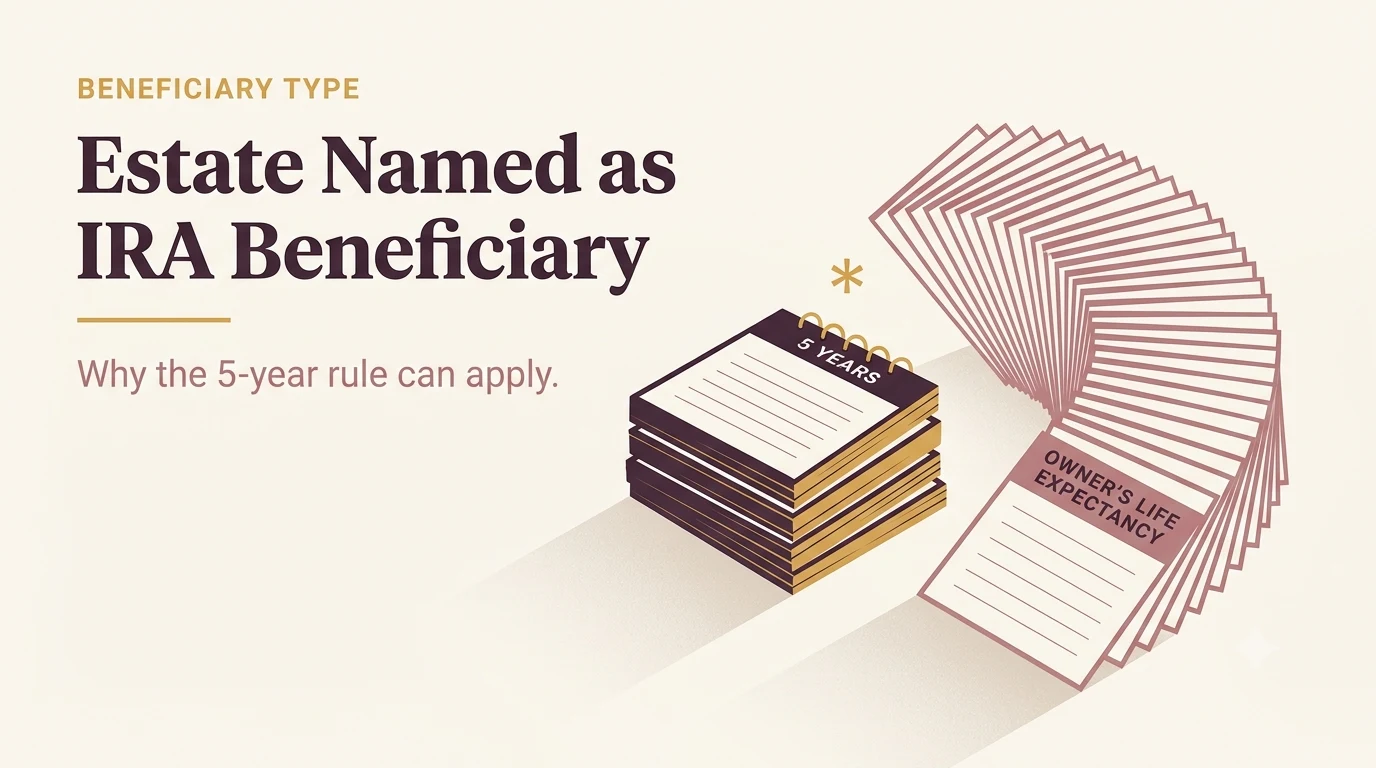
How a non-individual beneficiary can fall outside the SECURE Act 10-year rule and into the older 5-year or life-expectancy framework.
↗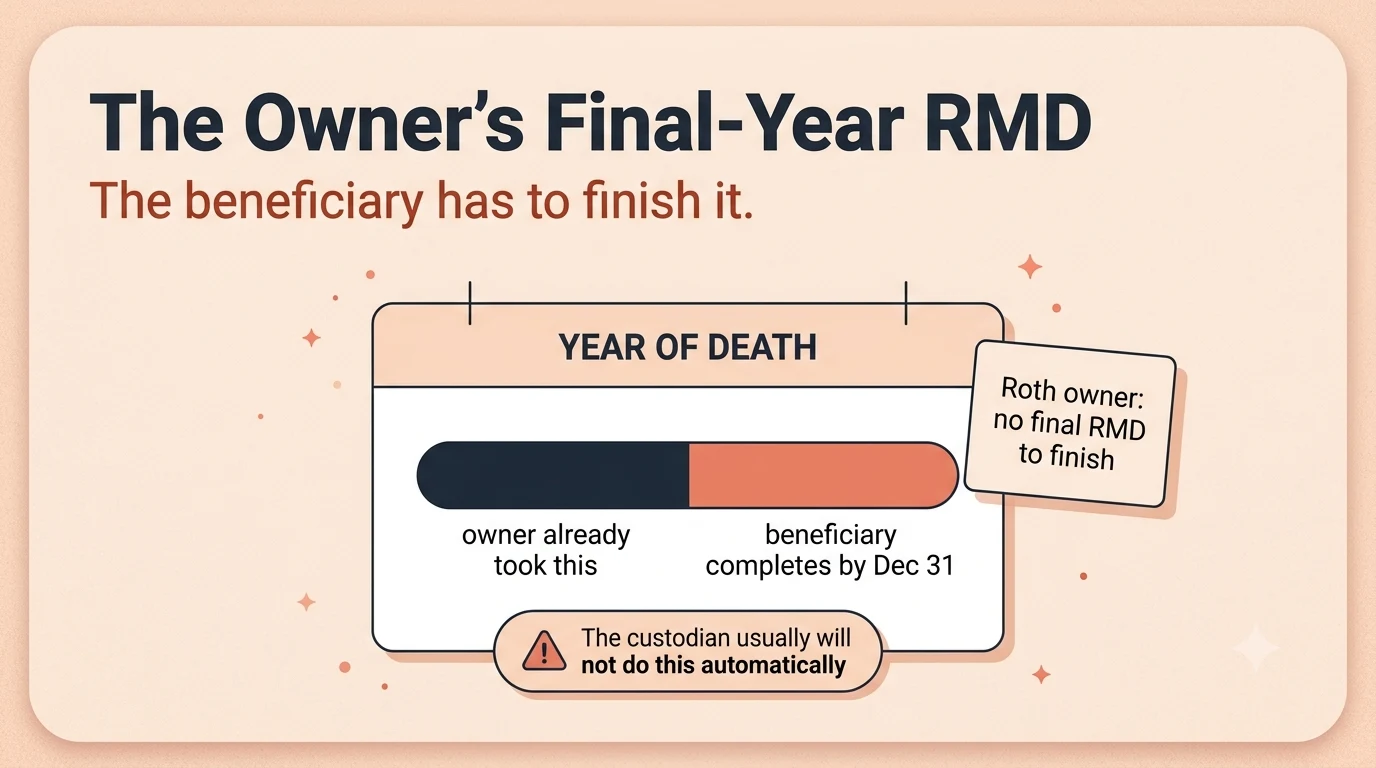
How to reconstruct and finish the deceased owner’s final RMD, including late-year deaths, multiple beneficiaries, Roth IRAs, and transfers from employer plans.
↗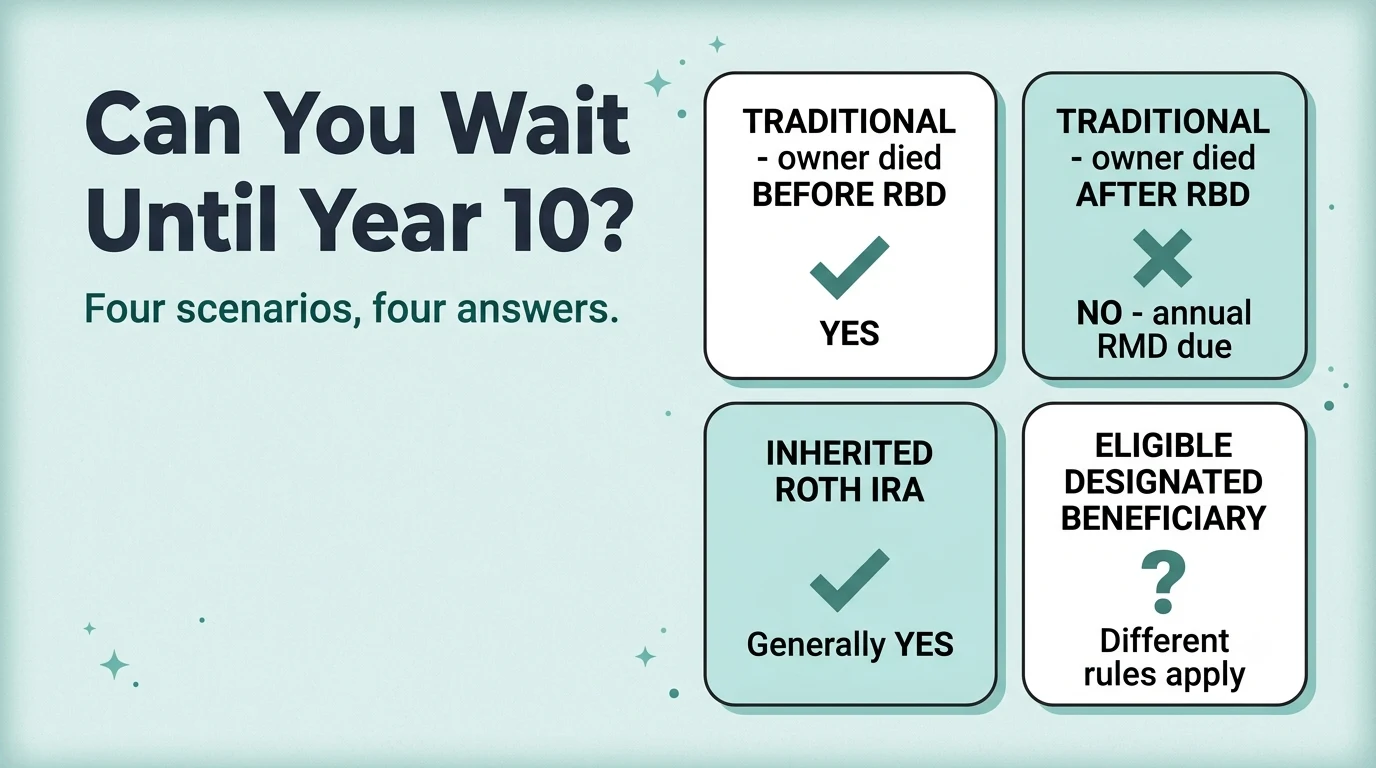
A scenario-by-scenario answer for traditional IRAs before and after the owner’s RBD, inherited Roth IRAs, and eligible designated beneficiaries.
↗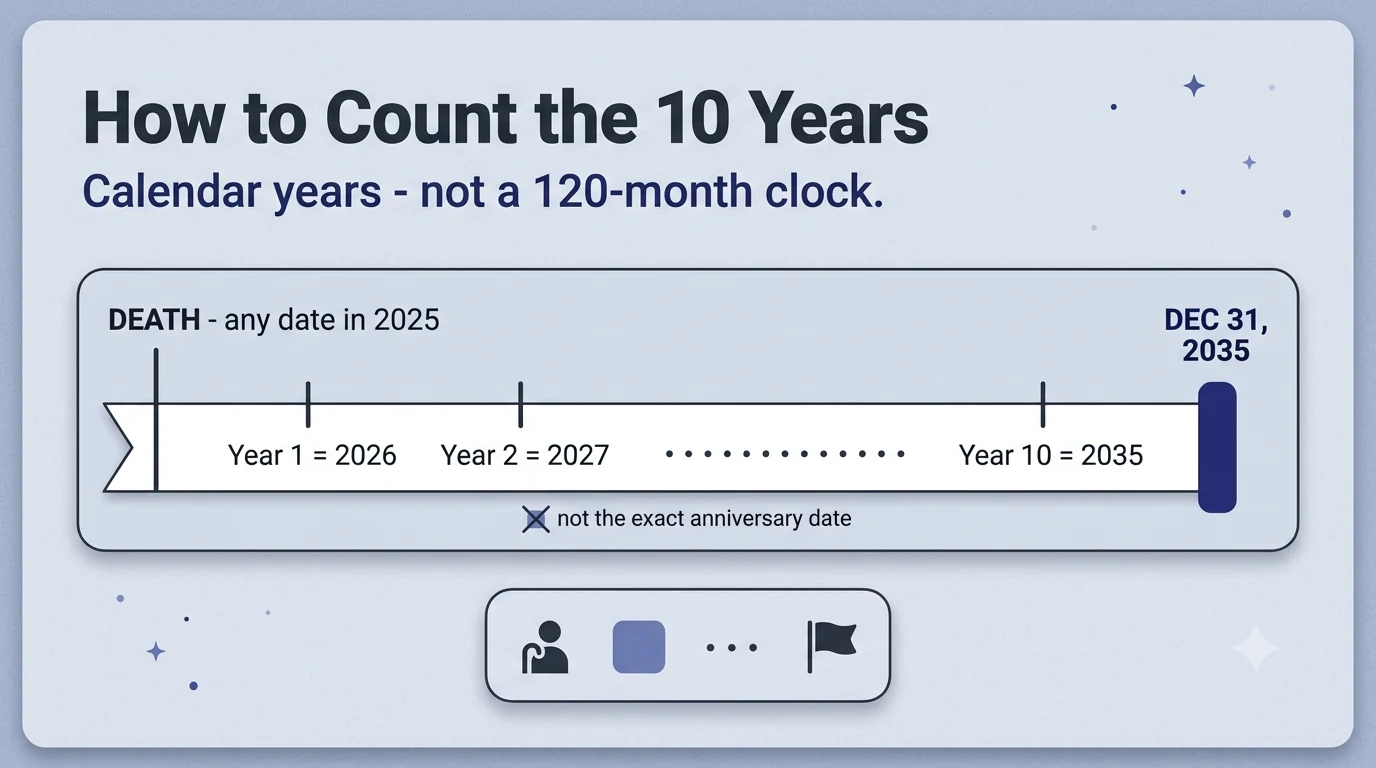
How to count year 1 through year 10, why the exact anniversary date is not the deadline, and how successor and age-21 triggers change the calculation.
↗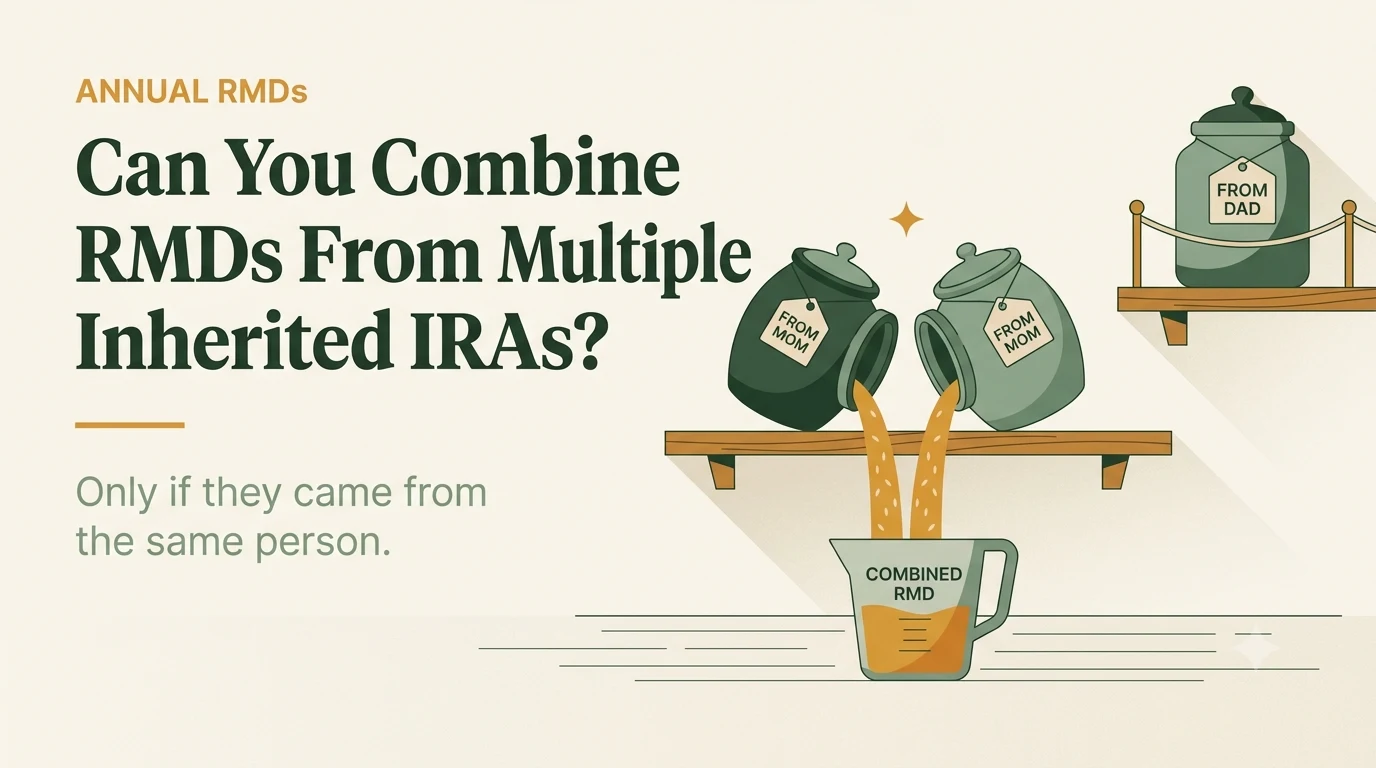
The aggregation rule is narrower for inherited IRAs than many beneficiaries expect, especially when accounts came from different people.
↗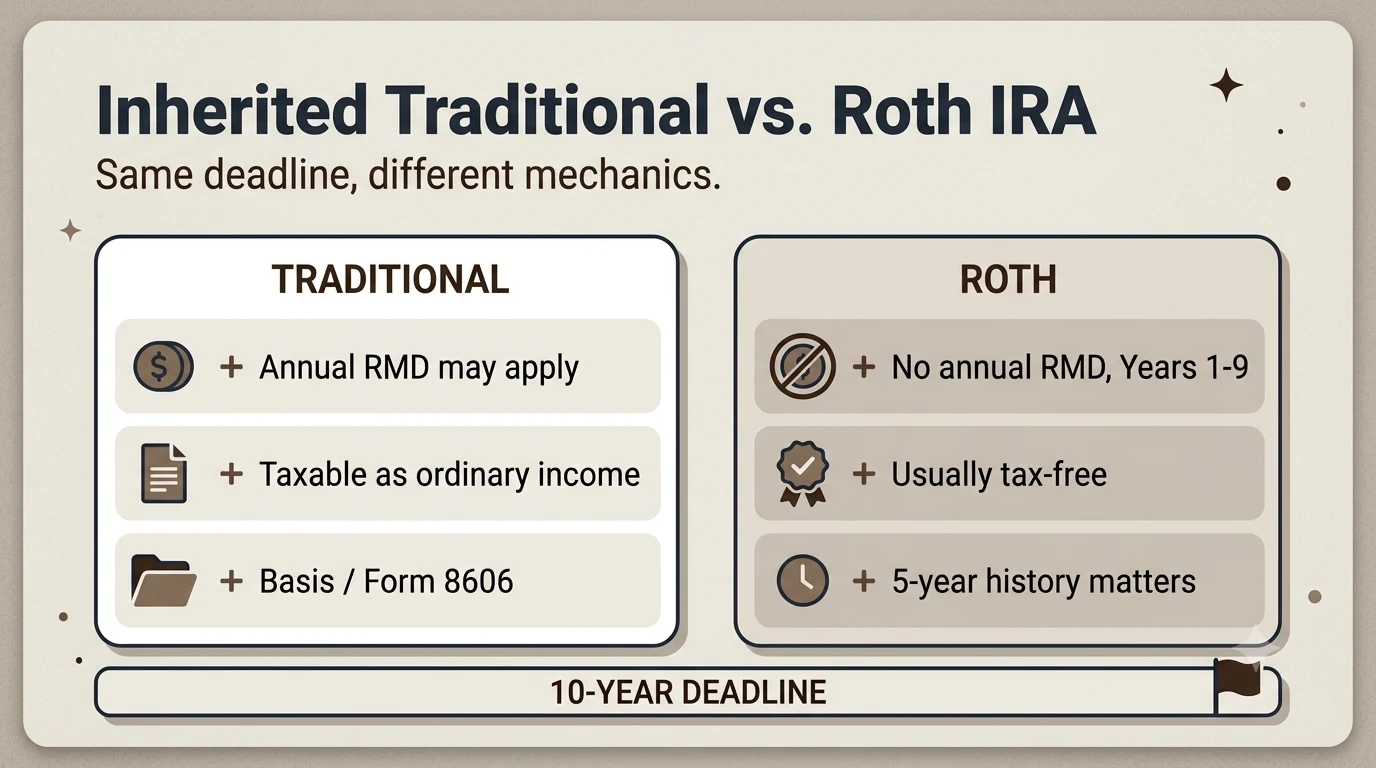
A direct comparison of annual RMDs, year-10 deadlines, taxable income, inherited basis, Roth five-year history, and account-registration rules.
↗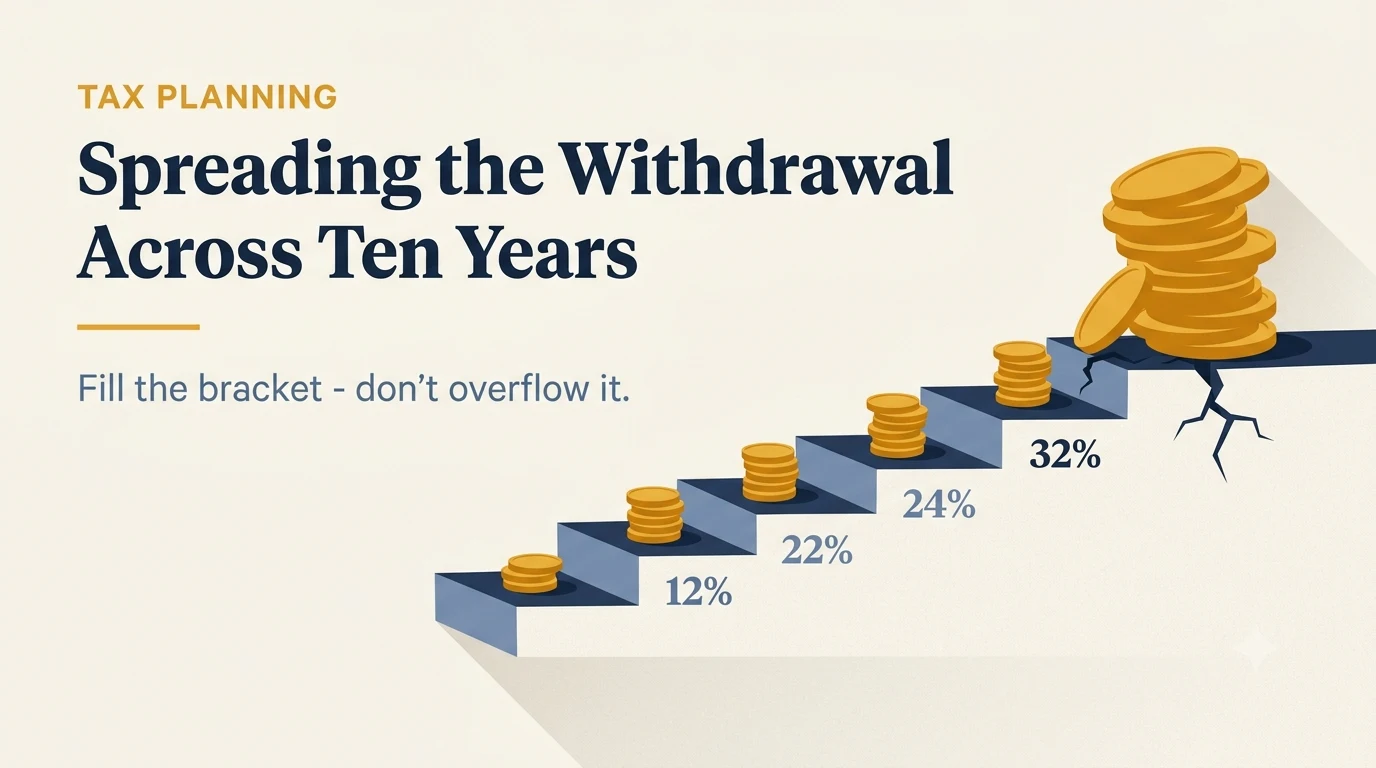
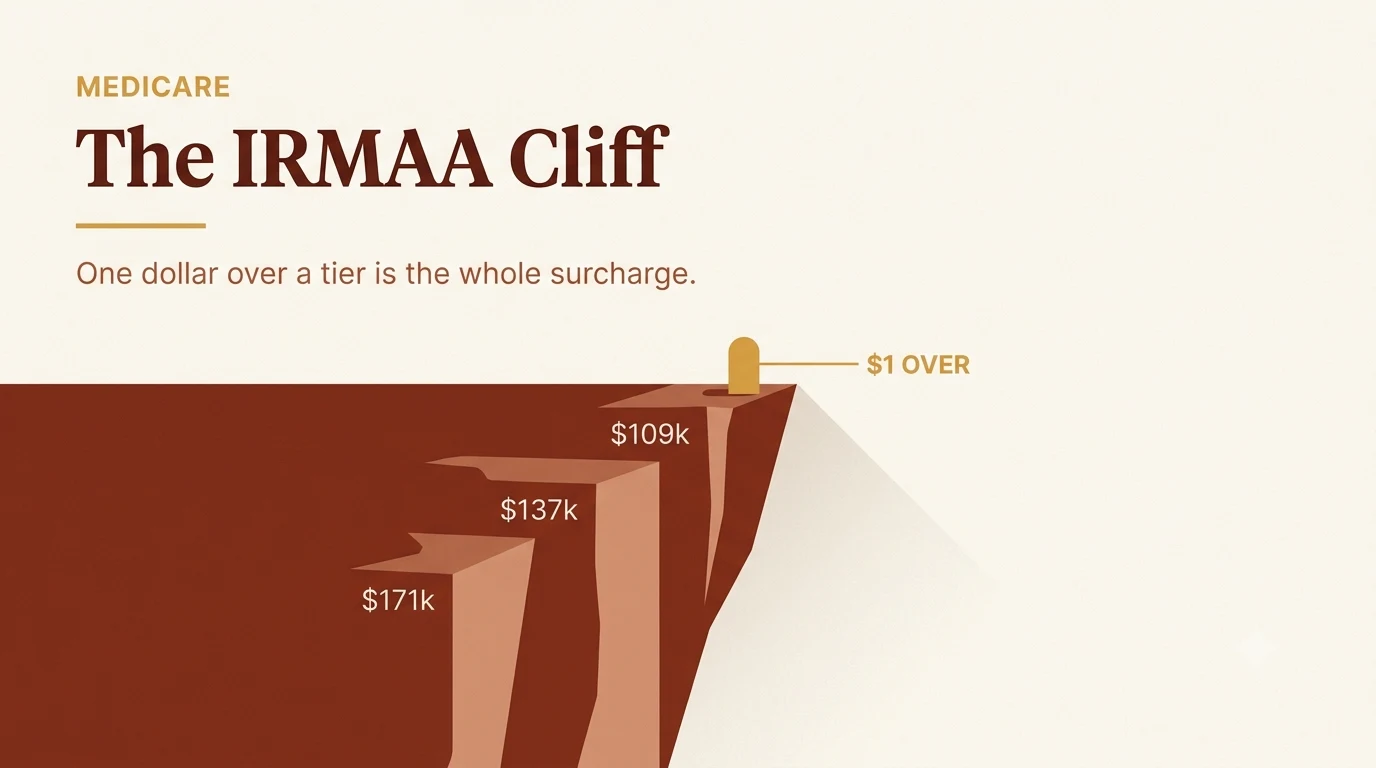
How ordinary-income brackets, Social Security taxation, capital gains, Medicare IRMAA, and state taxes can interact with optional inherited IRA withdrawals.
↗
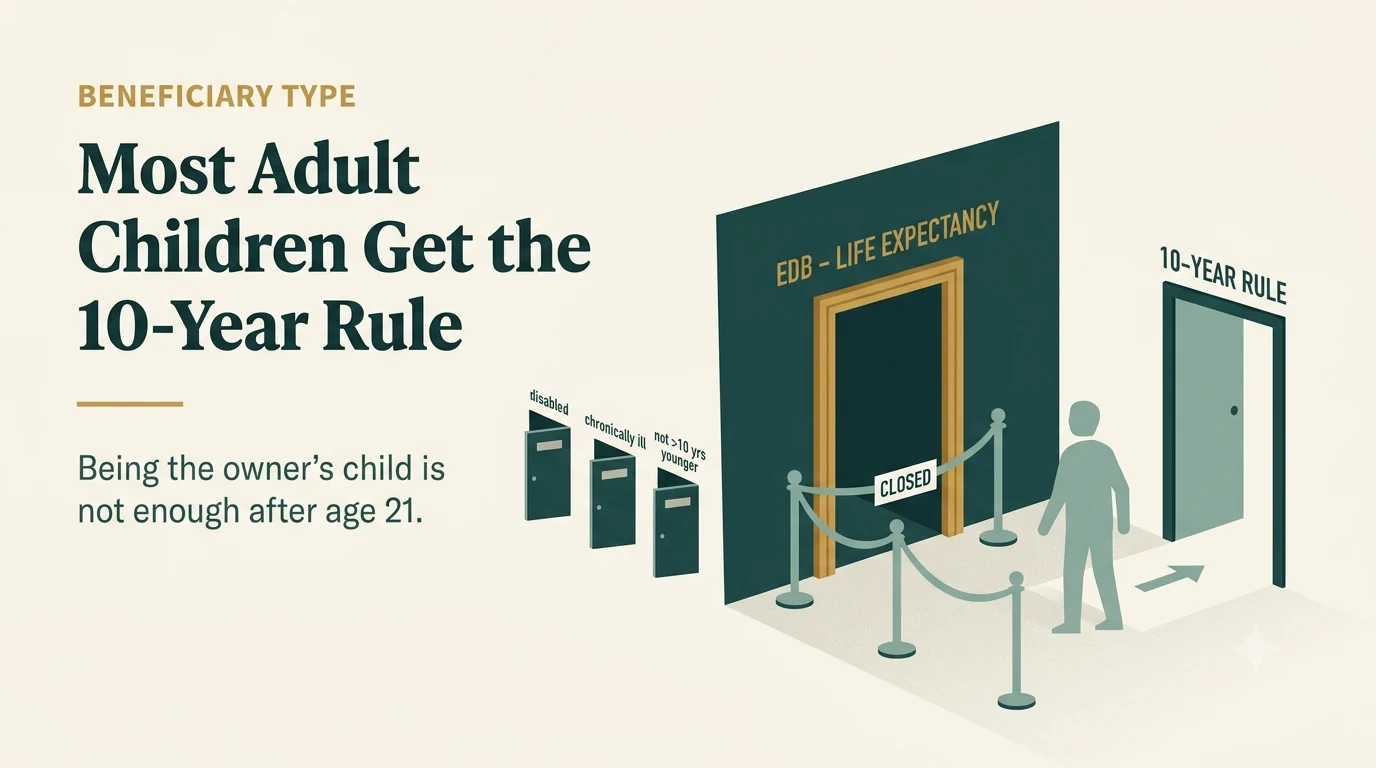
How taxable inherited IRA withdrawals feed into IRMAA MAGI, the typical two-year lookback, 2026 thresholds, SSA-44 life-changing events, and reassessment rules.
↗
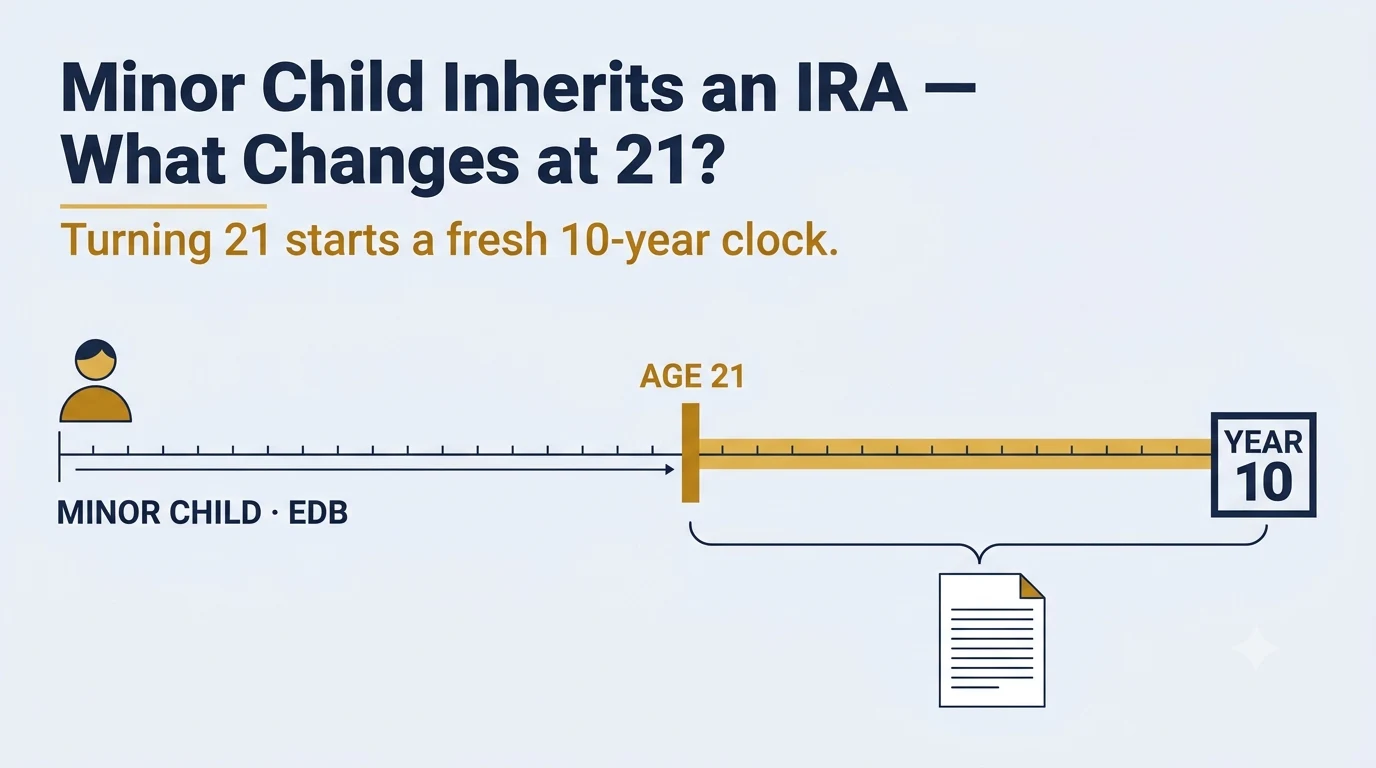
An adult son or daughter is not automatically an eligible designated beneficiary. Here is the classification test that determines whether the 10-year rule applies.
↗
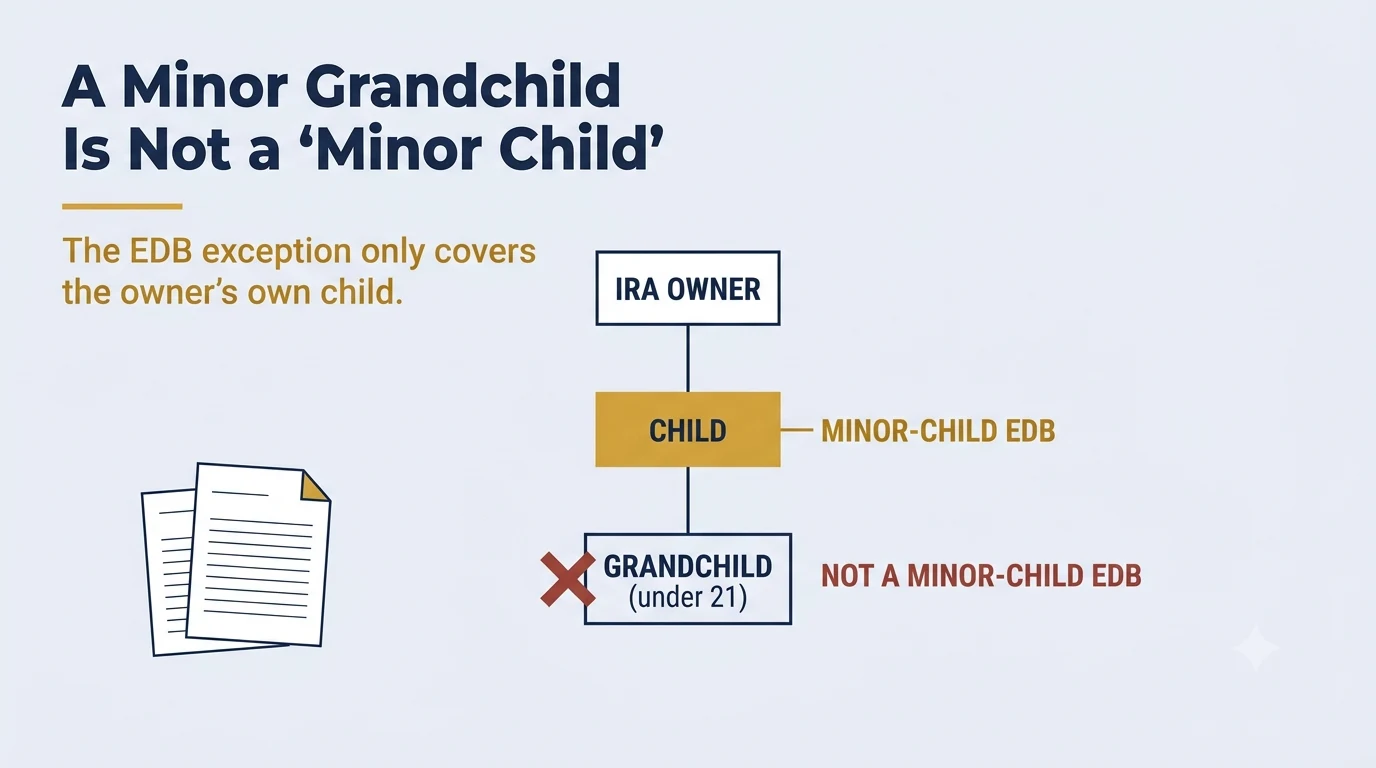
The owner’s minor child can receive eligible-designated-beneficiary treatment, but the final regulations start a new 10-year clock when the child reaches age 21.
↗
A beneficiary can be a legal minor and still miss the SECURE Act minor-child EDB exception because that exception is tied to the deceased owner’s child.
↗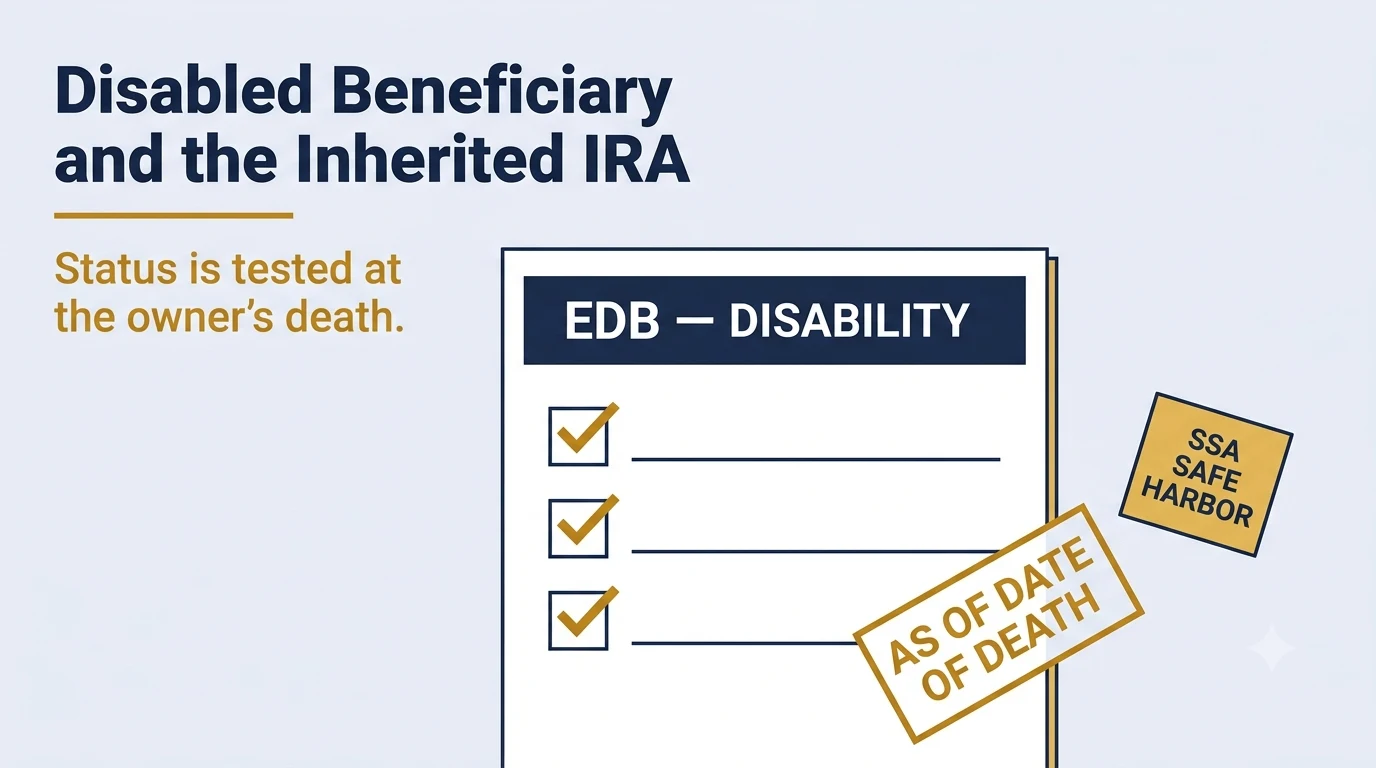
The disability EDB rule turns on the beneficiary’s condition at the owner’s death, with a Social Security safe harbor and special documentation rules for employer plans.
↗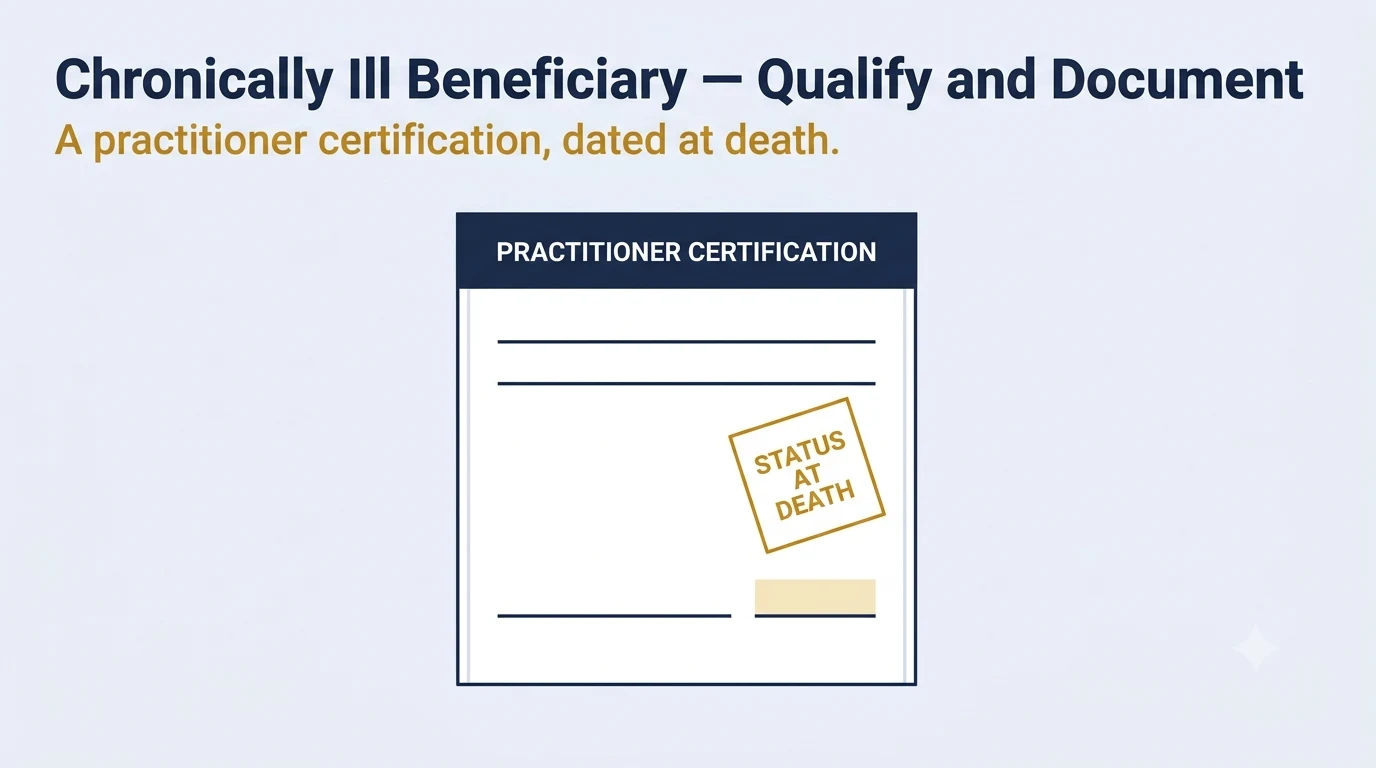
How the chronically ill EDB category works, what the health-care-practitioner certification is for, and why the status must exist at the owner’s death.
↗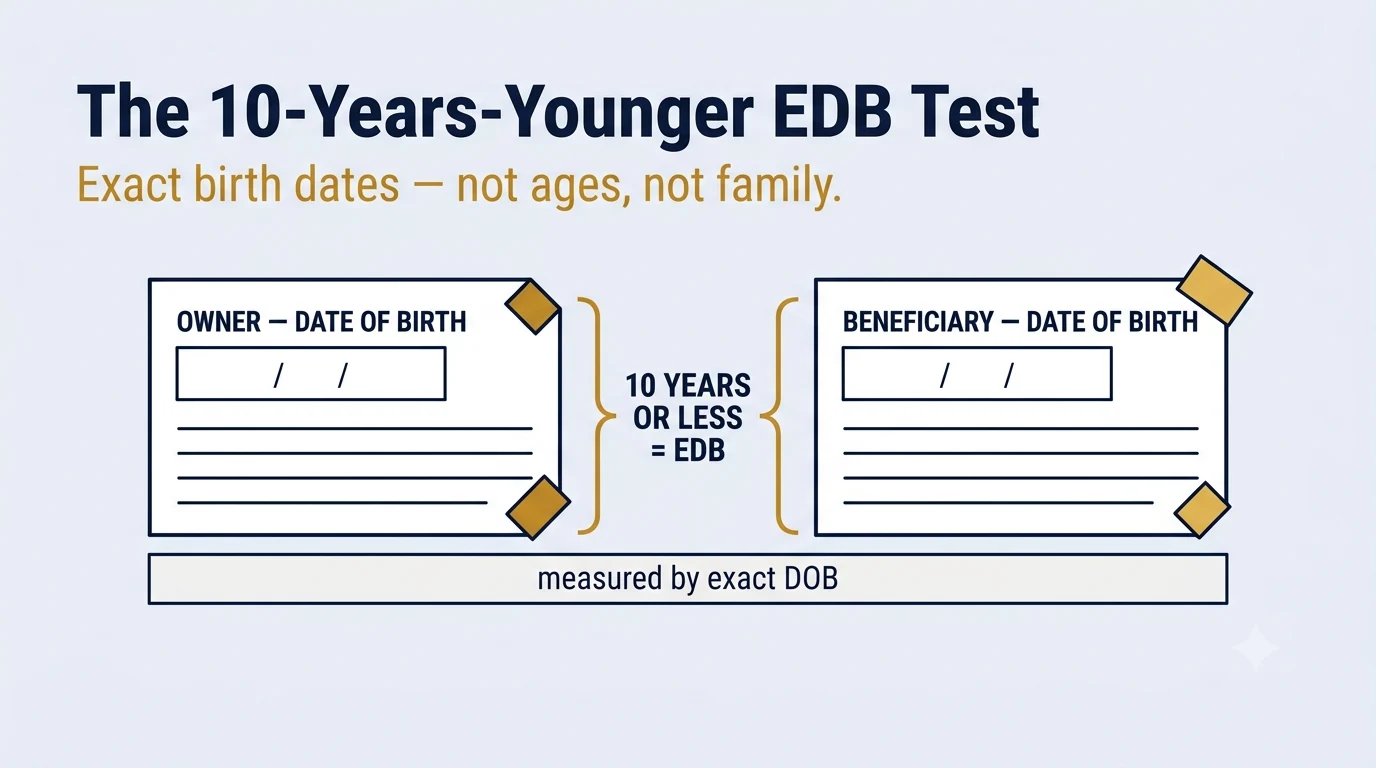
This EDB category is based on exact dates of birth, not calendar-year ages or family relationship. A sibling, friend, or older beneficiary may qualify.
↗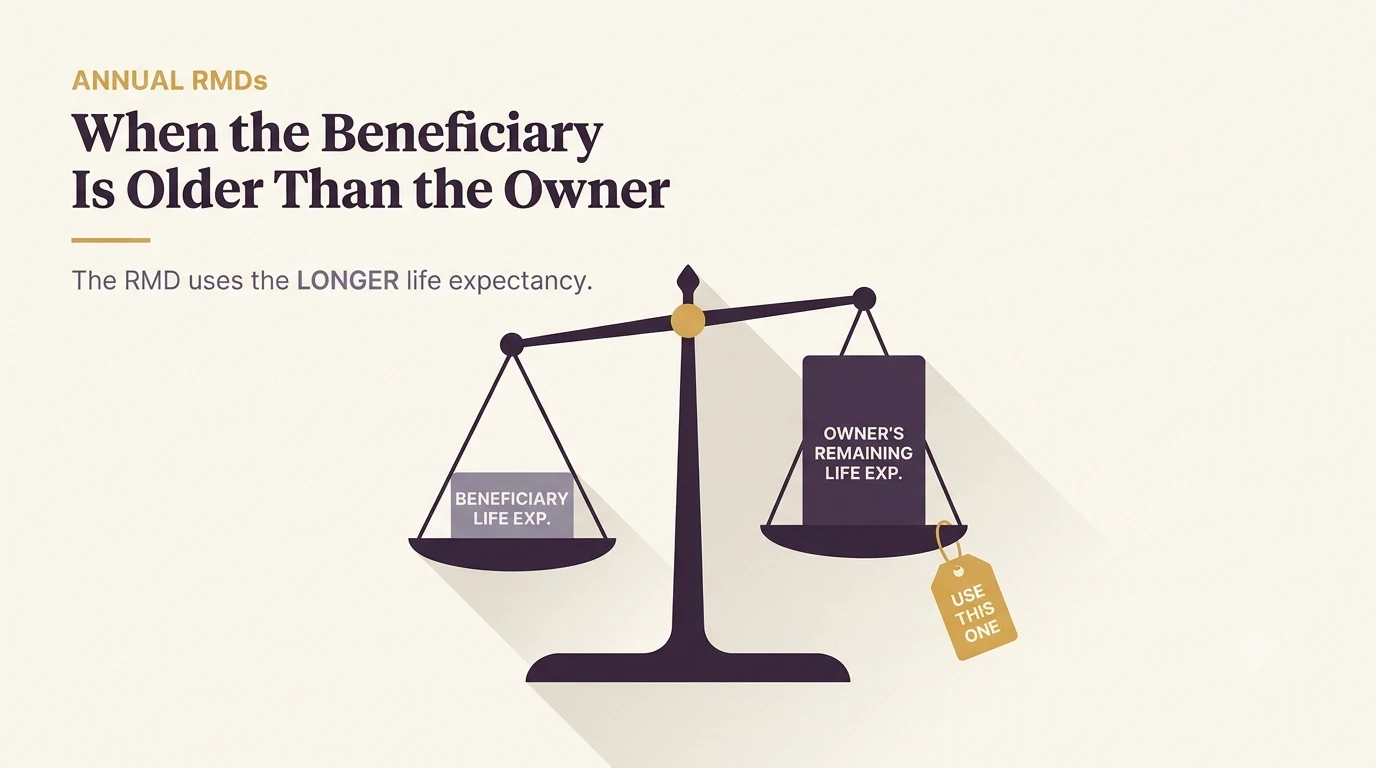
An older beneficiary can satisfy the “not more than 10 years younger” EDB test, but the owner’s remaining life expectancy may still control the annual denominator after death.
↗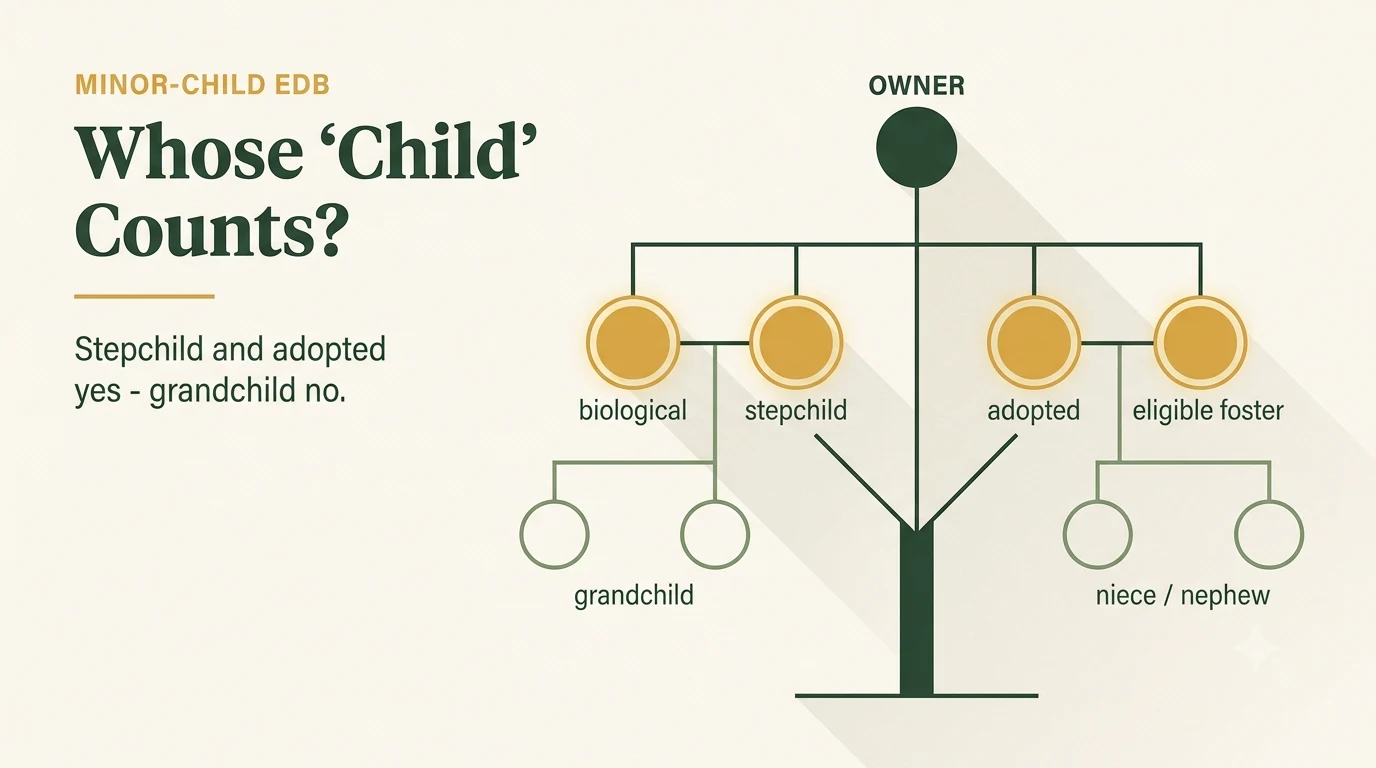
The final regulations use the tax-code definition of child, which can include a stepchild, adopted child, and eligible foster child—but not every younger relative.
↗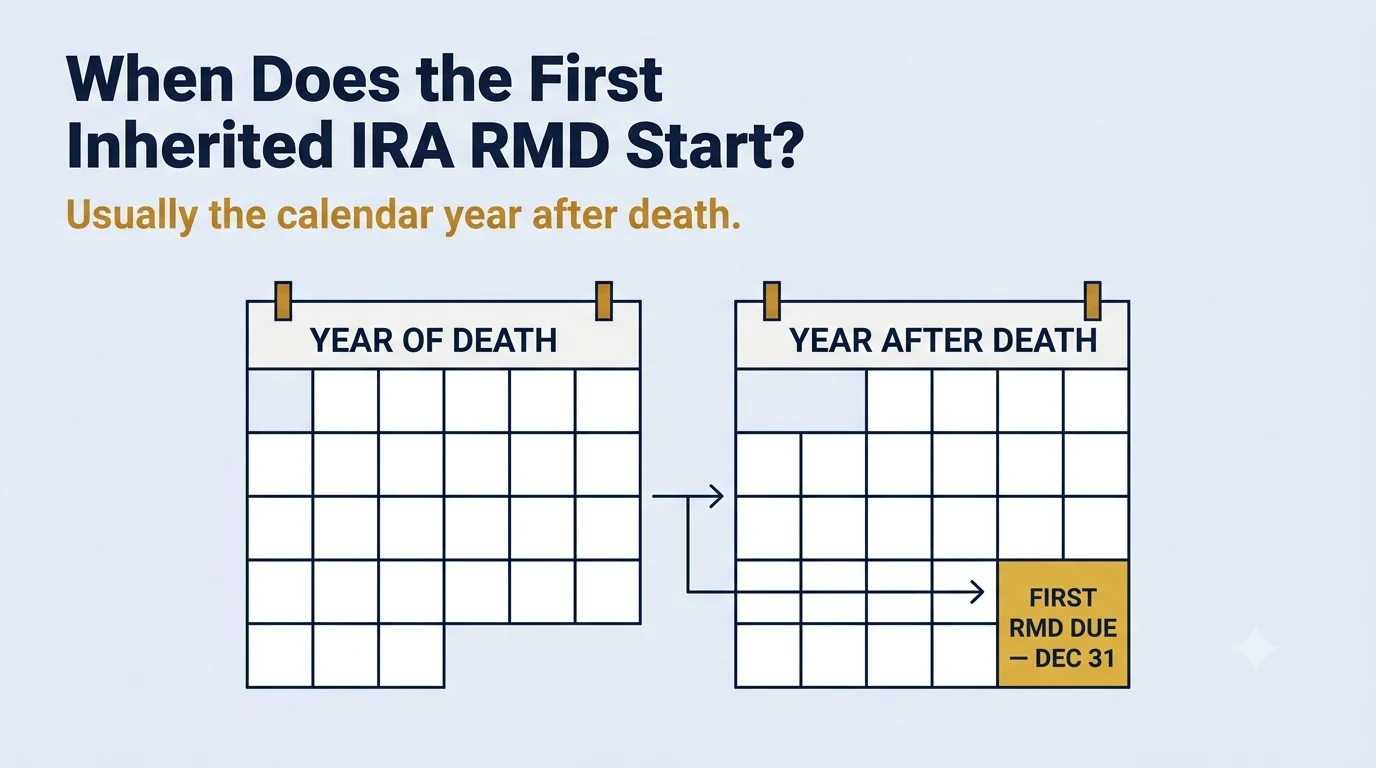
The first beneficiary RMD is usually tied to the calendar year after death, but the answer depends on beneficiary status, the owner’s required beginning date, and the 10-year branch.
↗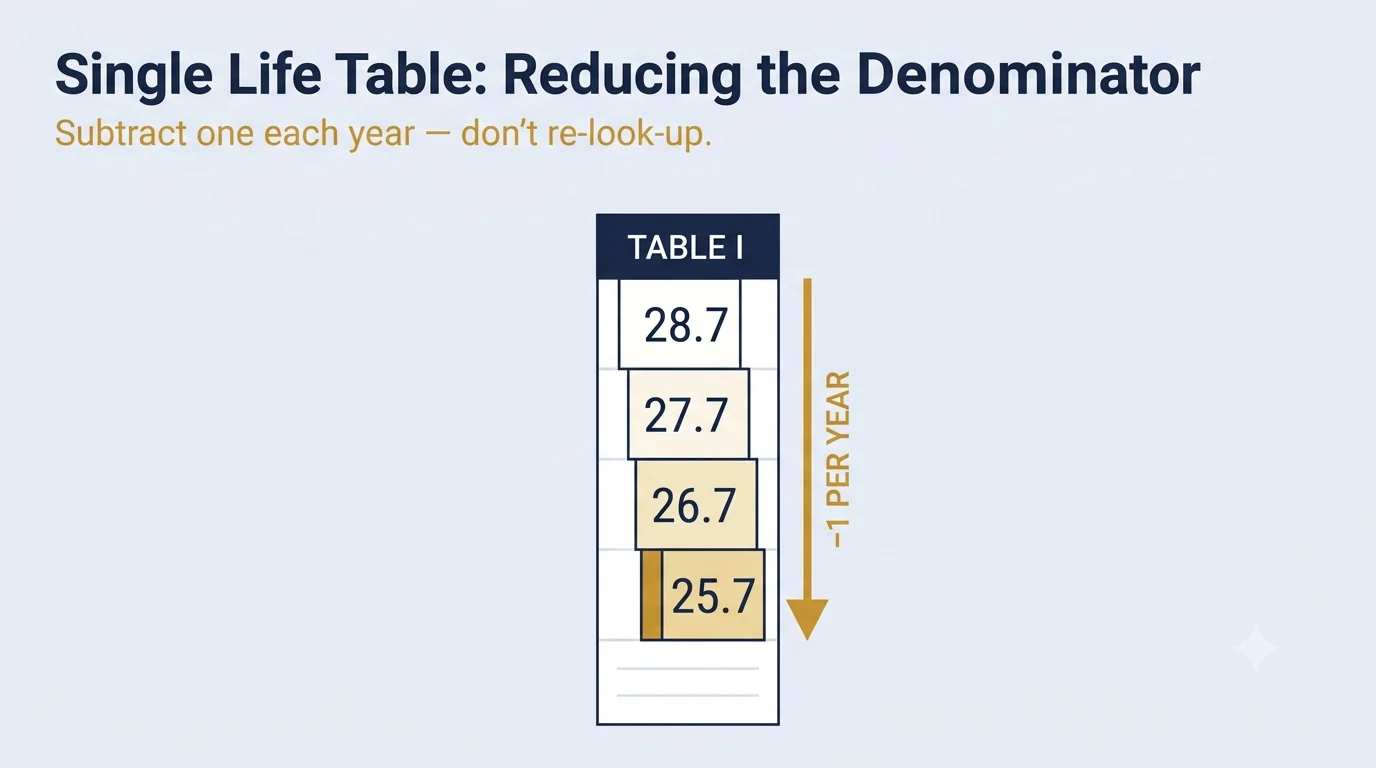
How nonspouse beneficiaries use Table I, when the initial age is measured, and why the denominator usually decreases by one rather than being looked up fresh each year.
↗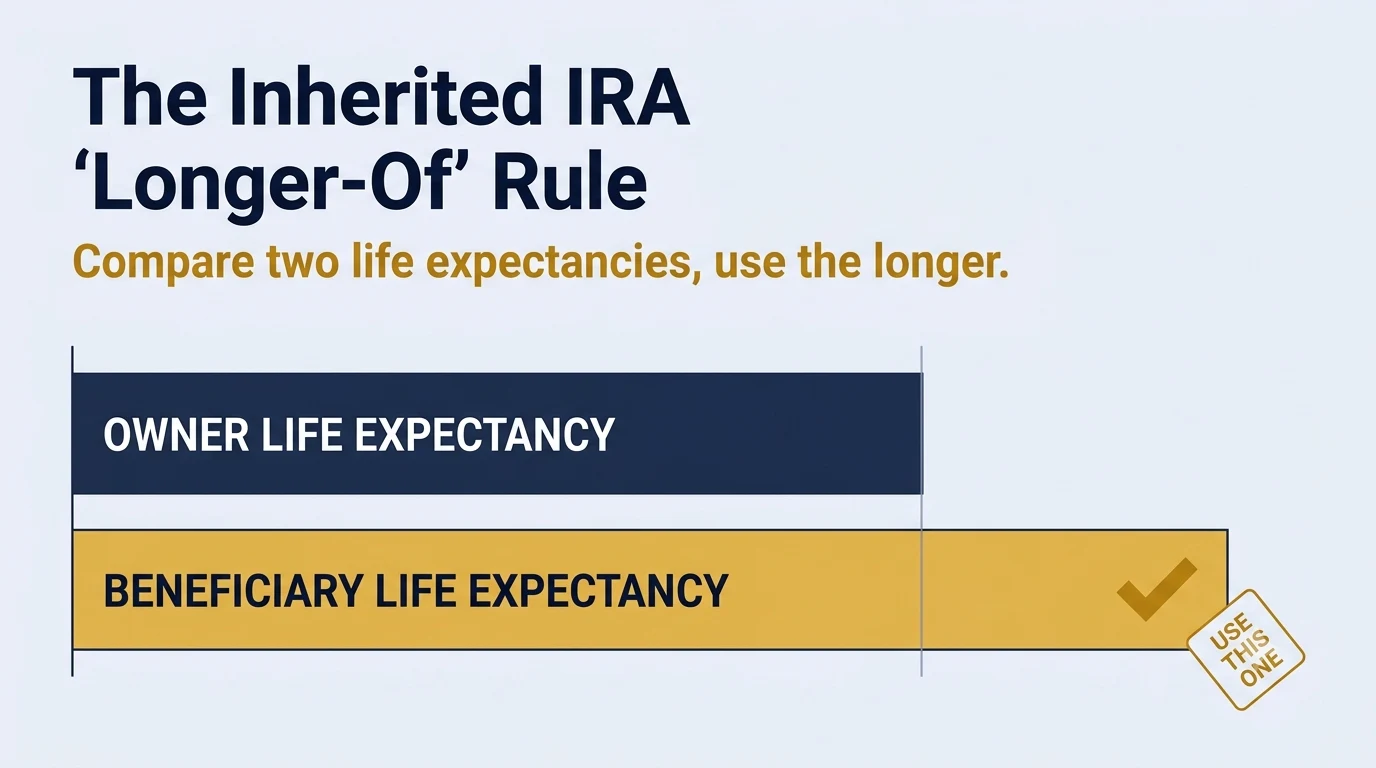
When an IRA owner dies on or after the required beginning date, the annual beneficiary RMD can depend on a denominator comparison that is easy to miss.
↗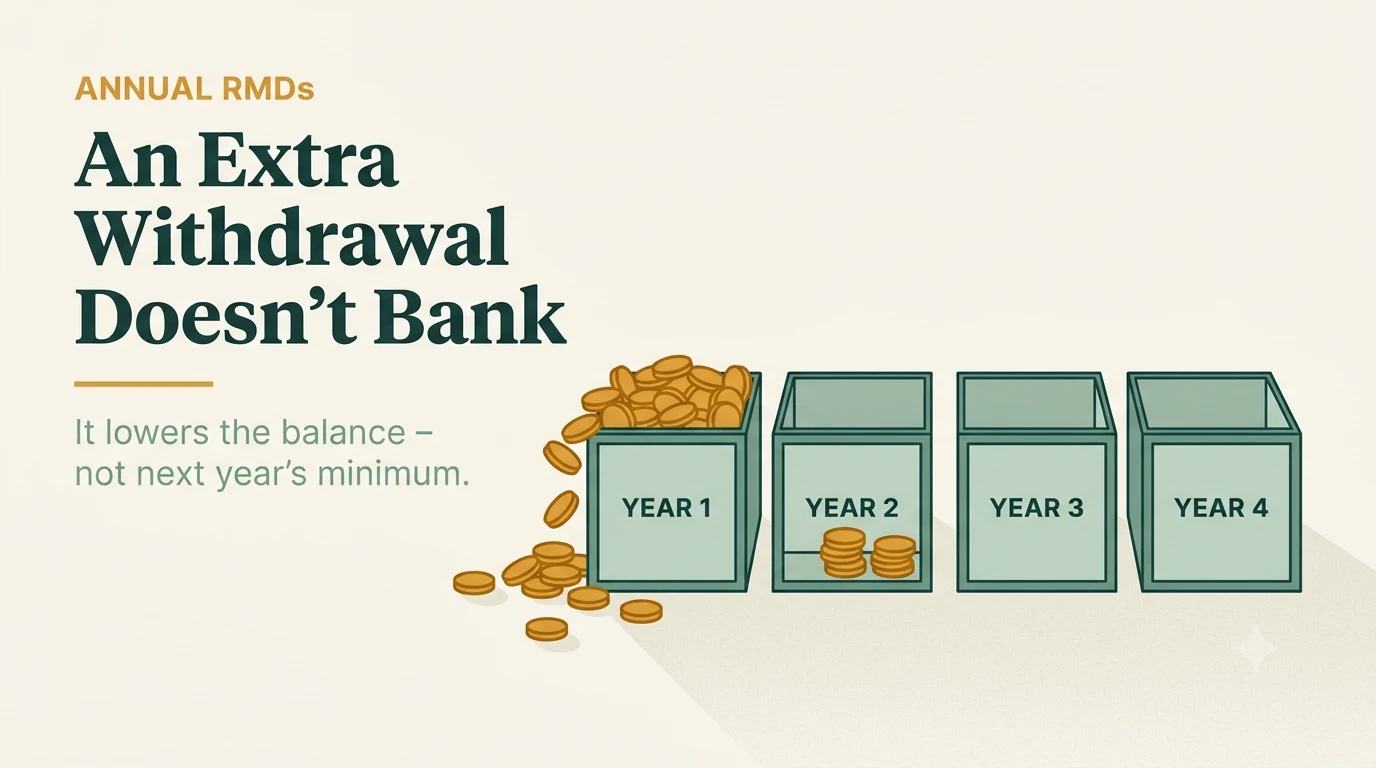
A distribution above the current inherited-IRA minimum can reduce the future account balance, but it does not create a carryforward credit against a later RMD.
↗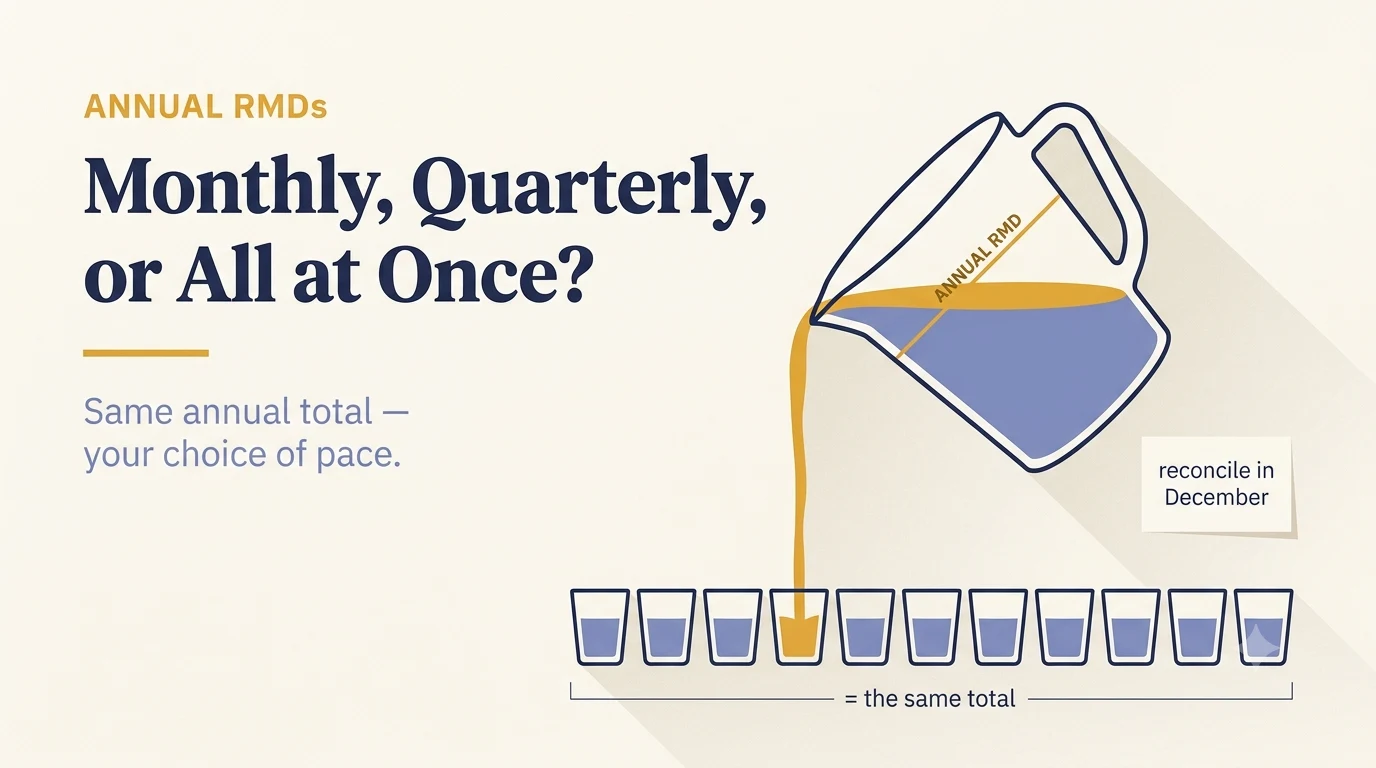
RMD rules set an annual minimum and deadline; beneficiaries can generally use installments, but timing and year-end reconciliation still matter.
↗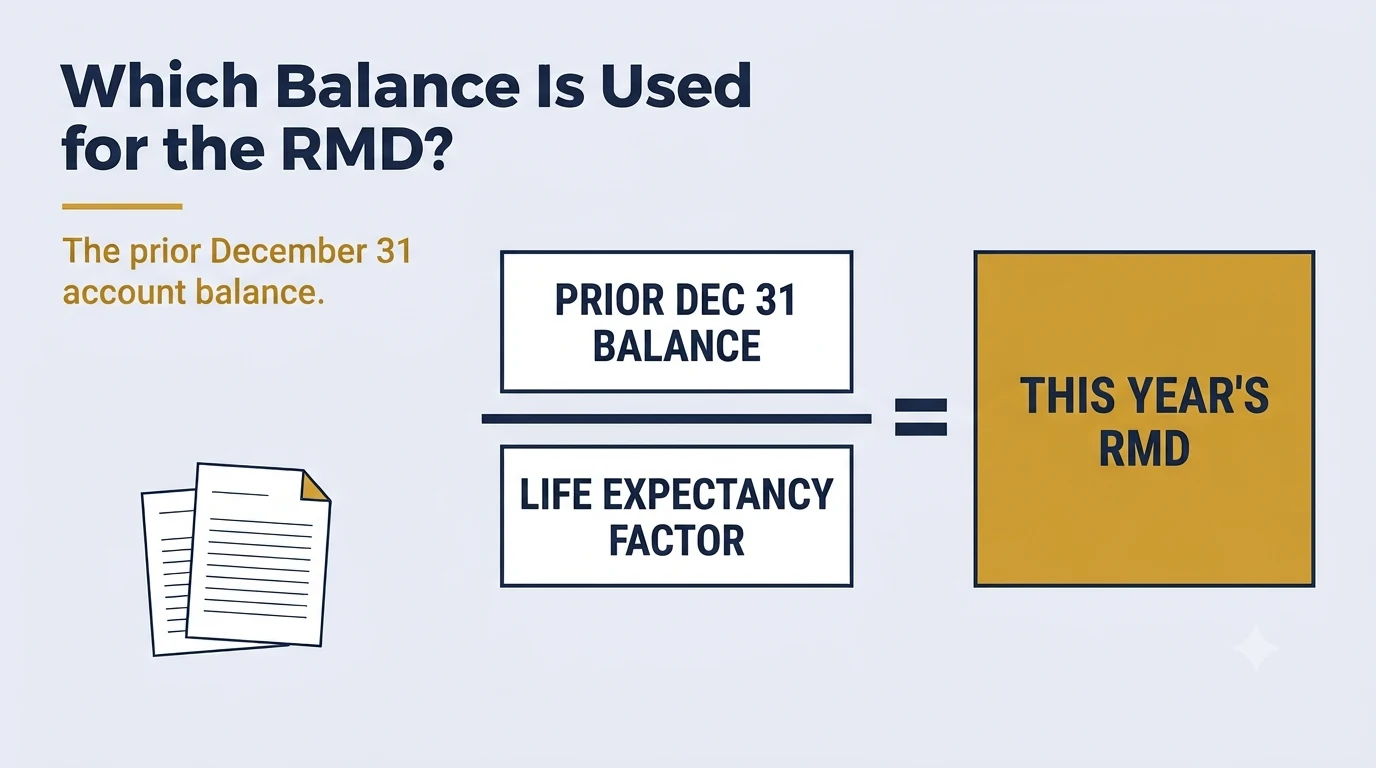
How the prior December 31 balance fits into the beneficiary RMD formula, including transfers and record gaps.
↗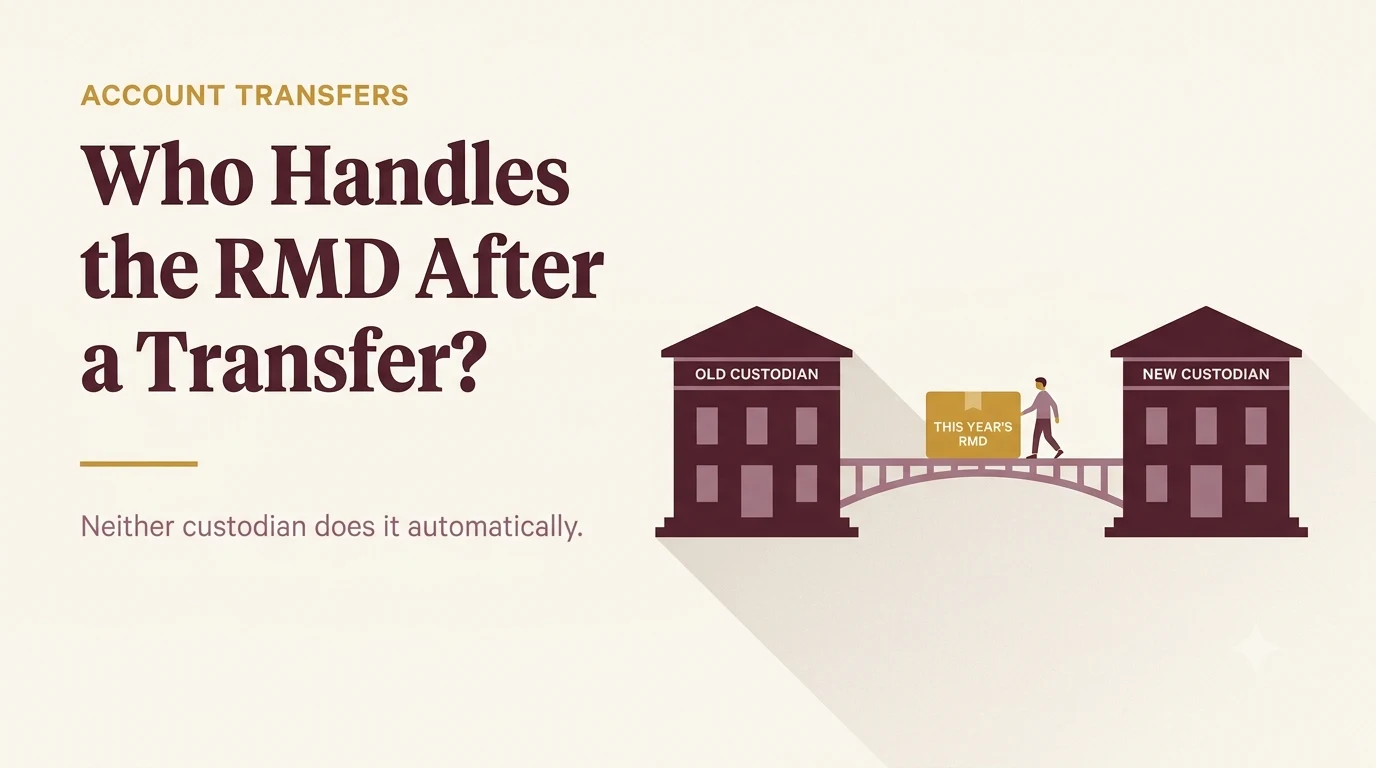
Moving an inherited IRA between custodians does not erase the annual minimum; preserve the balance, denominator, and distributions across both institutions.
↗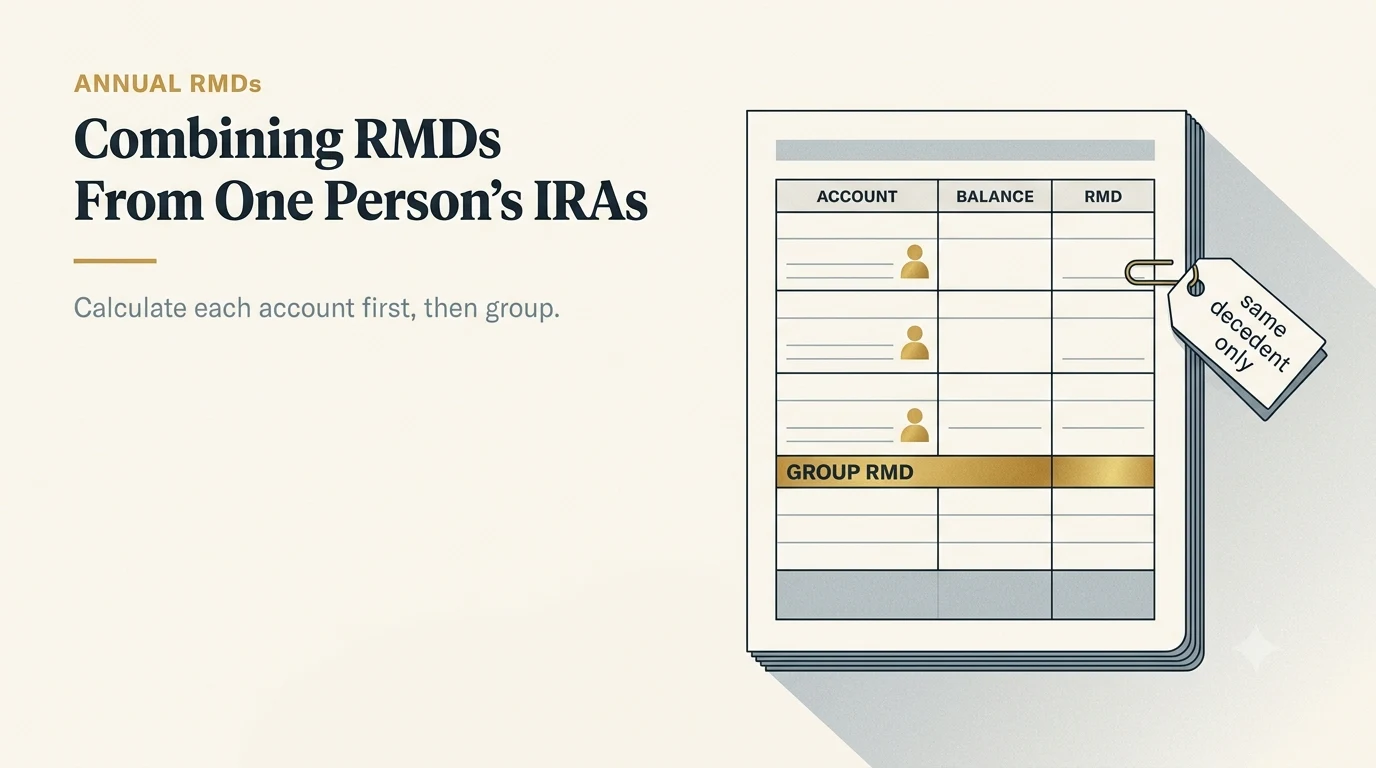
A practical worksheet for calculating each inherited IRA first and then deciding whether permitted aggregation can simplify the actual distributions.
↗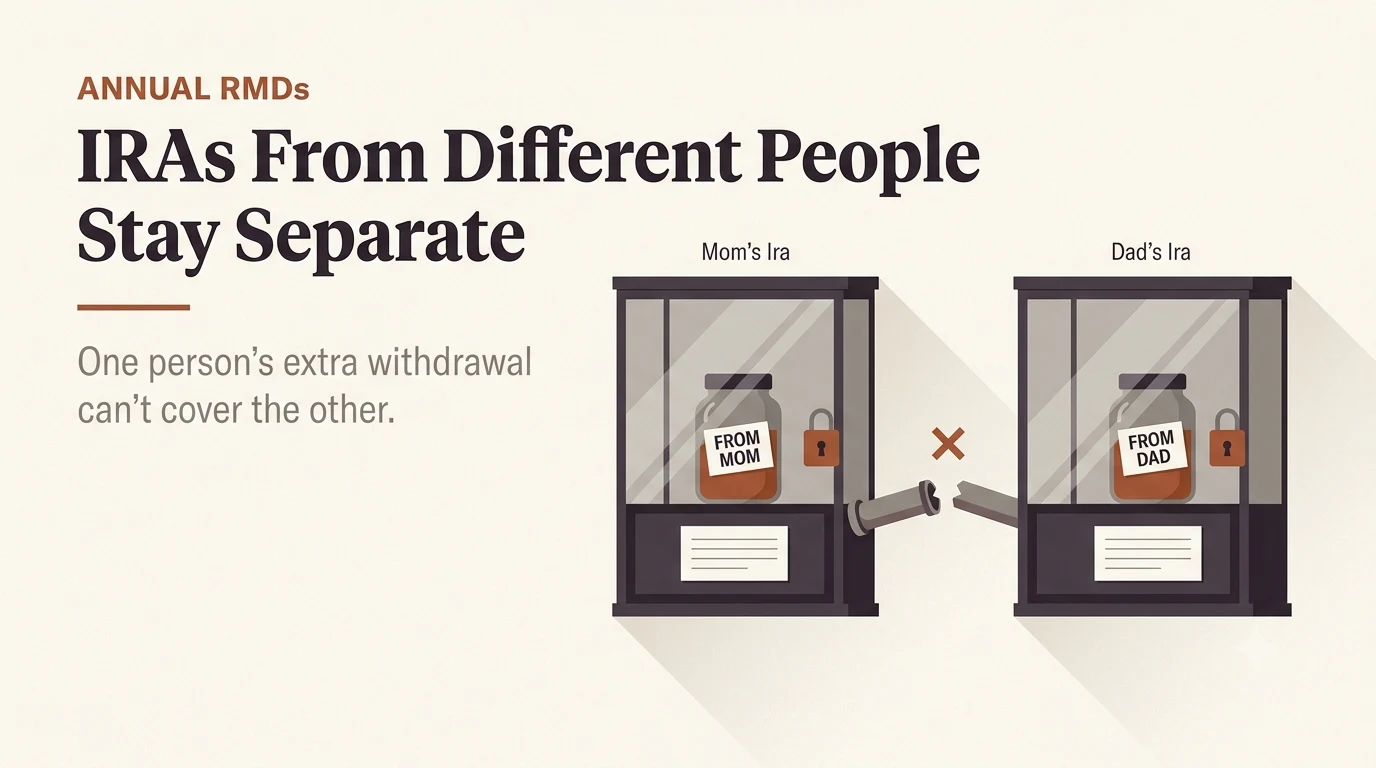
Two inherited IRAs in the same beneficiary’s name can still have completely separate RMD obligations when they came from different people.
↗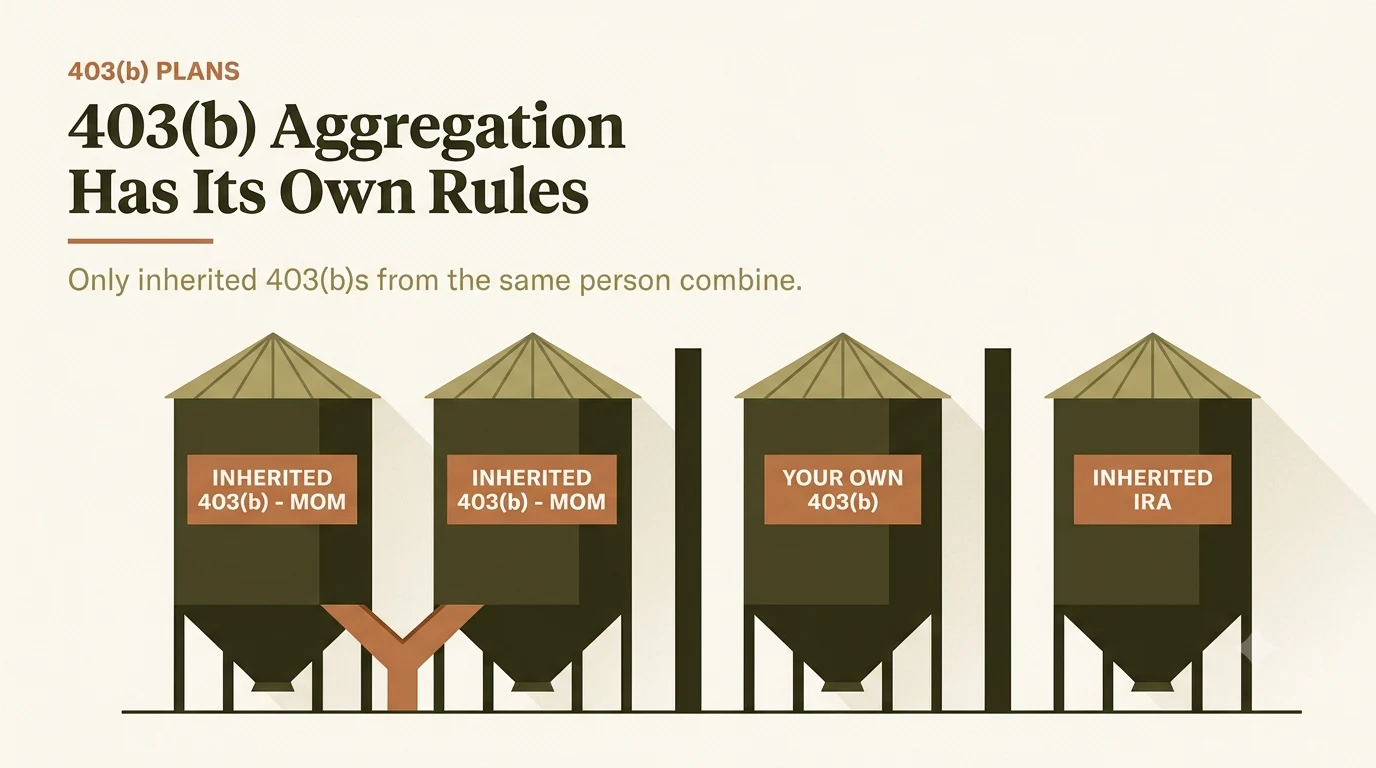
403(b) plans have their own aggregation framework; do not apply inherited-IRA pooling rules or 401(k) assumptions across account types.
↗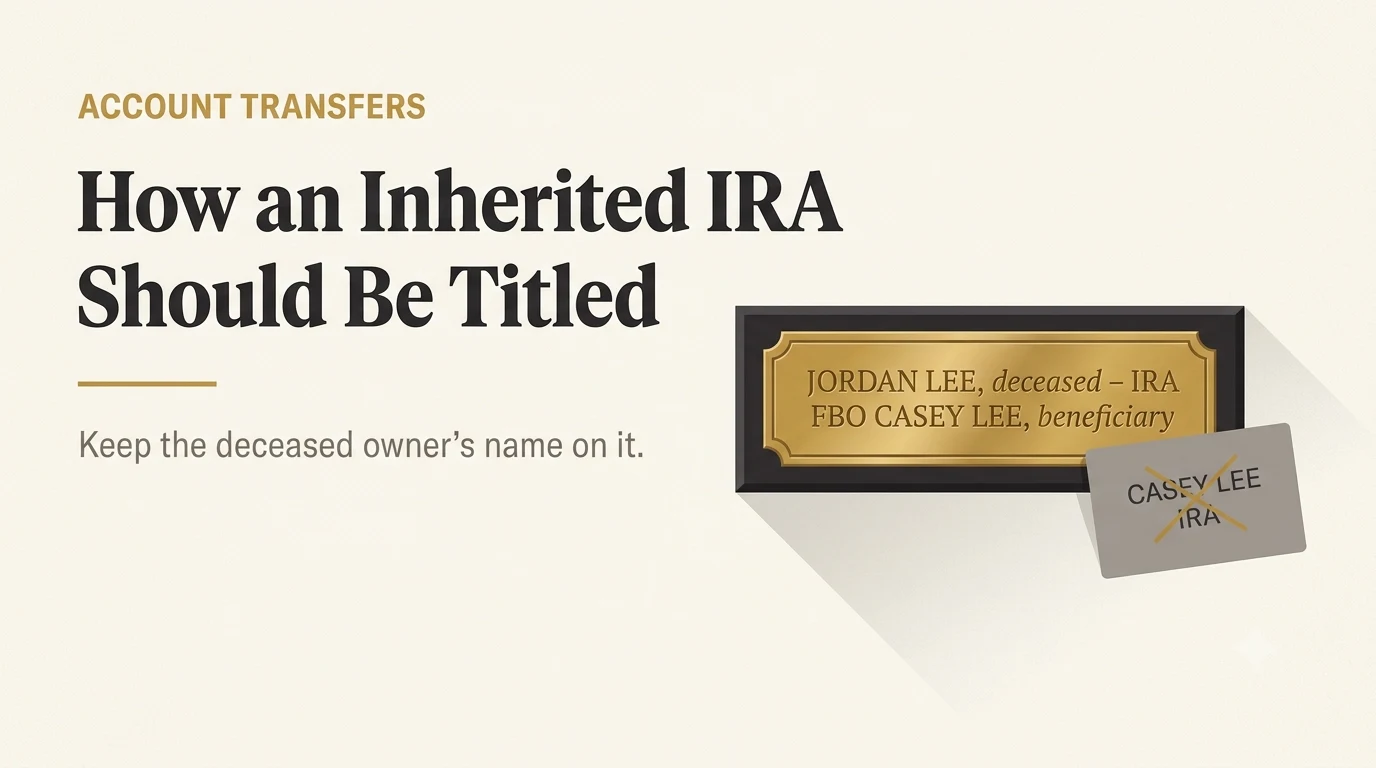
Inherited IRA registration should preserve the deceased owner and beneficiary relationship; a non-spouse beneficiary should not retitle it as a personal IRA.
↗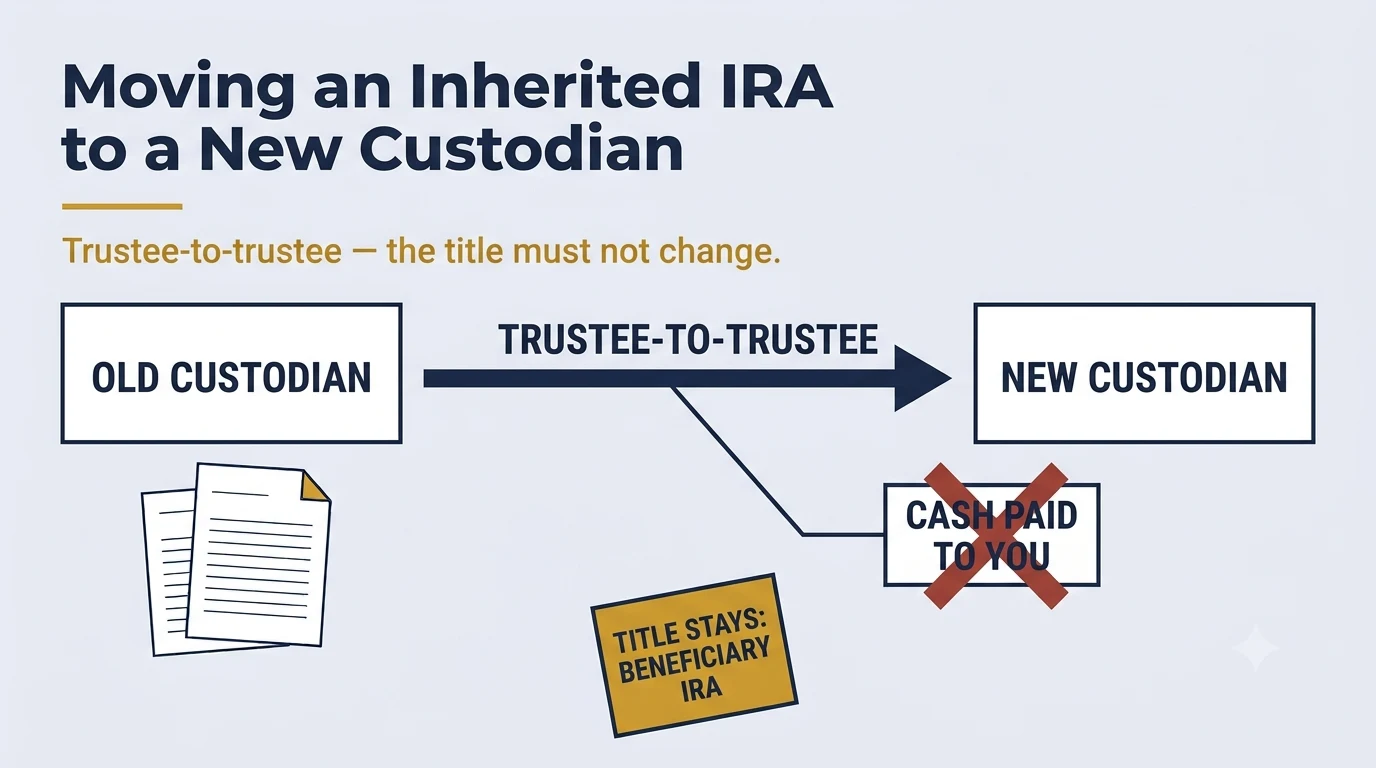
Non-spouse beneficiaries can change custodians without converting an inherited IRA into a personal IRA, but the transfer method and account title matter.
↗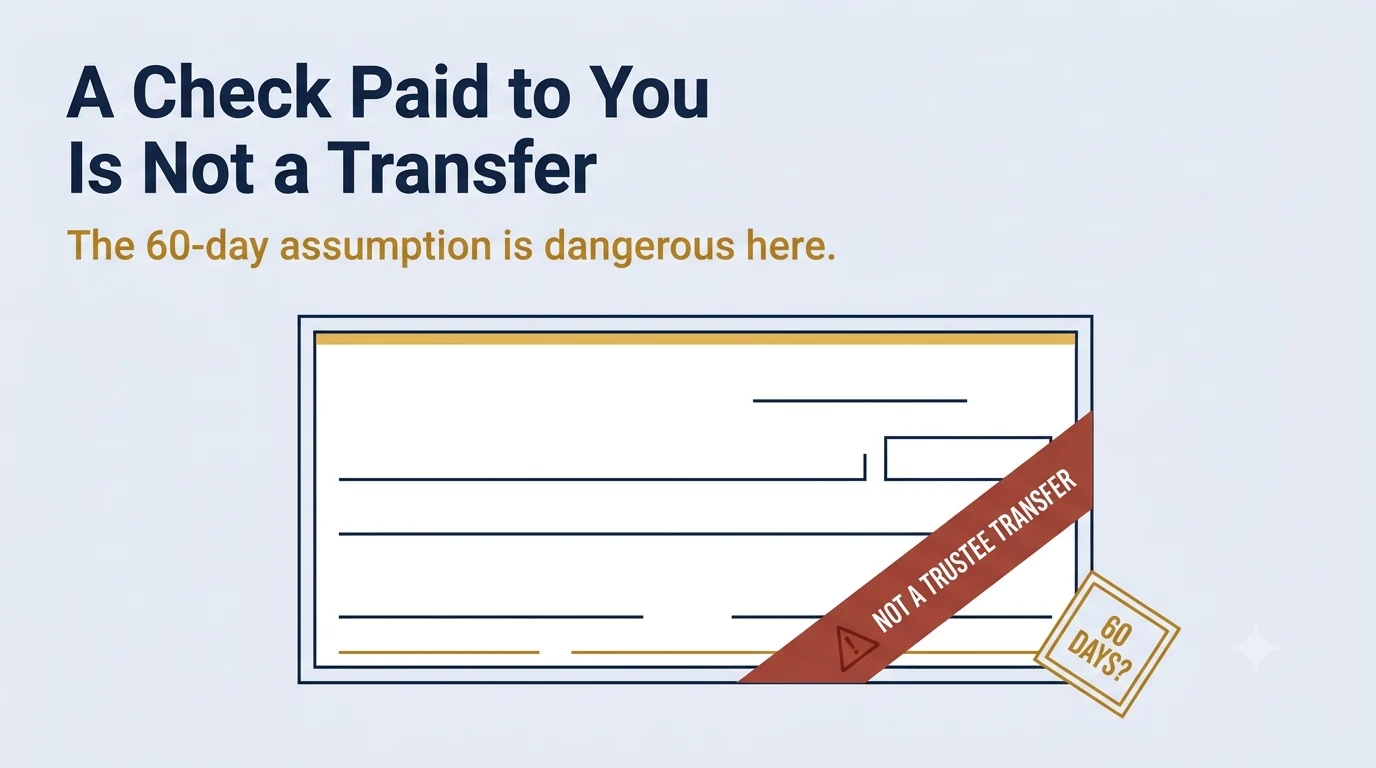
A check paid to a non-spouse beneficiary is not the same as a trustee-to-trustee inherited-IRA transfer; act before assuming the money can be redeposited.
↗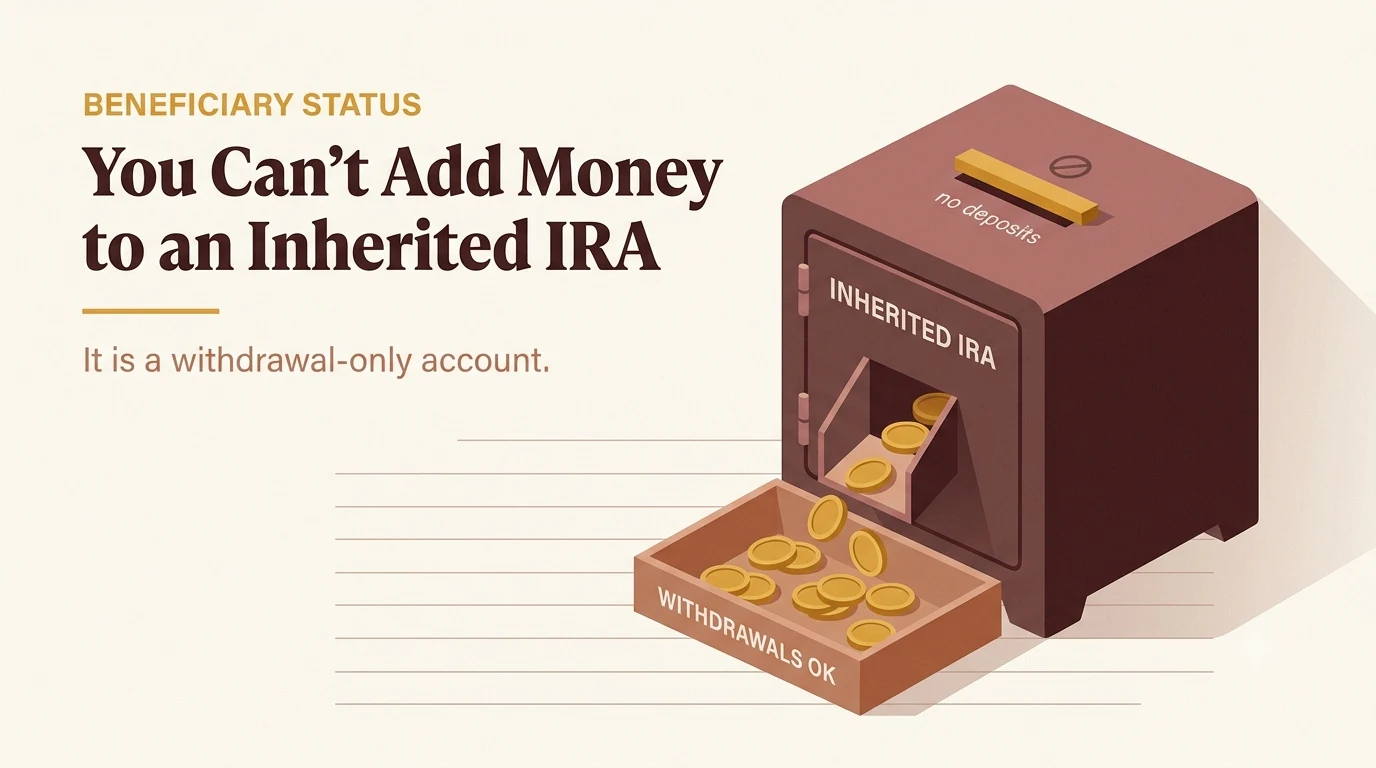
A non-spouse inherited IRA is a distribution account tied to the deceased owner; it is not an extra personal IRA contribution bucket.
↗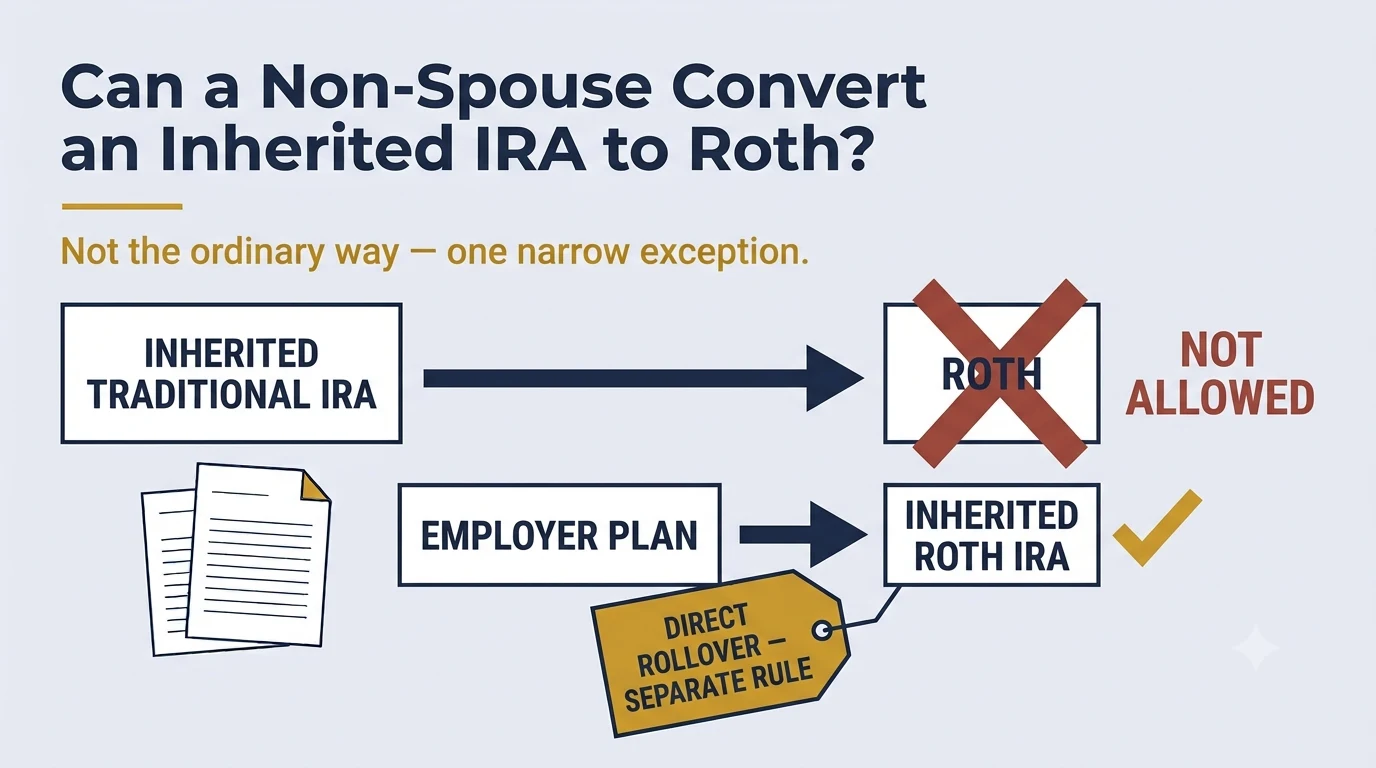
The ordinary IRA Roth-conversion route is generally unavailable to a non-spouse inherited IRA, but a direct rollover from an employer plan to an inherited Roth IRA is a distinct rule.
↗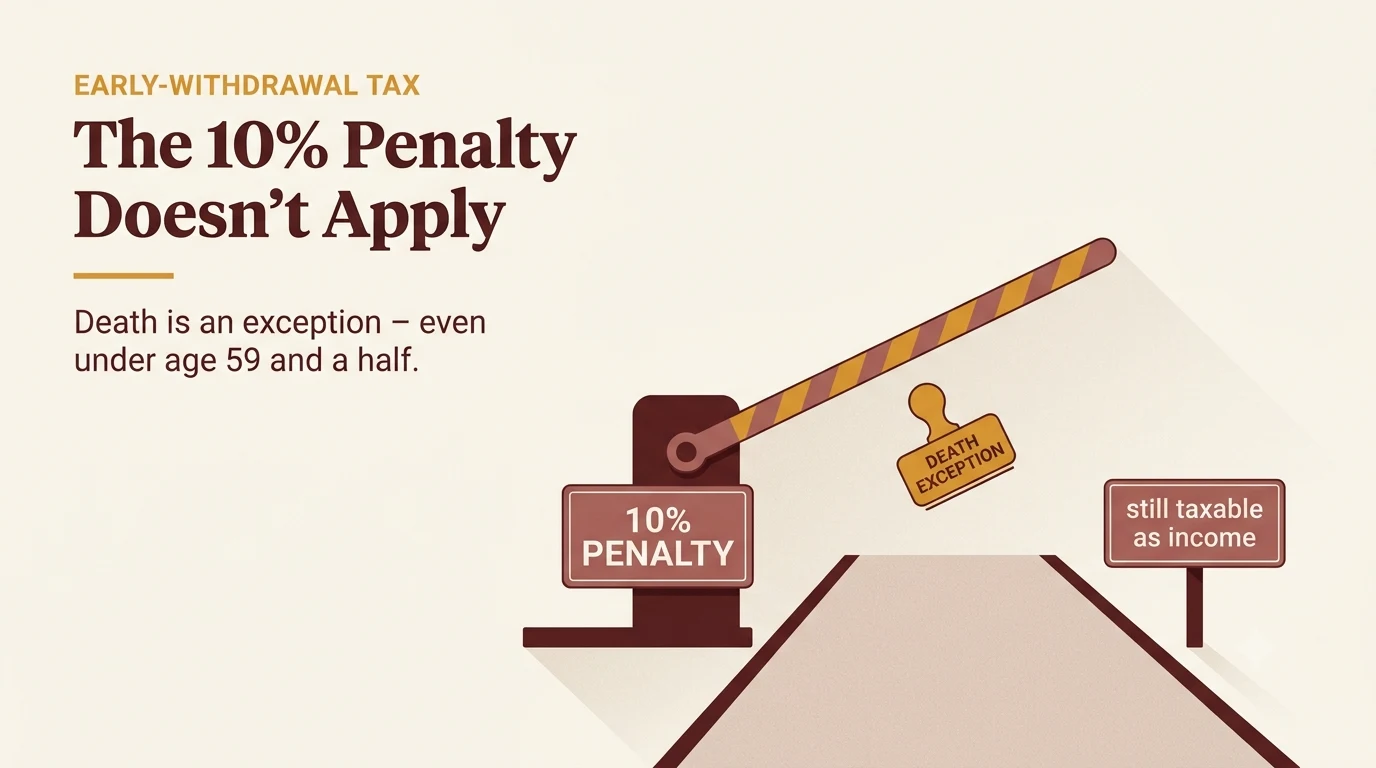
Distributions to a beneficiary after the owner’s death are generally excepted from the additional 10% early-distribution tax, even when the beneficiary is under 59½.
↗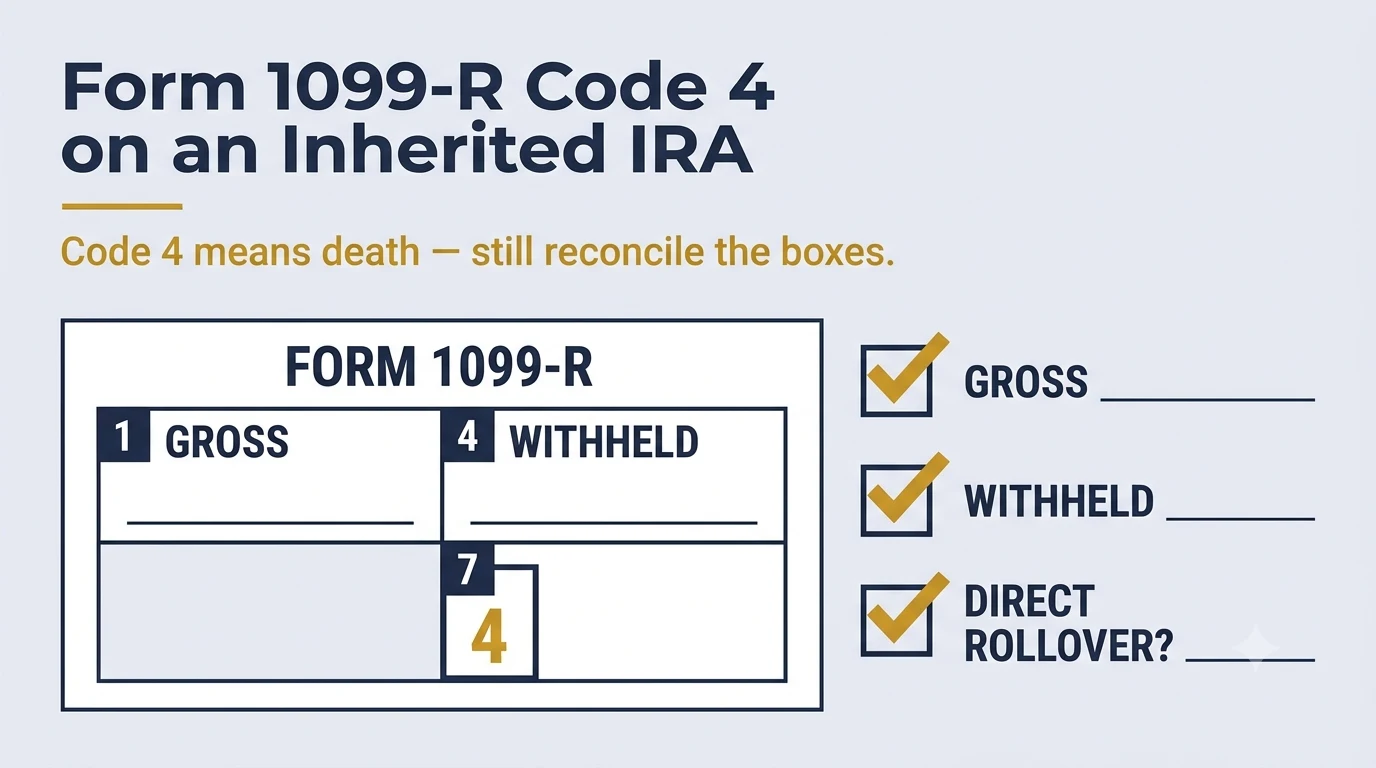
Code 4 generally identifies a death distribution, but beneficiaries should still reconcile the gross distribution, withholding, account type, and any direct rollover.
↗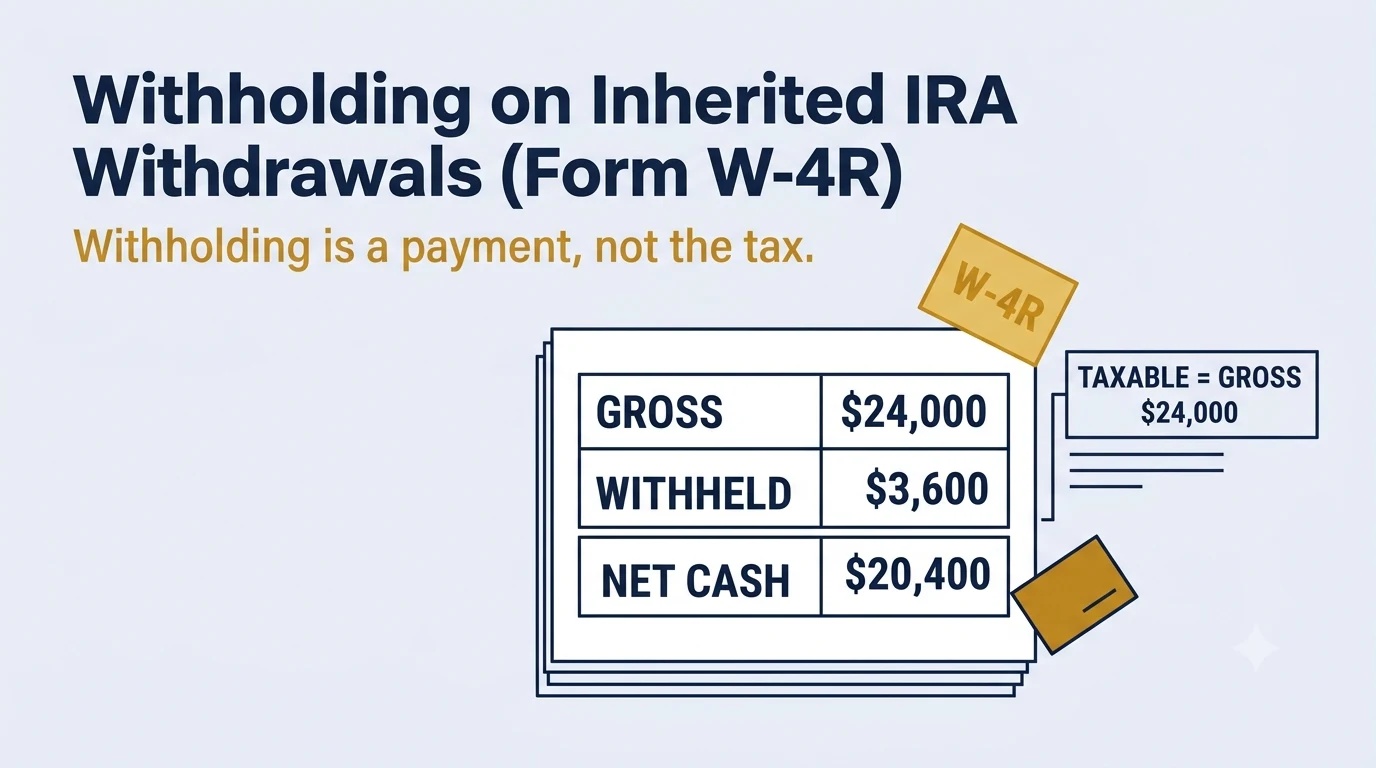
Withholding is a tax-payment mechanism, not the tax calculation itself; beneficiaries should choose a rate with the full-year tax picture in mind.
↗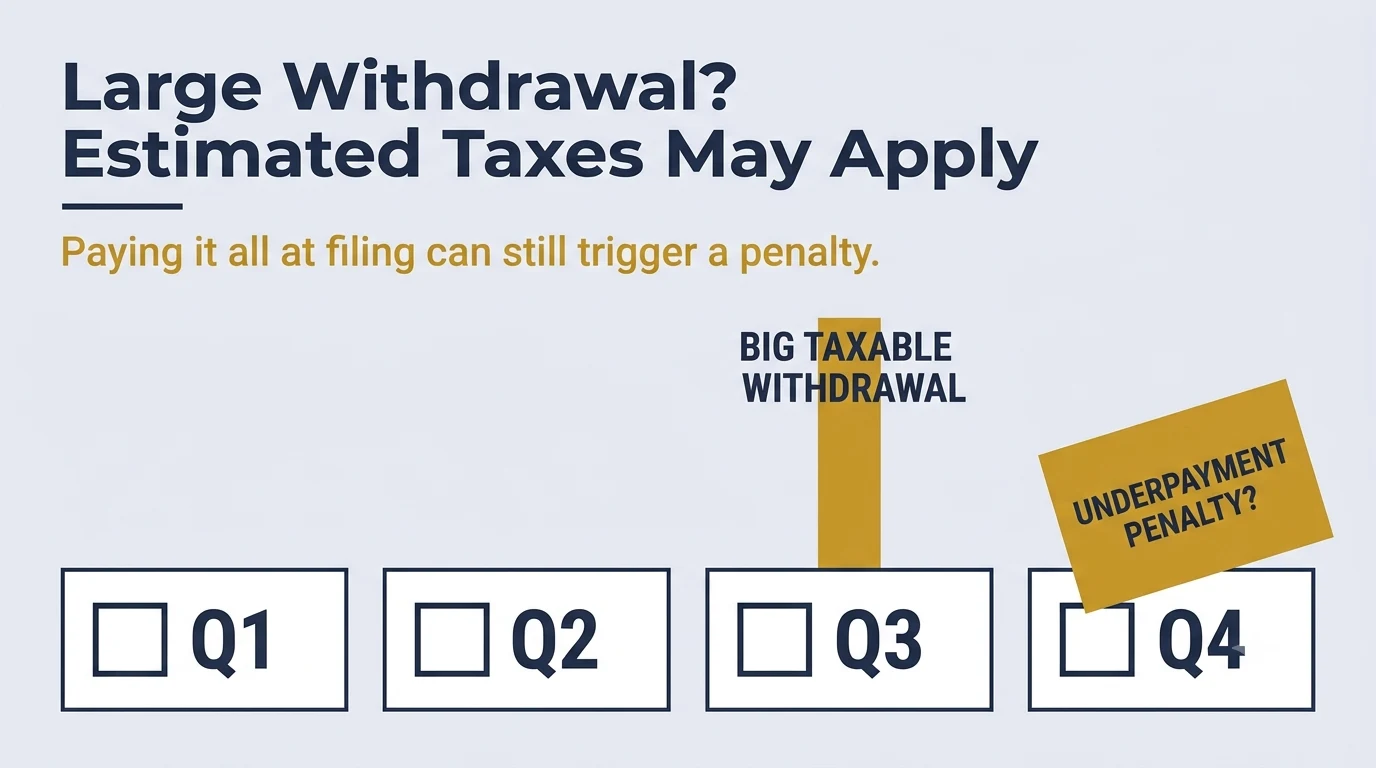
A large taxable distribution can create an underpayment problem even when the beneficiary plans to pay the full balance at filing time.
↗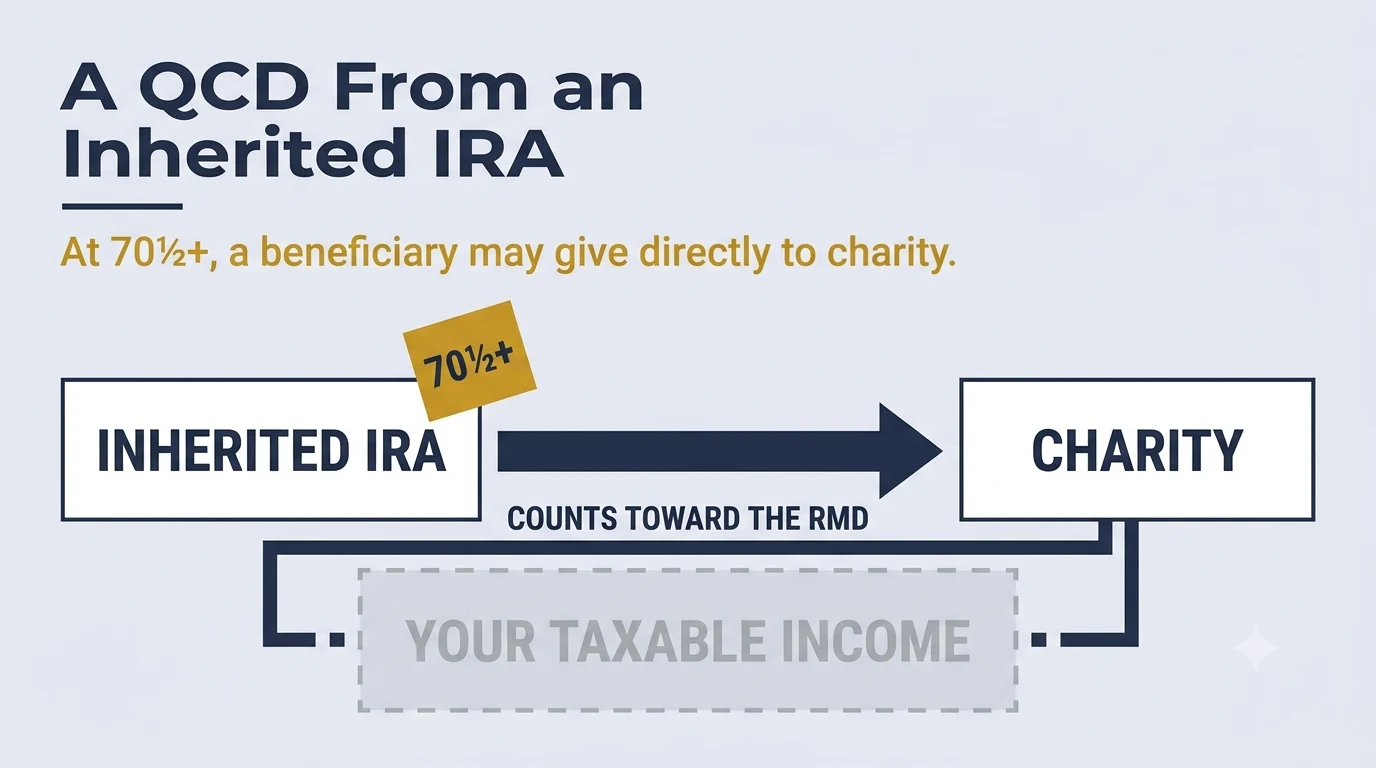
An inherited IRA beneficiary who has reached the QCD age can potentially direct an eligible IRA distribution to charity and have it count toward an RMD.
↗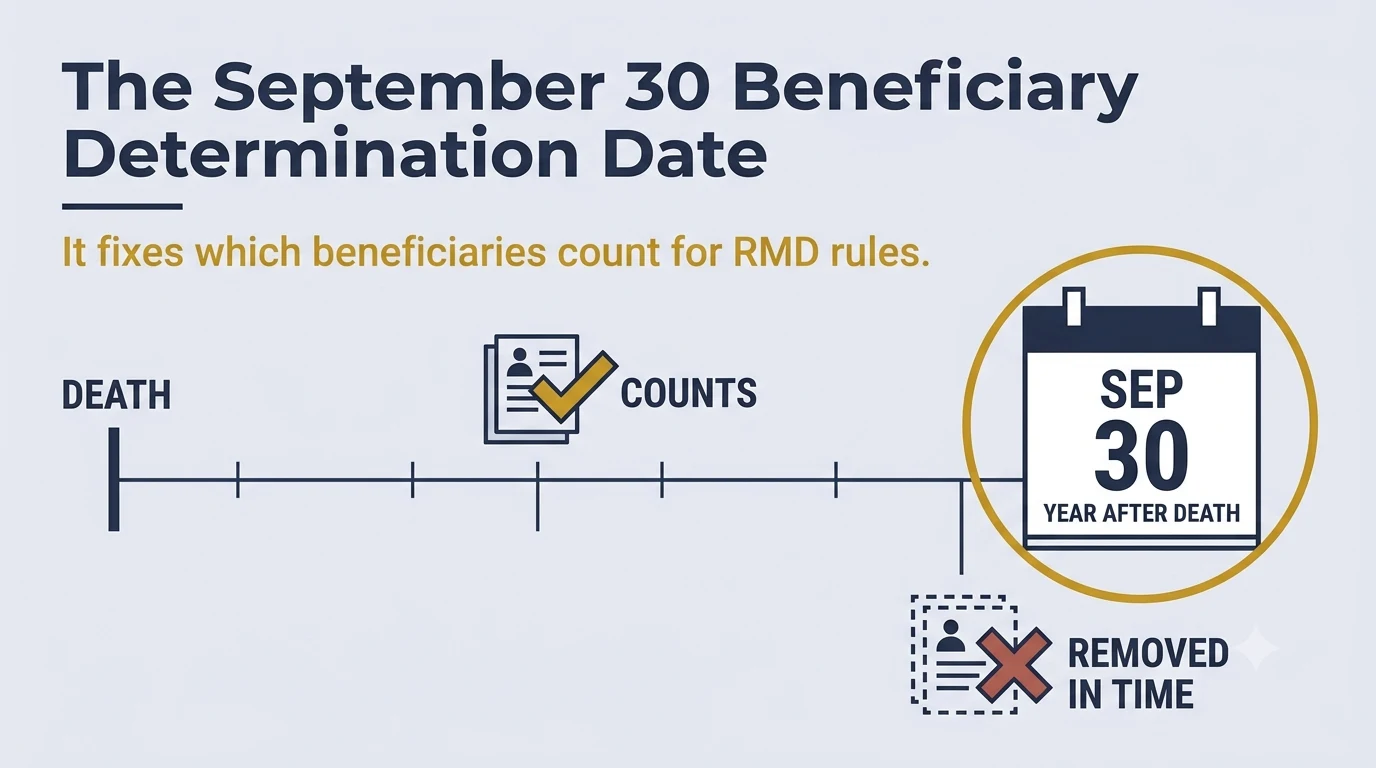
The beneficiary picture can change after death; the September 30 date of the following year helps determine which designated beneficiaries count for post-death RMD rules.
↗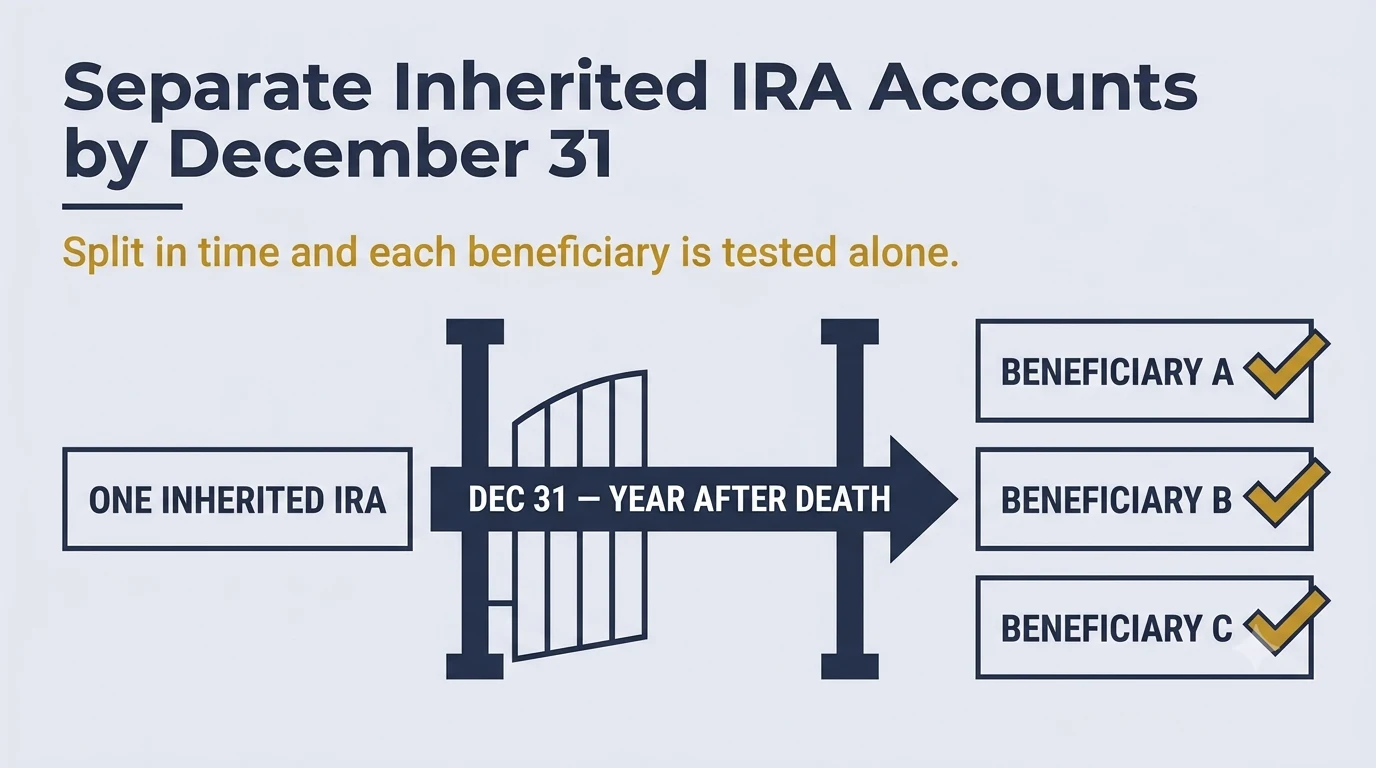
When multiple beneficiaries inherit one IRA, timely separate-account treatment can determine whether each beneficiary’s post-death RMD rules are tested independently.
↗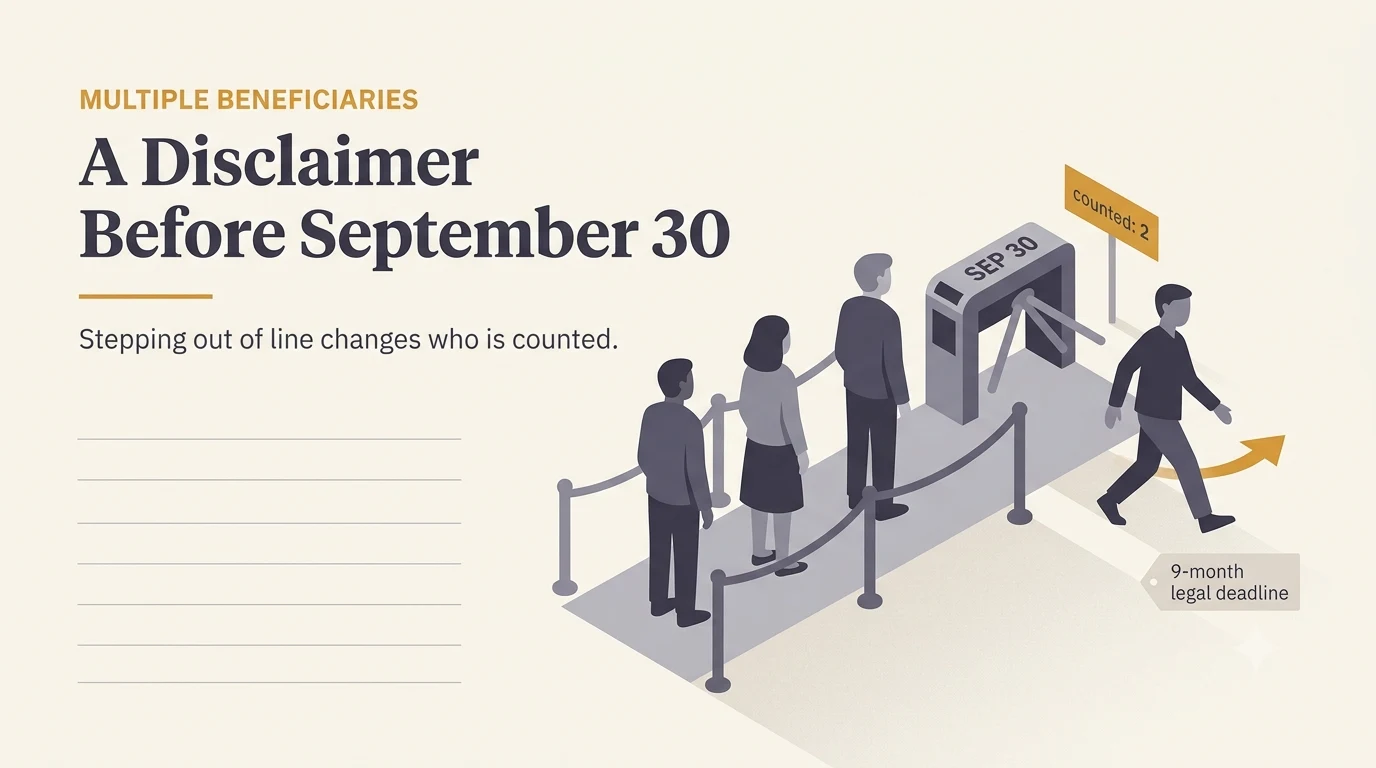
A valid disclaimer can change which beneficiaries are counted for post-death RMD purposes, but the tax rule does not replace the legal requirements for a disclaimer.
↗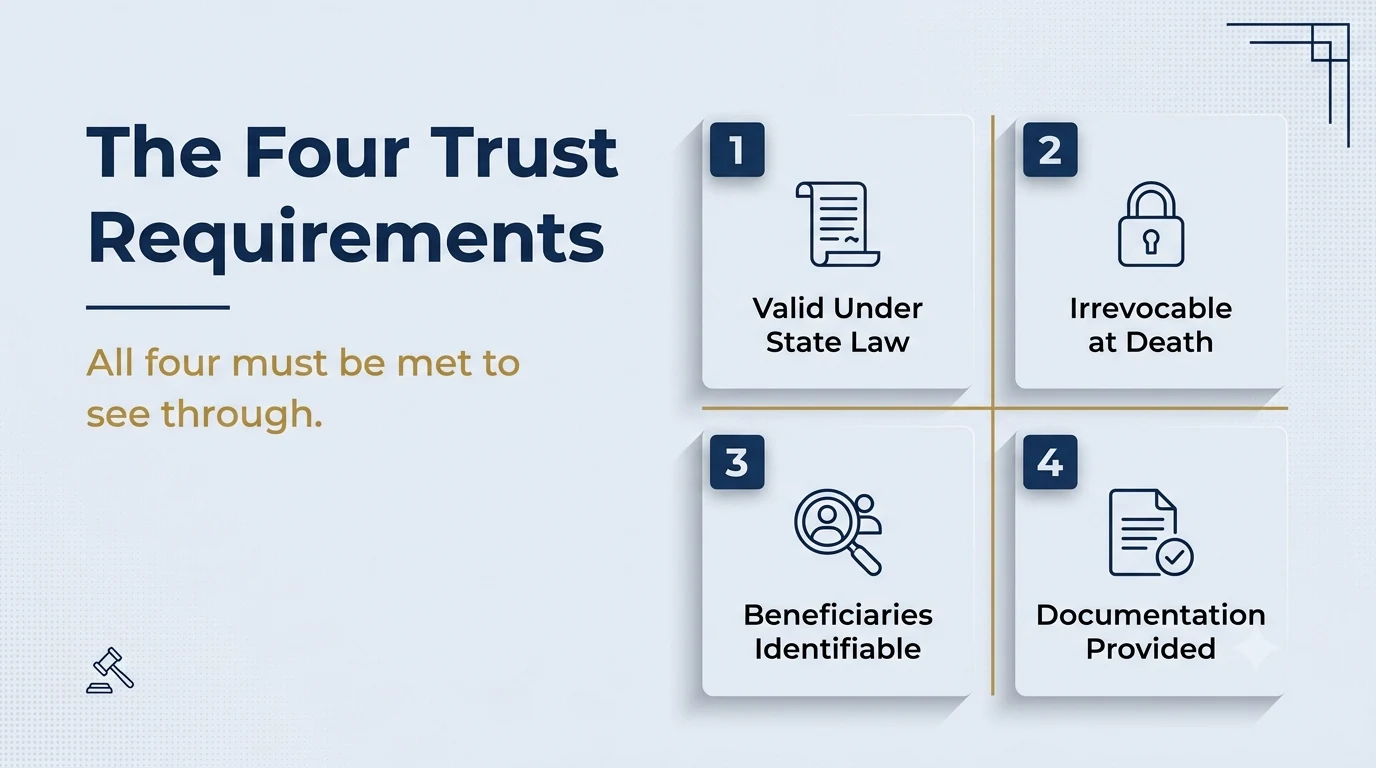
A trust named on an IRA is not automatically treated as an individual beneficiary; qualifying see-through treatment depends on specific trust and documentation requirements.
↗
Nested trust arrangements require tracing who can ultimately receive retirement assets; stopping at the name of a second trust can produce the wrong beneficiary classification.
↗
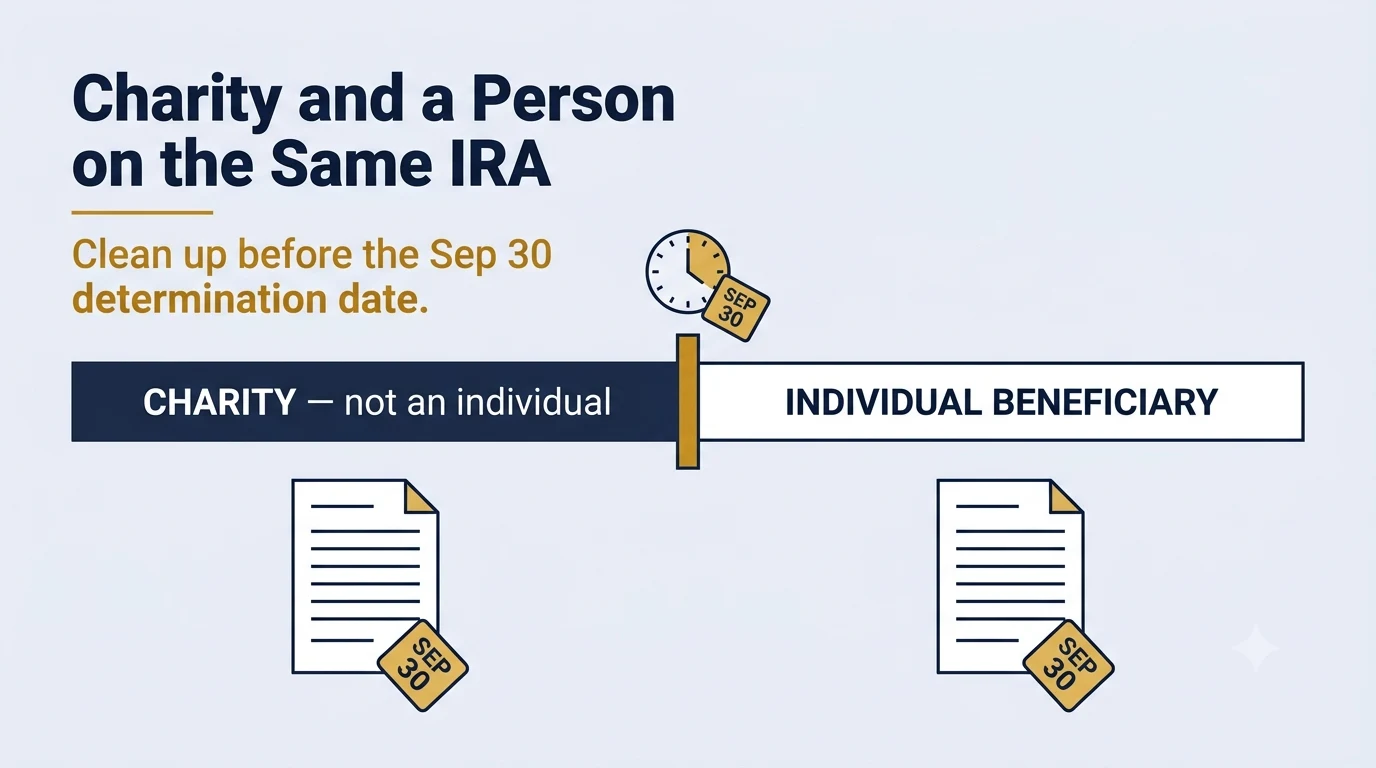
Special trust rules can preserve life-expectancy treatment for certain disabled or chronically ill beneficiaries even when a trust has multiple beneficiaries.
↗
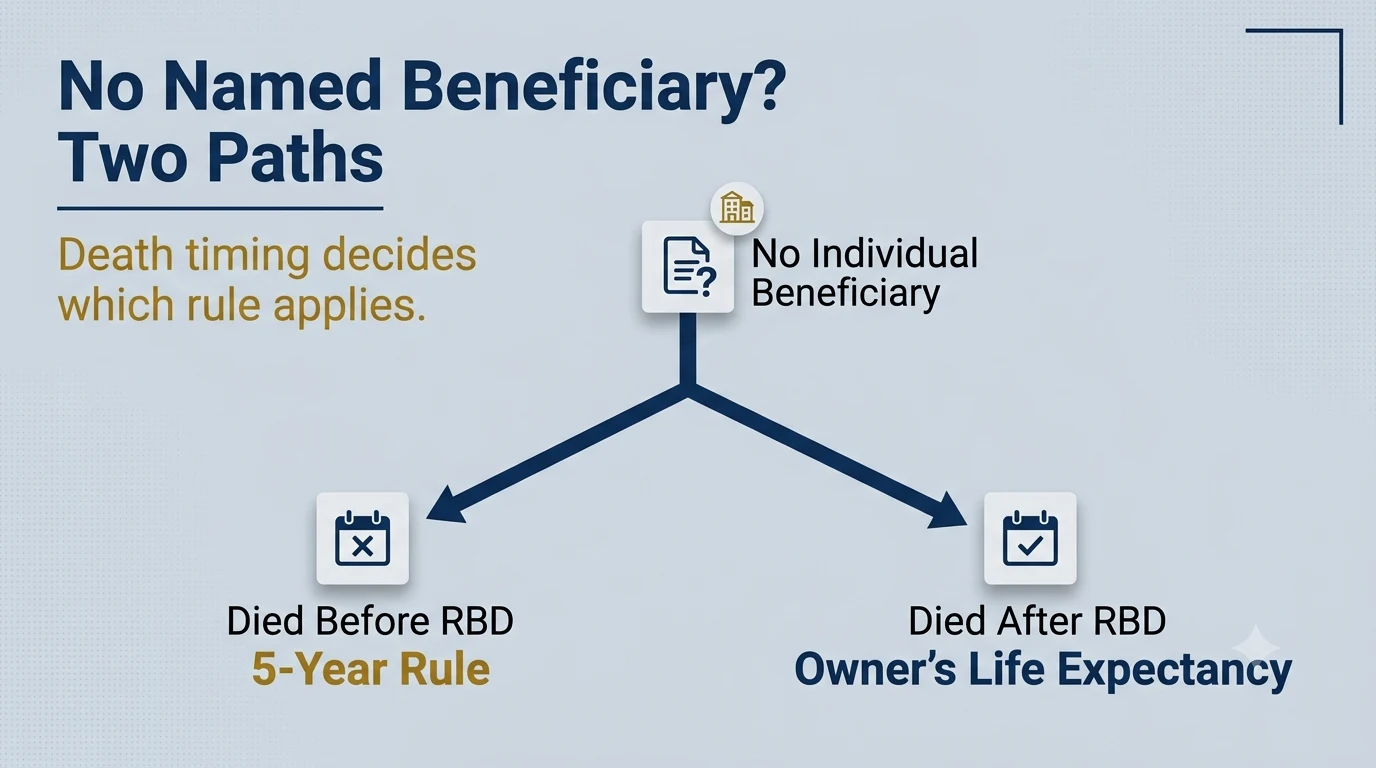
A charity is not an individual designated beneficiary; when a charity and person share an IRA, post-death cleanup before the beneficiary determination date can matter.
↗
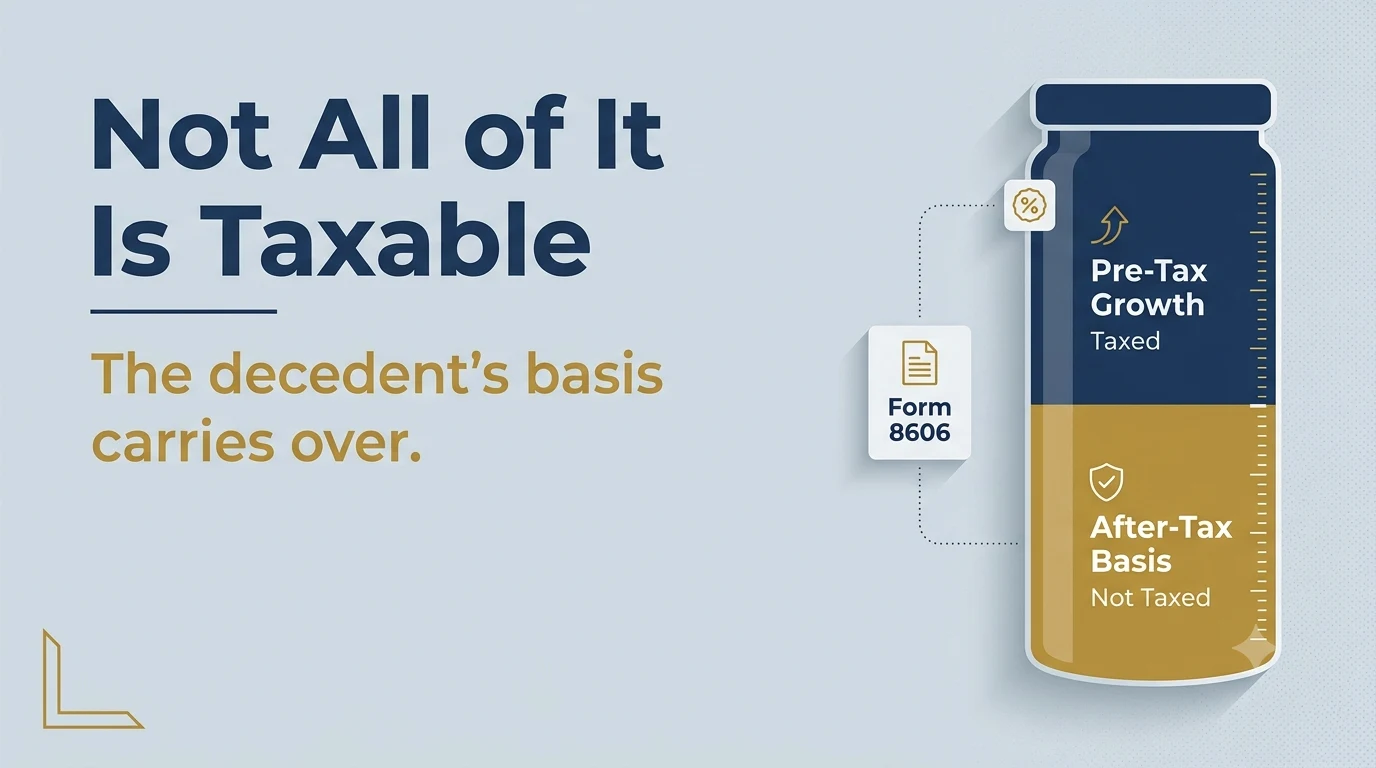
If the IRA has no designated individual beneficiary, the owner’s required beginning date becomes the key branch between the 5-year rule and remaining-life-expectancy treatment.
↗
After-tax basis in a traditional IRA does not disappear at death; beneficiaries need the decedent’s basis records to avoid treating every dollar as taxable.
↗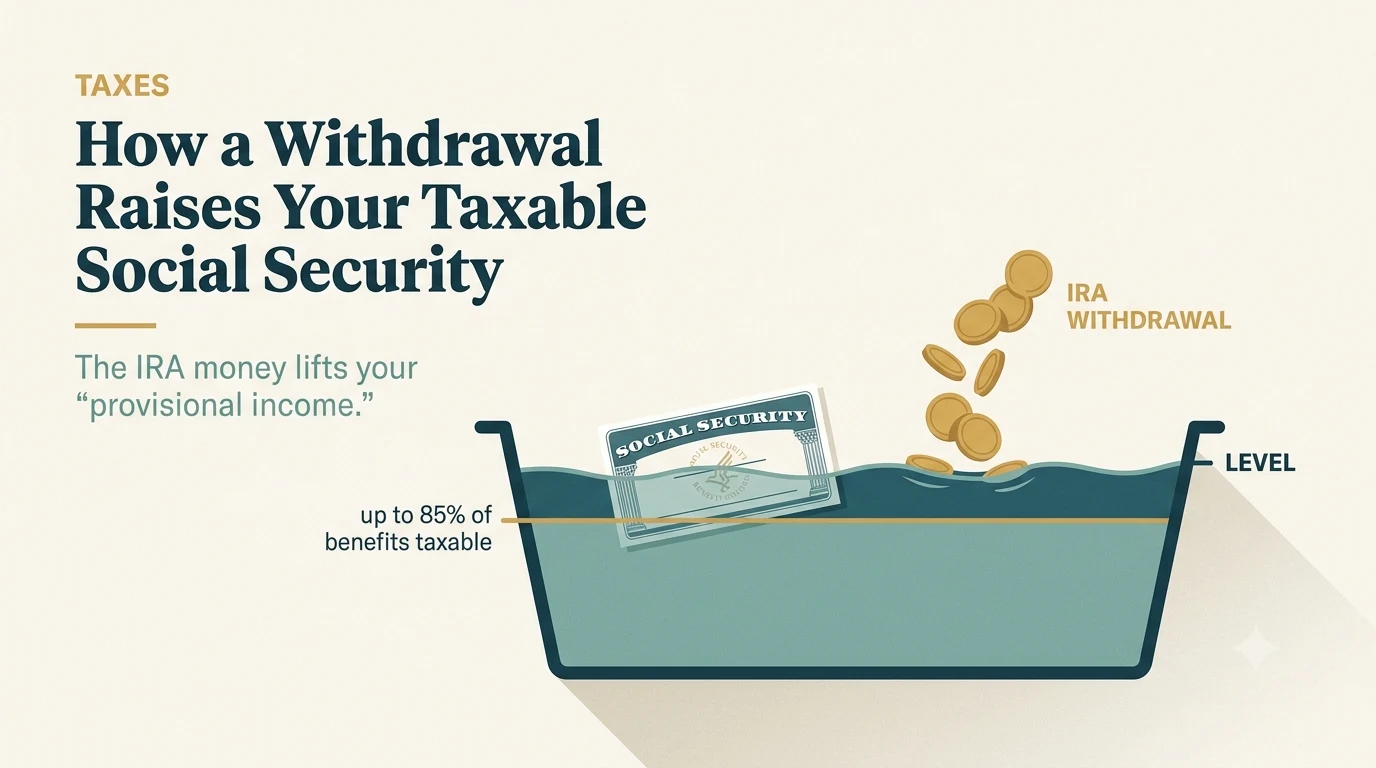
A taxable inherited traditional IRA withdrawal can increase provisional income and change how much Social Security is included in taxable income.
↗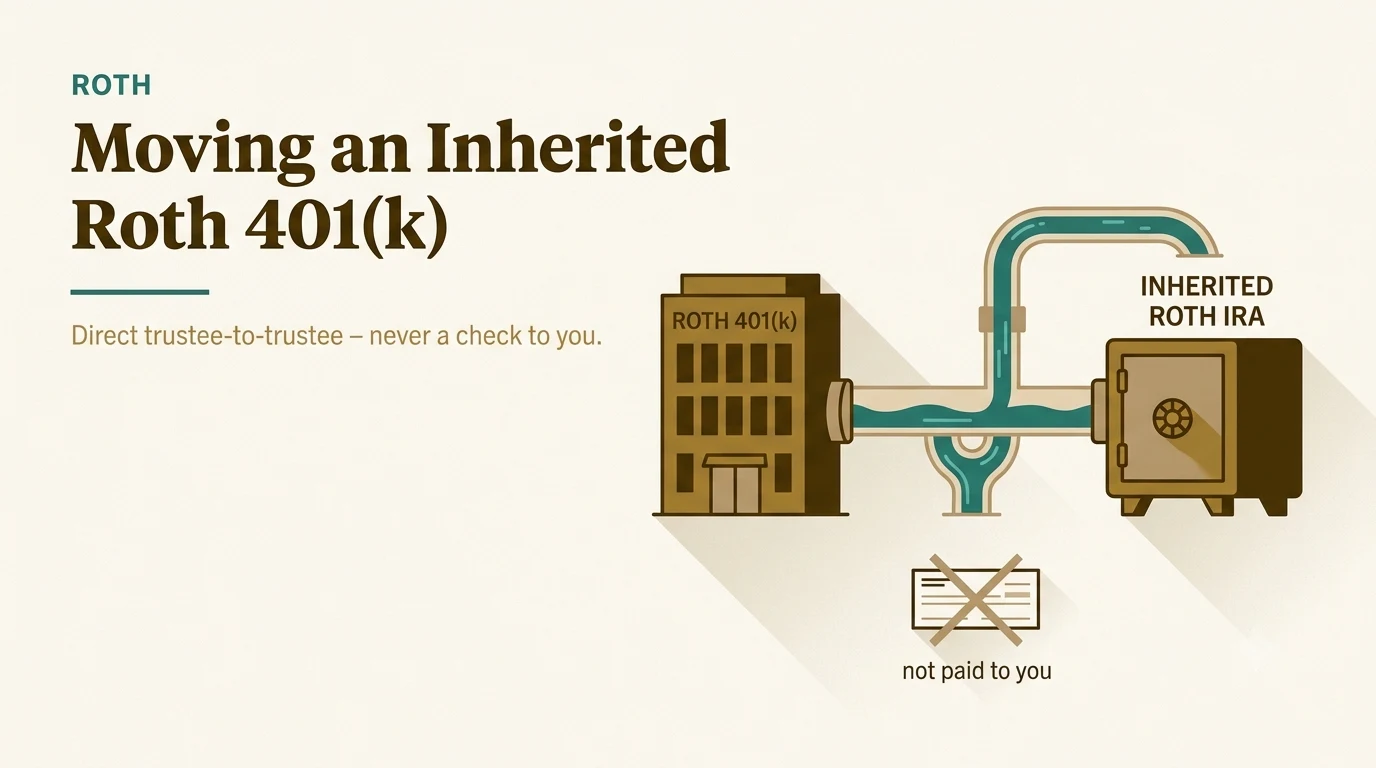
Designated Roth employer-plan accounts have post-death RMD rules, and a non-spouse beneficiary may have a direct-rollover route to a properly titled inherited Roth IRA.
↗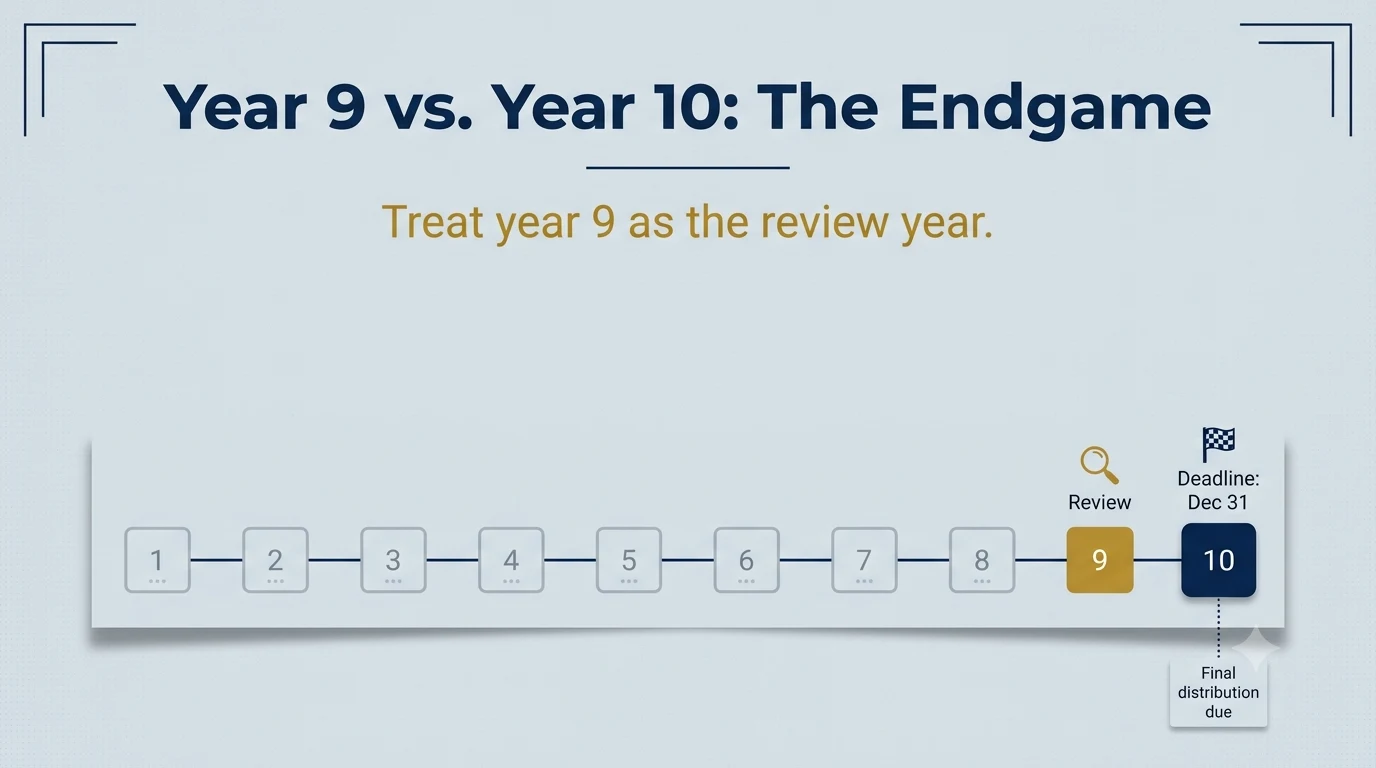
The last two years are different: year 9 is the time to reconcile the legal deadline and tax exposure; year 10 is the year the remaining balance must actually reach zero.
↗
Spousal inherited IRA rollover rules differ sharply from beneficiary rules for RMD timing, early withdrawals, account control, and future planning.
↗
Nonresident alien inherited IRA distributions can face U.S. withholding, treaty rules, Form W-8BEN documentation, and separate RMD deadlines.
↗
A younger surviving spouse may preserve penalty-free access by keeping an inherited IRA as beneficiary before later moving eligible funds into an own IRA.
↗
The final RMD regulations give surviving spouses special elections, delayed start rules, and a separate hypothetical-RMD catch-up rule for later rollovers.
↗
A surviving spouse can reach Roth treatment, but inherited-IRA status, spousal rollover rules, and Roth conversion mechanics must be sequenced correctly.
↗
A spouse under 59½ can often avoid the 10% early-distribution tax by preserving inherited-IRA beneficiary status until early-access needs are resolved.
↗
An ex-spouse named on an IRA may or may not remain beneficiary after divorce because state revocation statutes, plan type, and federal preemption can differ.
↗
Community property can give a spouse ownership rights in retirement assets, but IRA beneficiary consent rules are not uniform across all community-property states.
↗
Inherited IRA withdrawals can face state income tax as well as federal tax. Use this framework to identify your state rule before choosing withdrawal timing.
↗
California generally taxes taxable inherited IRA distributions for residents. Learn the federal starting point, California adjustments, and nonresident rule.
↗
Pennsylvania treats many inherited IRA death-benefit distributions differently from federal income tax. Learn the state exemption and the separate inheritance tax.
↗
New York can tax inherited IRA income but may allow a beneficiary share of the pension and annuity exclusion. Learn the $20,000 allocation rule.
↗
Moving states can change the state tax on later inherited IRA withdrawals, but only after a real residency change and within the same federal RMD deadlines.
↗
Five states still impose a separate inheritance tax in 2026. Learn how IRA inheritance tax differs from income tax and why beneficiary relationship matters.
↗
Clark v. Rameker denied the federal bankruptcy retirement-funds exemption to inherited IRAs. Learn what the Supreme Court held and what it did not hold.
↗
State exemption statutes can protect inherited IRAs even after Clark. Learn verified Florida and Arizona examples and why a 50-state list can mislead.
↗
A trust can add beneficiary creditor protection when the original owner names it correctly, but post-death transfers and inherited IRA RMD rules create major pitfalls.
↗
An inherited IRA is often separate property, but state divorce law, commingling, transfers, withdrawals, and marital agreements can change the analysis.
↗
A minor can inherit an IRA, but an adult usually must act for the child. Learn how custodianship, UTMA law, IRA registration, and age-21 RMD rules differ.
↗
A special needs trust can coordinate inherited IRA distributions with SSI or Medicaid, but the trust must satisfy both benefit rules and federal RMD rules.
↗
An inherited IRA beneficiary can usually designate a successor under the custodian agreement. Learn the paperwork, default rules, and the remaining 10-year deadline.
↗
The first month after inheriting an IRA is about preserving options: verify the beneficiary, account type, owner’s RMD status, title, and deadlines before acting.
↗
Multiple inherited IRAs from one decedent generally share the same death-based deadline, but RMD aggregation depends on account type and the same-decedent rule.
↗
Whether an inherited IRA affects Medicaid depends on the eligibility pathway and state. MAGI Medicaid has no asset test; long-term-care rules are different.
↗
An inherited precious-metals IRA follows the same federal beneficiary RMD rules, but valuation, custody, liquidation, and in-kind distributions add timing.
↗
Inherited IRA titles should preserve the decedent and beneficiary relationship. Learn which clerical errors are fixable and which payment mistakes can cause tax problems.
↗
Inherited brokerage assets often receive a date-of-death basis adjustment; a traditional inherited IRA generally does not. Compare sale tax, withdrawals, and records.
↗
A 2026 example shows how a $300,000 inherited IRA can create very different federal tax when cashed out at once versus spread across ten years.
↗
A non-spouse inherited traditional IRA is tracked separately from your own IRAs and generally is not included in the backdoor Roth pro-rata aggregation.
↗
An existing QLAC has special RMD and death-benefit rules after the IRA owner dies. A beneficiary cannot simply treat it as a blanket exception to the 10-year rule.
↗
Remarriage generally does not undo a completed spousal IRA rollover, but it can make beneficiary-designation and successor planning more important.
↗The 2024 final regulations removed the old proposed election deadline, but a 60-day rollover deadline can still matter after a spouse receives a distribution.
↗An inherited 401(k) may be rolled to an IRA or, if accepted, another employer plan. Compare plan rules, fees, investments, access, and tax details first.
↗A spouse can disclaim inherited IRA assets, but the nine-month deadline, written refusal, nonacceptance rule, and beneficiary form are all critical.
↗A spouse can often use different strategies for separate inherited IRAs, but RMDs, account titles, basis, and partial-transfer mechanics still matter.
↗If a spouse dies before an inherited IRA rollover settles, the result turns on account registration, completed steps, beneficiaries, and transfer status.
↗A valid common-law marriage can qualify for federal spousal IRA treatment, but state formation rules and proof become critical after the owner dies.
↗Same-sex spouses use the same federal inherited IRA rules as other spouses; the remaining issues are marital validity, beneficiary status, and account facts.
↗Living apart usually does not end a marriage, but a final separate-maintenance decree can change federal marital status depending on state law.
↗An annulment can treat a marriage as never valid for tax purposes, but an IRA beneficiary form still requires separate contract and state-law review.
↗A spouse inheriting a Roth 401(k) should compare plan rules, Roth five-year periods, beneficiary RMDs, and rollover destinations before moving the account.
↗The SIMPLE IRA two-year transfer restriction can survive the owner’s death even though beneficiary distributions may avoid the 25% early-distribution tax.
↗A traditional SEP IRA generally follows traditional IRA rules after death, so spouses usually use the familiar rollover, RMD, and basis framework.
↗When an inherited IRA owns an annuity, spouse treatment must be coordinated with the insurance contract because transfers can affect guarantees and charges.
↗A spousal IRA rollover has no universal processing time; beneficiary review, documents, transfer method, asset type, and custodian steps drive the timeline.
↗A spousal IRA rollover file often starts with a death certificate, beneficiary claim, identity details, account election, transfer instructions, and RMD data.
↗After-tax basis in a deceased spouse’s traditional IRA survives death. Form 8606 records should follow the inherited account and later owner treatment.
↗After a spouse becomes the IRA owner, future RMDs switch to owner rules. Prior beneficiary RMDs stay historical, and the election year needs care.
↗Military SBP annuity payments and an inherited IRA are separate benefits with different rules, though both can affect a surviving spouse’s taxable income.
↗An account may not pay the expected spouse if beneficiary records are stale, ambiguous, revoked, unaccepted, or subject to workplace-plan protections.
↗