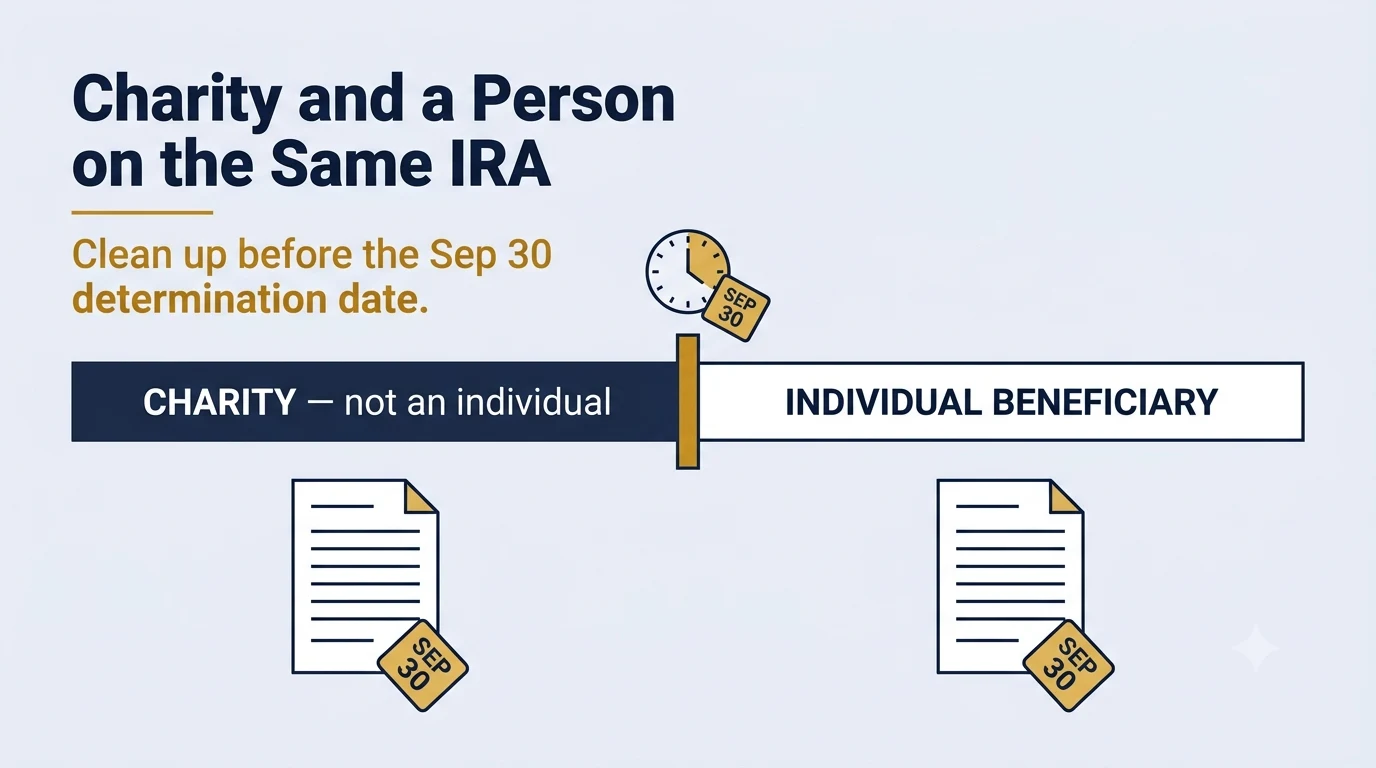
A charity is a beneficiary, but not a designated beneficiary for life-expectancy purposes
Only individuals can be designated beneficiaries under the RMD framework. A charity named directly on an IRA is therefore a non-designated beneficiary. When an IRA names both a charity and an individual, the beneficiary mix can affect which post-death rule applies if the interests are not separated or resolved under the regulatory rules.
Example: 90% adult son, 10% charity
An owner dies naming an adult son for 90% and a charity for 10%. If the charity remains a beneficiary through the September 30 beneficiary determination date, the account cannot simply be analyzed as though the son were the only beneficiary. If the charity’s entire interest is distributed before that date and the regulatory conditions are satisfied, Publication 590-B allows certain beneficiaries who are no longer beneficiaries by the determination date to be disregarded.
Paying the charity is different from changing the beneficiary form after death
The owner’s beneficiary designation controls at death. The post-death rules can disregard a beneficiary in defined circumstances, but surviving beneficiaries cannot casually rewrite the designation. The custodian should document exactly how the charity’s share was allocated and distributed.
Separate-account timing can also matter
When interests remain, establishing separate accounts by the end of the year following death can be important for separate RMD treatment. The September 30 beneficiary determination date and December 31 separate-account date serve different functions and should both be calendared.
- By September 30 of following yearResolve and document which beneficiaries remain for RMD classification.
- By December 31 of following yearComplete any required separate-account steps for separate RMD treatment.
- Before relying on removalConfirm the charity's full interest, including residual assets, was distributed.
Timely separate accounts can protect the individual even if the charity stays
Under the 2024 final regulations, if the individual's interest and the charity's interest are placed in separate accounts established by the end of the year following death, the individual's separate account can be treated as having a designated beneficiary and can use the rule that applies to that person. The charity's separate account follows the non-designated-beneficiary rule. This is often the cleaner fix when fully paying the charity before September 30 is not practical.
If the charity is not removed and no separate accounts are established
The whole account is then analyzed as having a non-designated beneficiary. If the owner died before the required beginning date, the 5-year rule can apply to the entire IRA, including the individual's share. If the owner died on or after that date, the account can be distributed over the owner's remaining single life expectancy. Either outcome is usually less favorable for the individual than a 10-year or life-expectancy result, which is why the September 30 and December 31 steps matter.
Do not use a charitable distribution rule as a substitute
A charity receiving its beneficiary share is not the same transaction as a qualified charitable distribution (QCD) made by an IRA owner or eligible beneficiary. QCD age, direct-payment, and reporting rules address a different tax provision.
First-year workflow
- Obtain the signed beneficiary designation.
- Confirm each percentage and whether the charity is named directly or through a trust.
- Ask the custodian how and when the charity’s share can be distributed.
- Before September 30 of the following year, document which beneficiaries remain.
- Before year end, complete any required separate-account steps.
The percentage paid to charity can be small and still matter
A 1% charitable beneficiary is still a non-individual beneficiary while that interest remains. Do not assume a small percentage is de minimis for beneficiary classification. Resolve the interest under the actual beneficiary-determination and separate-account rules.
A charity may have its own processing timeline
Large charities often require estate paperwork, tax identification confirmation, and their own beneficiary claim forms before accepting retirement assets. If the goal is to complete the charity’s payout before the September 30 determination date, contact the organization early rather than assuming the custodian can send funds immediately.
Separate the estate-planning intent from post-death tax mechanics
The owner may have intentionally used the IRA for a charitable bequest. Post-death beneficiaries should not alter that intent merely to seek a different RMD outcome. The job is to administer the valid designation and understand the resulting tax rule.
Confirm the charity’s interest is actually complete before the determination date
If residual dividends, cash, or a fractional position remains allocated to the charitable share, the interest may not be fully paid. Obtain a closing statement or custodian confirmation showing the charity’s entitlement has been completely distributed before treating that beneficiary as removed from the RMD analysis.