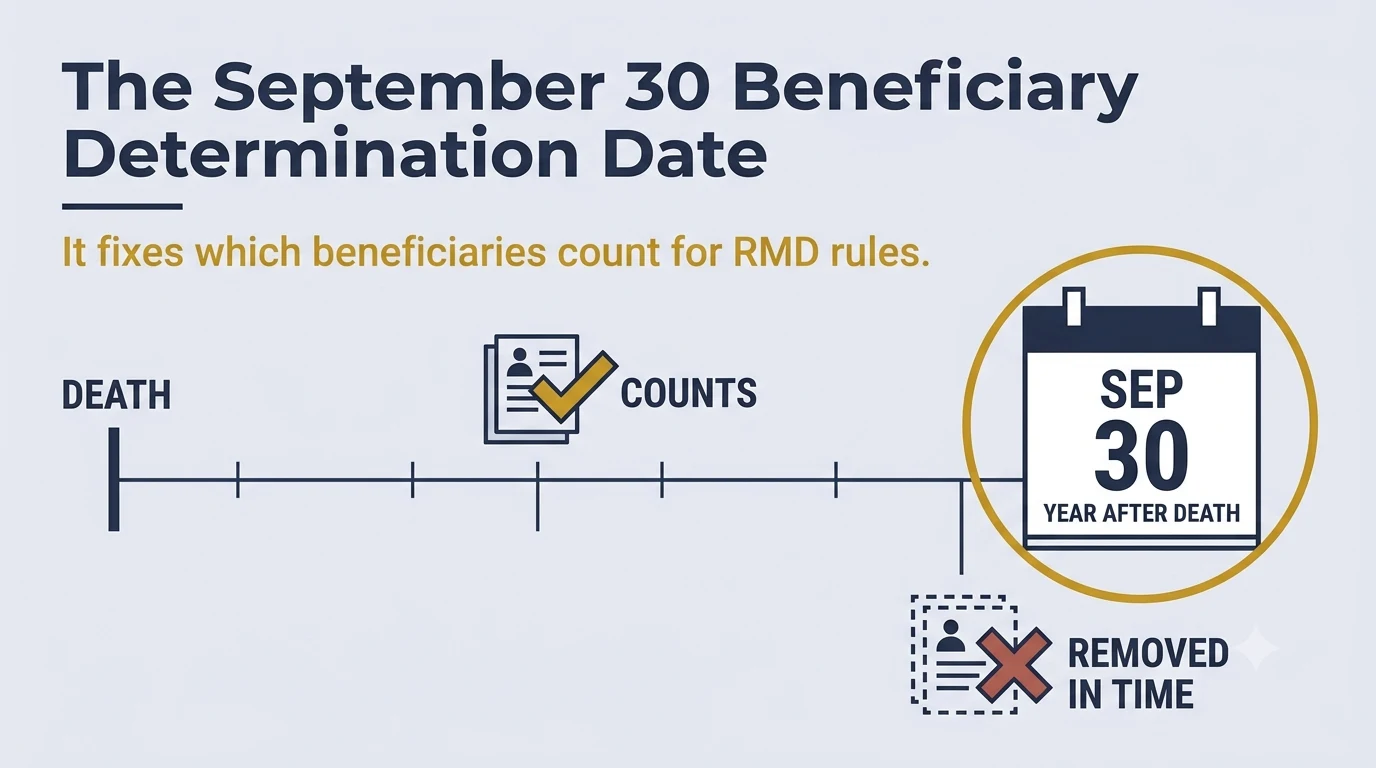
The beneficiary list at the date of death is not always the final RMD list
Publication 590-B uses a beneficiary determination date of September 30 of the calendar year following the owner’s death for post-death RMD purposes. Certain beneficiaries who are removed by that date—for example, through a qualifying disclaimer or by receiving the entire benefit—can be disregarded when determining the beneficiaries for the distribution rules.
Example: owner dies in 2026
If the IRA owner dies in 2026, the beneficiary determination date is September 30, 2027. That date is different from the year-10 distribution deadline and different from the separate-account deadline that can fall at the end of the year following death.
| Date | Function |
|---|---|
| Date of death | Starts the post-death analysis |
| September 30, 2027 | Beneficiary determination date in this example |
| December 31, 2027 | Common deadline relevant to establishing separate accounts for RMD treatment |
| December 31 of year 10 | Final cleanout deadline if the 10-year rule applies |
“Removed” must be real, not just an agreement among family members
A beneficiary is not disregarded merely because siblings privately agree that one person will not take the IRA. The IRS rules look to actual legal and account events, such as a valid disclaimer or complete distribution of that beneficiary’s interest by the determination date.
Why charities and estates can complicate the analysis
If an IRA names both individuals and a non-designated beneficiary such as a charity or estate, the presence or removal of that interest by the beneficiary determination date can affect whether the remaining group is treated as having a designated beneficiary. This is a fact-specific area where the exact beneficiary form and post-death actions matter.
Do not treat September 30 as a universal disclaimer deadline
The RMD beneficiary-determination date is not a substitute for state-law or federal qualified-disclaimer deadlines. A disclaimer has its own legal requirements. This guide explains only the RMD effect of whether a beneficiary is taken into account by the IRS determination date.
The date can only remove beneficiaries, not add them
The determination date narrows the group that existed at death. It does not bring in anyone who was not a beneficiary when the owner died. A contingent beneficiary who moves up because a primary beneficiary disclaims was already in the beneficiary chain; a person with no interest under the designation on the date of death is not added just because the family would prefer it. This is why the beneficiary designation in force at death is the starting document for the whole analysis.
The determination date removes beneficiaries who existed at death; it does not bring in anyone who was not a beneficiary then. The beneficiary designation in force at death is the starting document.
Do not let the September 30 date delay the year-of-death RMD
If the owner died on or after the required beginning date, the owner's final-year RMD is still due by December 31 of the year of death—months before the following-September determination date. Beneficiaries should finish that owner RMD on the normal schedule and treat the September 30 analysis as a separate step about classification, not a reason to wait.
Document the beneficiary picture on both dates
- Save the beneficiary designation in force at death.
- Save any disclaimer, payout, or settlement documents.
- Ask the custodian for a written list of interests remaining on September 30 of the following year.
- Keep later separate-account confirmations.
Complete payout can remove a beneficiary from the RMD determination even without a disclaimer
Publication 590-B recognizes that a beneficiary who receives the entire benefit to which that person is entitled before the September 30 determination date can be disregarded for identifying the remaining beneficiaries. That can matter when an IRA includes a small charity share or another beneficiary whose interest can be fully paid promptly.
The custodian’s processing date matters more than an unsigned intention
If a beneficiary plans to be paid out before September 30, start early enough for valuation, liquidation, and distribution to finish. A request submitted September 29 but completed in October may not produce the intended beneficiary-determination result.
Keep the September 30 snapshot as a permanent tax record
Create a one-page record listing every beneficiary still holding an interest on that date, the percentage or trust interest, and supporting account documents. Later RMD calculations often depend on this historical snapshot long after the original custodian correspondence is hard to retrieve.