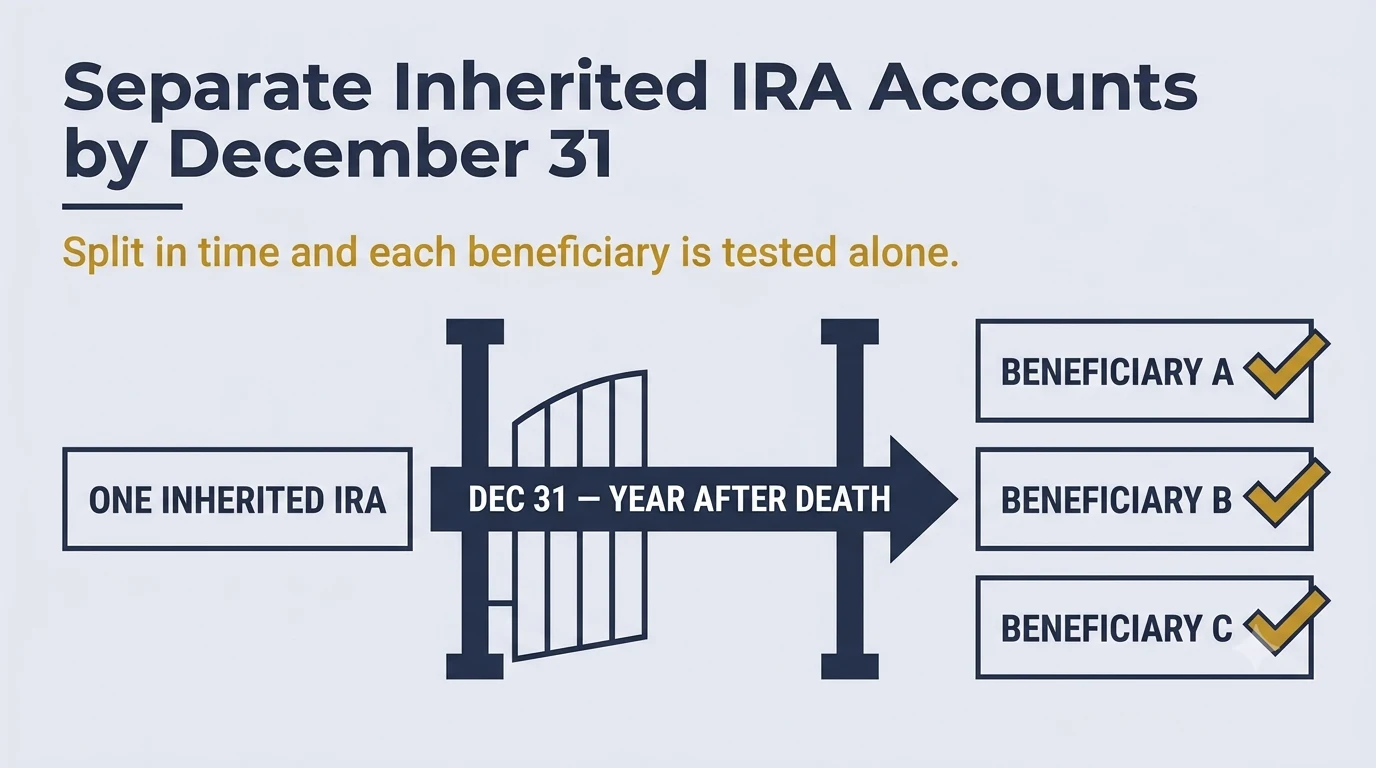
December 31 of the following year is a tax-law boundary, not just a custodian target
Publication 590-B says separate inherited accounts generally stop being combined for post-death RMD purposes when the separate accounts are established by the end of the calendar year following the owner’s death. The 2024 final regulations go further by describing what happens when the separate-account requirements are satisfied only after that deadline.
What “separate account” requires
Formal account numbers alone are not the whole test. The final regulations require separate accounting so that post-death distributions are allocated to the beneficiary receiving them, and pre-separation gains, losses, contributions, forfeitures, and expenses are allocated among the separate interests in a reasonable and consistent way. Investment-only segregation or spreadsheet columns may not establish the required separate-account treatment.
Example timeline: owner dies in 2026
| Date | What it controls |
|---|---|
| September 30, 2027 | General beneficiary-determination date |
| December 31, 2027 | Deadline for timely separate-account treatment |
| After December 31, 2027 | A later split may still occur administratively, but the late-account rules apply for RMD purposes |
Late separation does not simply “fix everything going forward”
Under the final regulations, if qualifying separate accounts are not established until after the end of the calendar year following death, the aggregate required distribution for later years is still determined without using the ordinary separate-account rule. The aggregate amount is then allocated among beneficiaries according to each beneficiary’s share of the total remaining balance, and each allocated share must be distributed to that beneficiary.
That is a much more specific consequence than saying a late split is merely “less convenient.” It can preserve an aggregate RMD calculation even after separate account numbers eventually exist.
Why timely separation can matter when beneficiaries are different
Multiple beneficiaries may have different ages, EDB classifications, withholding preferences, and distribution schedules. Timely separate-account treatment can allow section 401(a)(9) to apply separately to each beneficiary’s interest, subject to the applicable rules. A late administrative split may not produce the same RMD result.
Three adult children: what to finish before the deadline
Assume a parent dies in 2026 naming three adult children 50%/30%/20%. Before December 31, 2027, the custodian should have completed the formal inherited-account division and the records should show how post-death activity was allocated to the three shares. The percentages should come from the governing beneficiary designation and valid post-death events—not from an informal family agreement.
One beneficiary’s delay can create group-level consequences
Identity verification, medallion guarantees, trust documents, or transfer paperwork can delay the entire division. Because the tax-law deadline is not the custodian’s processing deadline, beneficiaries should ask the custodian months in advance what documents must be completed for the separate accounts to be established by year end.
Trusts do not automatically get the ordinary separate-account result
The final regulations generally do not apply section 401(a)(9) separately to the individual interests of beneficiaries of a see-through trust, except for specified trust structures such as certain trusts divided immediately at death. Creating subaccounts on the custodian’s system is not enough by itself to bypass the trust rules.
Resolve disclaimers before splitting, not after
Three dates cluster in the year after death: the nine-month federal disclaimer window (measured from the death), the September 30 beneficiary-determination date, and the December 31 separate-account deadline. If any beneficiary is considering a disclaimer, that has to be completed first, because it changes who the shares belong to. Splitting the account into shares that a later disclaimer then rearranges creates avoidable rework and can muddy the allocation records.
Set an internal deadline well before December 31
Custodian processing for a multi-beneficiary division routinely takes weeks: beneficiary claim forms, identity verification, medallion signature guarantees, and sometimes trust or court documents. Treat roughly 60 to 90 days before year end as the real cutoff. Ask the custodian in writing for its list of required documents and its expected processing time, and get written confirmation once the separate inherited accounts are actually established—not just submitted.
- Within nine months of deathThe federal disclaimer window, measured from the death. Finish any disclaimer before splitting.
- September 30 of the next yearBeneficiary-determination date.
- 60 to 90 days before December 31Treat this as the real cutoff for custodian paperwork on a multi-beneficiary division.
- December 31 of the next yearTax-law deadline for establishing timely separate accounts.
The original death year never changes
Timely separation can change how beneficiary interests are administered, but it does not create a new date of death or restart a 10-year period. Every resulting inherited account should retain the original owner’s death year and the applicable full-distribution deadline.
Deadline file checklist
- Beneficiary designation and percentages.
- September 30 beneficiary-determination analysis.
- Custodian confirmation that separate inherited accounts were established by December 31 of the following year.
- Allocation of post-death distributions to the beneficiary who received them.
- Allocation method for gains, losses, and expenses before the split.
- Original death year and year-10 deadline on each resulting account file.