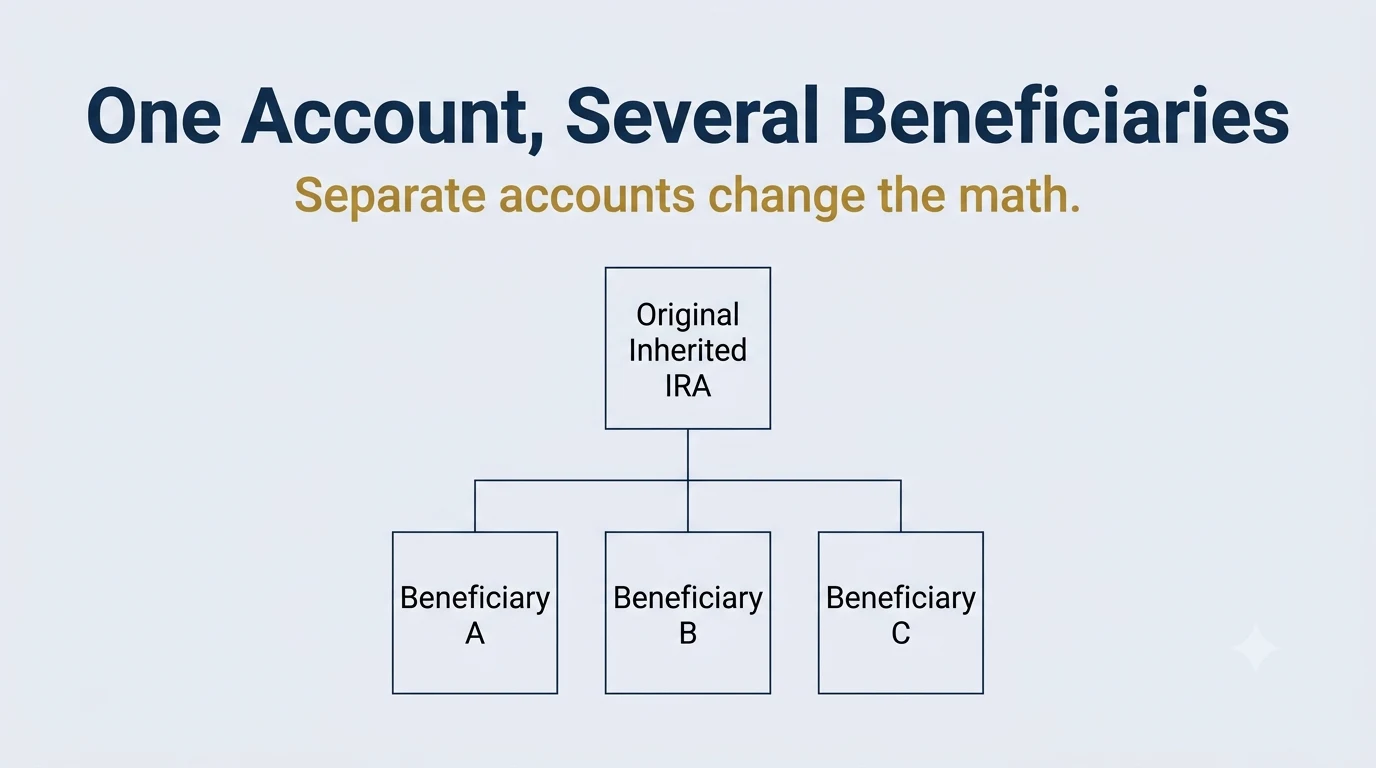
One inherited IRA can create several sets of facts
When multiple people are named on one IRA, each person may have a different age, tax situation, and possibly a different beneficiary classification. Separate inherited accounts do not change the owner’s date of death, but they can make each beneficiary’s share and distributions easier to administer.
Publication 590-B includes a separate-account deadline
The publication explains that separate accounts or shares generally are combined for RMD purposes after death unless the separate accounts are established by the end of the year following the year of the IRA owner’s death. Once the separate-account rules apply, each beneficiary’s interest can be administered separately for RMD purposes subject to the rules that govern that beneficiary.
Do not confuse “separate account” with a new inheritance date
Splitting an account does not create ten new years. If the original owner died in 2025, a beneficiary subject to the 10-year rule still measures the outer deadline from that 2025 death even if the beneficiary’s separate inherited account is opened in 2026.
- Owner dies in 2025This is the death year for the separate-account deadline.
- By end of 2026The example's separate inherited shares are established by this time.
- December 31, 2035An ordinary beneficiary's ten-year deadline still follows the 2025 death.
The publication's timing rule uses the year after the owner's death; a split does not reset a beneficiary's deadline.
Trust beneficiaries have additional restrictions
Publication 590-B warns that the ordinary separate-account rule is not available in the same way for trust beneficiaries unless the trust is an applicable multi-beneficiary trust. A trustee dealing with a see-through trust should not assume individual-account rules automatically carry over.
Why beneficiaries often prefer administrative separation
- Each beneficiary can see the balance attributable to that person.
- Distributions and tax forms are less likely to be mixed.
- One beneficiary’s timing choice is less likely to force an operational decision for another.
- Custodian records can more clearly show each inherited account’s registration.
Where separation changes the result, not just the paperwork
The clearest case is a mix of beneficiary types. If one beneficiary is an eligible designated beneficiary—a disabled sibling, or a beneficiary not more than 10 years younger than the owner—and the others are ordinary designated beneficiaries, timely separate accounts can let the EDB use life-expectancy payments while the others use the 10-year rule. Without a timely split, the whole account is generally tested as if there were no EDB, and everyone lands on the less favorable schedule.
A timely split can matter when beneficiaries fall into different categories.
Separation does not multiply the year-of-death RMD
If the owner died on or after the required beginning date, the owner's final-year RMD is a single obligation for that IRA. Splitting the account into three inherited shares does not create three year-of-death RMDs. The remaining unpaid amount can be distributed from any one share or spread across them, as long as the total is completed by December 31 of the year of death.
Get the custodian’s deadline in writing
Custodians have processing timelines, signature requirements, and transfer procedures. A beneficiary who wants separate accounts should start well before the tax-law deadline rather than submitting paperwork at year-end.
Example: three adult children
Assume an owner dies in 2025 naming three adult children equally. If the custodian establishes three separate inherited shares by the end of 2026 and the separate-account rule is satisfied, each child can generally administer the child’s own inherited share under the rules that apply to that beneficiary. The ten-year deadline for an ordinary designated beneficiary still runs to December 31, 2035.
Why one beneficiary’s distribution should not be treated as everyone’s
Before separation, a distribution from the shared inherited account can complicate allocation and recordkeeping. Beneficiaries should confirm how the custodian attributes distributions among shares and whether each beneficiary receives separate tax reporting. This is especially important if one beneficiary wants cash immediately and another wants to retain assets.
- Ask the custodian for its processing timeline and signature requirements.
- Get the custodian's deadline for establishing separate accounts in writing.
- Confirm how distributions from a shared account are allocated before separation.
- Ask whether each beneficiary will receive separate tax reporting.
- Confirm whether a trust is involved before relying on the ordinary separate-account rule.
- Keep the original owner's death date attached to each inherited share's records.
Disclaimers can change who is counted as a beneficiary
Publication 590-B notes that the designated beneficiary is generally determined as of September 30 of the calendar year following the year of death, and a person who properly disclaims or receives the entire benefit before that date may not be taken into account in the same way. Beneficiary changes after death can therefore affect the classification analysis; they should be handled with legal guidance rather than improvised transfers.
Separate accounts do not cure an invalid beneficiary designation
If the estate or a trust is the actual beneficiary under the account documents, simply opening accounts in the names of family members does not necessarily convert them into designated beneficiaries. The beneficiary designation and applicable trust rules must be resolved first.