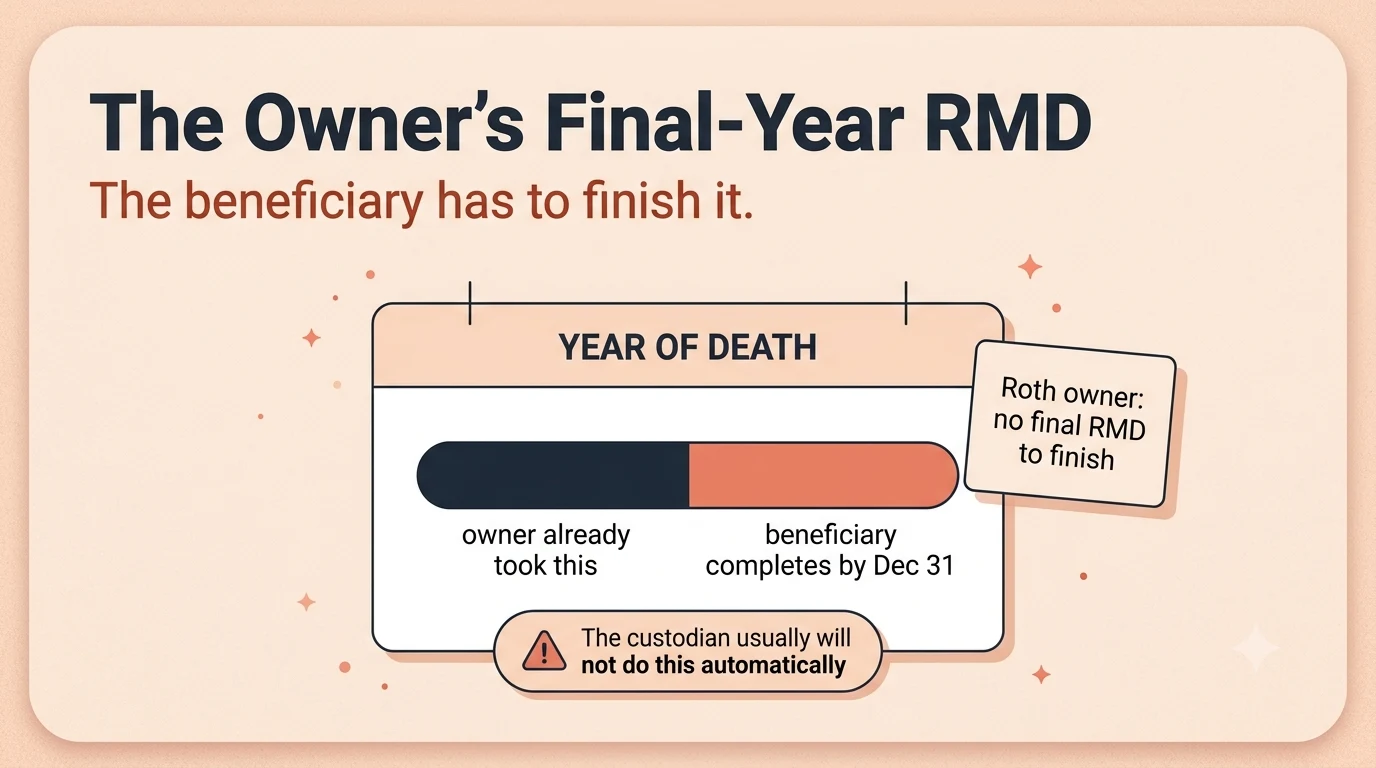
The owner’s final RMD does not disappear at death
If an IRA owner dies on or after the required beginning date, Publication 590-B says the beneficiaries are responsible for figuring and distributing the owner’s RMD for the year of death to the extent it had not already been distributed. The final regulations likewise state that an RMD is due for the calendar year of the owner’s death.
If the owner died before the required beginning date, there is no owner year-of-death RMD. That first fork should be resolved before looking for a shortfall.
Figure the year-of-death RMD as though the owner lived the entire year
Publication 590-B instructs beneficiaries to calculate the year-of-death RMD as if the owner had lived for the whole calendar year. For most IRA owners, the applicable lifetime denominator comes from the Uniform Lifetime Table. If the sole beneficiary is the owner’s spouse and the spouse is more than 10 years younger, the Joint and Last Survivor Table can apply instead.
The beneficiary then subtracts qualifying distributions the owner already received during the year. The result is the amount still left to be distributed for the owner’s final lifetime RMD.
Late-year deaths require transaction-level review
An October, November, or December death can create an administrative race because family members may not know what the owner already received. The beneficiary should obtain year-to-date transaction history rather than rely on the latest paper statement.
Recurring monthly withdrawals, one-time distributions, qualified charitable distributions, and distributions from other IRAs can affect whether the owner’s RMD was already satisfied. The review should identify actual settlement or payment dates and not just pending instructions.
Example: the owner had already taken part of the RMD
Assume the owner’s 2025 RMD was $24,000 and $15,000 of qualifying distributions had been completed before the owner died in October. The remaining owner year-of-death RMD is $9,000. The beneficiary does not owe another $24,000 simply because the owner died; the task is to finish the unpaid portion.
The beneficiary’s own post-death RMD schedule is a separate calculation beginning with later years.
- Use the full-year owner calculationCalculate as though the owner lived for the entire calendar year.
- Collect year-to-date transaction historyInclude completed qualifying payments, not pending instructions.
- Subtract qualifying distributionsThe remainder is the amount still due for the owner.
- Keep later beneficiary RMDs separateThe beneficiary schedule is a different calculation.
The owner’s RMD and the beneficiary’s first RMD should be separate spreadsheet rows
The year-of-death amount belongs to the deceased owner’s lifetime RMD calculation. The next year’s beneficiary RMD, when one is required, uses post-death life-expectancy rules and a different year-end balance.
Combining the two into one “inherited IRA RMD” number makes it easier to double count a distribution, use the wrong denominator, or mistakenly think the owner’s final RMD satisfied the beneficiary’s first post-death minimum.
Multiple IRA beneficiaries need evidence that the total owner RMD was completed
If an account is divided among several beneficiaries, the owner still had one unpaid year-of-death obligation for that IRA. Custodians can process the remaining amount across beneficiary shares in different ways. Each beneficiary should keep written confirmation of what was distributed and how the custodian treated it.
Where the owner had multiple IRAs, lifetime IRA aggregation rules may also affect whether distributions from another IRA had already satisfied part of the owner’s RMD before death. The beneficiary should reconstruct the owner’s complete year-to-date IRA distribution picture when the amounts are material.
Roth IRA owners do not have a lifetime Roth RMD to finish
Original Roth IRA owners have no lifetime Roth IRA RMD. There is therefore no owner year-of-death Roth IRA RMD to complete. Beneficiary distribution rules start after death and can still include a 10-year full-distribution requirement.
This is a simple example of why “the decedent had an IRA” is not enough information; the account type changes the year-of-death analysis.
Employer plans should be checked before any direct transfer
For an inherited 401(k) or other qualified plan, the plan administrator controls the plan’s distribution and transfer process. RMD amounts are not eligible rollover distributions. If the participant had an unpaid year-of-death RMD, identify that amount before directing the eligible remainder to an inherited IRA.
A transfer packet that moves the entire plan balance without first addressing the required amount can create reporting and correction problems.
A late-year workflow that is easier to audit later
- Confirm whether the owner died before or on/after the required beginning date.
- Obtain the prior-year December 31 balance and the table used for the owner’s lifetime RMD.
- Collect all year-to-date IRA or plan distributions that count toward the owner’s RMD.
- Calculate the unpaid remainder.
- Aim to complete the remaining year-of-death RMD by December 31, the normal statutory deadline.
- Keep the calculation separate from the beneficiary’s post-death RMD file.
A special automatic-waiver rule can matter when the death-year RMD is missed
The 2024 final regulations include an automatic excise-tax waiver for a missed RMD in the calendar year an individual dies if the beneficiary takes the corrective distribution within the special deadline. The corrective distribution generally must be taken by the later of the beneficiary’s tax-return filing deadline, including extensions, for the taxable year beginning with or within the calendar year of death, or the last day of the following calendar year.
This relief does not change the original December 31 RMD due date. It changes the excise-tax consequence when the required amount was not completed on time and the beneficiary corrects it within the regulatory window. A late-year beneficiary should therefore distinguish three dates in the file: the original year-end due date, the actual corrective-distribution date, and the deadline for the automatic waiver.
Any one beneficiary can satisfy the whole owner RMD
When an IRA has several beneficiaries, the owner's unpaid final-year RMD is one amount for that account. The final regulations do not require it to be split among the beneficiaries in proportion to their shares. The beneficiaries can agree that one person takes the entire remaining owner RMD, and that satisfies the requirement for the account. Whoever takes it reports it as income and receives the Form 1099-R, so the beneficiaries usually reconcile that among themselves.
The custodian's default is often to do nothing
Many custodians will not calculate or automatically distribute a deceased owner's final-year RMD. The account simply sits until the beneficiary opens an inherited account and asks. A beneficiary who assumes the institution is handling it can miss the December 31 deadline without any warning. Make the first call to the custodian include a direct question: was the owner's RMD for this year completed, and if not, what is the remaining amount.
- Ask whether the owner's RMD for this year was completed.
- Request the year-to-date distribution history and gross amounts.
- Ask what unpaid amount remains and how it will be reported.
- For a shared inherited account, confirm how a payment is allocated.
- Save the calculation separately from the beneficiary's later RMD worksheet.
Why this small task can have an outsized penalty consequence
A beneficiary focused on setting up the inherited account can easily overlook the owner’s final RMD, especially when death occurs near year-end. If a required amount is missed and the special automatic waiver does not apply, Form 5329 and the excess-accumulation rules can become relevant. The cleanest prevention is still to make “year-of-death RMD completed?” a mandatory item in the first beneficiary review.