Calculate first, aggregate only where the IRS permits it
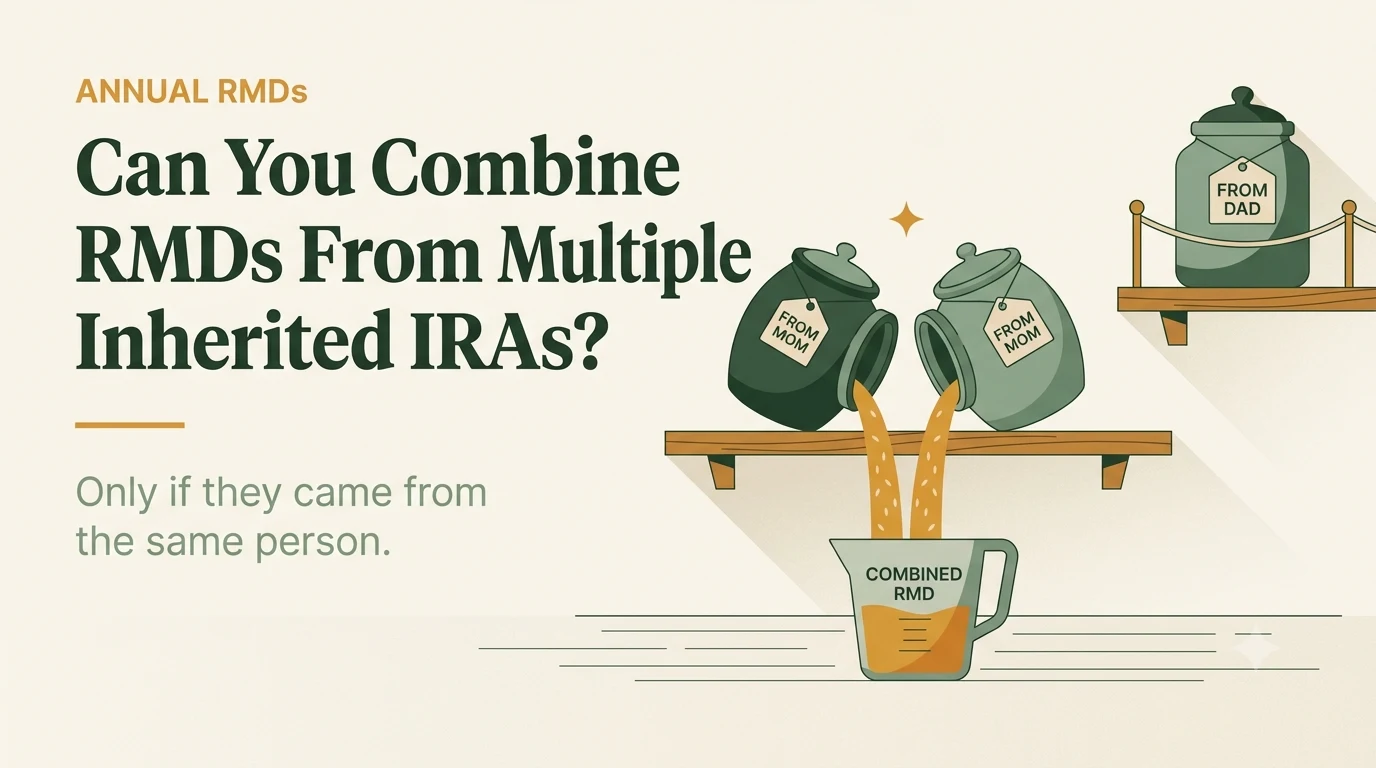
Form 5329 instructions explain that RMDs are generally figured separately for each IRA. For inherited IRAs, distributions can be combined to satisfy RMDs only under limited rules. One key condition is that the inherited IRAs come from the same decedent.
Same decedent versus different decedents
If a beneficiary inherited two IRAs from the same parent, the beneficiary may be able to use distributions from one inherited IRA to satisfy the combined RMD amount for inherited IRAs from that same decedent, subject to the applicable rules. An inherited IRA from Parent A cannot simply be used to satisfy an RMD on an inherited IRA from Parent B.
Inherited Roth IRAs have their own aggregation rule
The Form 5329 instructions separately state that withdrawals from Roth IRAs inherited from the same decedent can be combined to satisfy the RMD requirement for those inherited Roth IRAs. Traditional inherited IRAs and inherited Roth IRAs should not be casually mixed in one calculation.
Employer plans are stricter
Qualified retirement plans generally cannot aggregate RMDs. The required amount must be figured for each plan and withdrawn from that plan. This is one practical difference between managing inherited IRAs and leaving inherited assets inside multiple employer plans.
403(b) accounts have a specific aggregation exception
The Form 5329 instructions note a special rule for a person with more than one 403(b) tax-sheltered annuity account: the required amounts may be totaled and taken from one or more of the 403(b) accounts. That exception should not be generalized to 401(k) plans, which generally must satisfy the RMD from the specific plan.
Where inherited 403(b) accounts are involved, confirm the beneficiary and plan rules before applying the exception because employer-plan administration can differ from IRA administration.
| Account group | Can distributions be combined? | Boundary |
|---|---|---|
| Inherited traditional IRAs | May be allowed for accounts from the same decedent | Different decedents cannot simply be combined |
| Inherited Roth IRAs | Same-decedent inherited Roth withdrawals may be combined | Keep traditional and Roth calculations separate |
| Qualified plans | Generally no | Each plan's RMD is paid from that plan |
| 403(b) accounts | A specific aggregation exception exists | Do not generalize it to 401(k) plans |
Keep a decedent-by-decedent worksheet
A beneficiary who has inherited from more than one person should maintain a separate RMD worksheet for each decedent. The worksheet should show account numbers, prior-year balances, required amounts, distributions credited, and the year-10 deadline if applicable. That structure reduces the risk of using a distribution from the wrong inherited account to satisfy another obligation.
Example: two inherited traditional IRAs from one parent
Suppose a beneficiary has two inherited traditional IRAs from the same mother, and both use compatible beneficiary RMD rules. The RMD is calculated for each inherited IRA, and IRS aggregation rules may allow the combined required amount to be withdrawn from one or both inherited IRAs from that same decedent. The beneficiary should preserve the separate calculations even if the cash comes from only one account.
Example: one IRA from each parent
If the beneficiary also inherited an IRA from the father, that account has a different decedent and its RMD cannot simply be satisfied with a distribution from the mother’s inherited IRA. Each decedent has a separate death date, deadline, and RMD history.
Do not apply IRA aggregation rules to 401(k)s
A qualified plan RMD generally must come from that specific plan. A beneficiary cannot take extra money from an inherited IRA and use it to satisfy an inherited 401(k)’s minimum distribution merely because both came from the same person.
Aggregation is per beneficiary — a co-beneficiary's withdrawals do not count for you
The rule lets one beneficiary combine that beneficiary's own inherited IRAs from a single decedent. It does not let two siblings pool their separate inherited shares. If a parent's IRA is split into an inherited IRA for each of two children, each child calculates and satisfies their own RMD from their own account. A large withdrawal by one sibling does nothing for the other sibling's requirement.
If there is no annual RMD, there is nothing to aggregate
Aggregation only matters in years when an annual RMD actually exists. An ordinary designated beneficiary whose owner died before the required beginning date has no annual RMD in years 1 through 9 under the 10-year rule, so the aggregation question does not arise until the final year, when the entire remaining balance of each inherited account has to be distributed anyway.
Why a worksheet should show source account even when aggregation is allowed
Tax forms and custodian statements still report distributions by account. Recording which inherited IRA produced the cash allows a preparer to reconcile Forms 1099-R, verify that the total RMD was satisfied, and maintain the correct basis or Roth information for each account.
- Make a separate worksheet for each decedent.
- List each account's prior-year balance and required amount.
- Record which account paid each distribution.
- Keep each beneficiary's share and tax form separate.
- Confirm an annual RMD exists before considering aggregation.