The answer can be yes or no
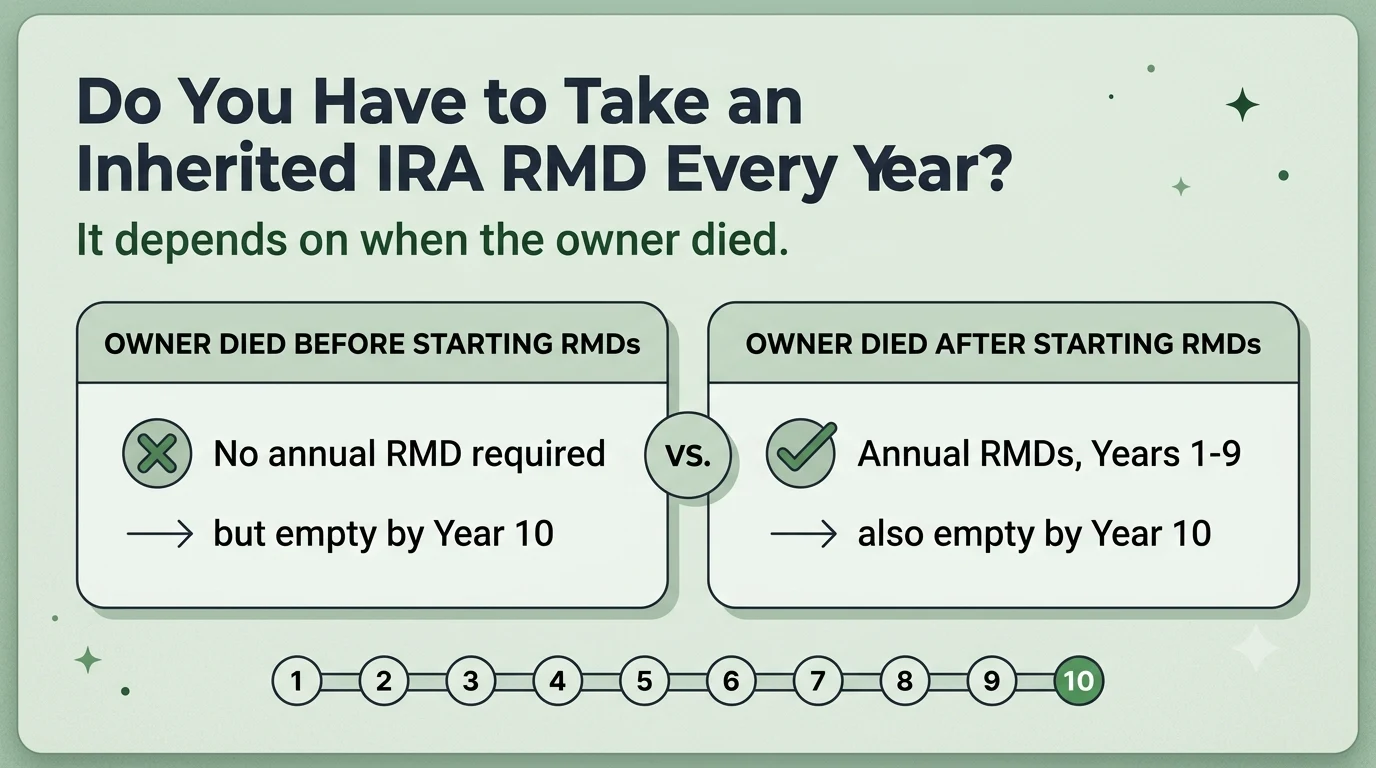
Two inherited accounts can both be subject to the 10-year rule and still have different requirements in years 1 through 9. The dividing line is the original owner’s required beginning date. That date is the point at which the owner was required to start lifetime RMDs under the applicable rules.
Owner died before the required beginning date
If a designated beneficiary is subject to the 10-year rule and the owner died before the required beginning date, Publication 590-B says no distribution is required for a year before the tenth year solely because of that 10-year rule. The account must still be fully distributed by the end of the tenth calendar year after the year of death.
This gives the beneficiary timing flexibility, but it does not make tax planning automatic. A large traditional IRA left untouched for nine years could create a very large taxable distribution in year 10. The law permits timing flexibility in this branch; it does not promise that waiting is tax-efficient.
Owner died on or after the required beginning date
If the owner died after RMDs had already begun, the final regulations generally require continued annual distributions to a non-eligible designated beneficiary while the 10-year clock is running. The account also must be fully emptied by the end of year 10. These are two simultaneous constraints, not alternatives.
The annual RMD is not a simple equal division over ten years. When the owner died on or after the required beginning date and there is a designated beneficiary, Publication 590-B directs the beneficiary to use the longer of the beneficiary’s single life expectancy and the owner’s remaining life expectancy. In regulatory terms, the calculation uses the greater applicable denominator. The beneficiary’s initial life expectancy is generally measured using the beneficiary’s age in the calendar year after death; the owner-side life expectancy begins with the owner’s age in the year of death. Each is then reduced under the post-death rules for later years.
That distinction matters when the beneficiary is older than the owner. In that case, the owner’s remaining life expectancy can produce the larger denominator and therefore the smaller annual minimum. A custodian may supply the calculation, but the beneficiary should keep the age inputs, prior-year balance, and denominator rather than saving only the final dollar amount.
| Owner's status | Before required beginning date | On or after required beginning date |
|---|---|---|
| Annual payments in years 1 through 9 | No distribution solely under the 10-year rule | Annual beneficiary RMDs generally continue |
| Final deadline | Empty the account by the end of year 10 | Empty the account by the end of year 10 |
| How to plan | Timing is flexible, but year-10 tax impact can be large | Track annual RMDs and separately review the final balance |
The owner's required beginning date changes annual payments; the year-10 deadline still applies.
Three facts to get in writing
- The date of death and the owner’s age/date of birth.
- Whether the custodian or former plan treated the owner as having reached the required beginning date.
- The year-end account balance used for any beneficiary RMD calculation.
These facts are more useful than asking a custodian only, “Am I under the 10-year rule?” because that single label does not resolve the annual-RMD issue.
How to tell whether the owner had reached the required beginning date
Do not use a rough memory such as “Dad was in his seventies, so he must have been taking RMDs.” The required beginning date changed under recent retirement legislation, and employer plans can have retirement-related timing rules that differ from IRAs. Use the owner’s date of birth, account type, employment status where relevant, and actual plan or IRA records.
For an IRA, prior-year Forms 1099-R and custodian statements may show that lifetime RMDs had begun, but the absence of a distribution does not prove that no RMD was required. The legal date should be determined from the applicable rule for the owner’s year and account.
How this question was unsettled for four years
The SECURE Act passed in late 2019. The IRS's proposed regulations in early 2022 surprised practitioners by requiring annual RMDs inside the 10-year period when the owner died after the required beginning date—most commentary had assumed the 10-year rule replaced annual RMDs entirely. The IRS then waived the penalty for missed annual RMDs for 2021 through 2024 while it finalized the rules. The final regulations, effective for 2025, adopted the proposed position. A beneficiary reading pre-2024 guidance may see a flat statement that no annual RMD is required; that is no longer correct for a post-required-beginning-date death.
- Late 2019The SECURE Act passes.
- Early 2022Proposed regulations say annual RMDs continue in the 10-year period after an on-or-after-date death.
- 2021 through 2024The IRS waives penalties for missed annual RMDs while it finalizes the rules.
- 2025Final regulations take effect and adopt the proposed position.
The article traces the debate from the SECURE Act through the final regulations.
The at-least-as-rapidly principle is the reason
The underlying tax-code requirement is that after a death on or after the required beginning date, distributions must continue at least as rapidly as the method in effect at death. The owner was taking annual RMDs; the beneficiary keeps taking them. The 10-year rule adds an outer deadline on top of that requirement rather than switching it off. That is why the debate resolved the way it did.
An annual RMD does not satisfy the year-10 requirement by itself
A common operational mistake is to take only the custodian-computed annual minimum for nine years and assume the account will naturally reach zero. It may not. Investment growth can leave a substantial balance, and the annual life-expectancy calculation was not designed to guarantee that the account is empty by the tenth-year deadline. The final year therefore needs its own balance review.
What to do when two institutions give different answers
If an inherited account has moved between custodians, the receiving institution may not have every historical fact. Ask each institution to state the assumption behind its answer. Then compare the answer with Publication 590-B and the final regulations. The most useful written response is one that identifies the owner’s required beginning date, beneficiary category, prior-year balance, and denominator used.
- Ask each institution to state the assumptions behind its answer.
- Compare each answer with Publication 590-B and the final regulations.
- Request the owner's required beginning date in writing.
- Have the response identify the beneficiary category and prior-year balance.
- Ask which denominator the institution used.
Transition relief should be documented, not guessed
For affected 2021–2024 distributions, Notice 2024-35 and earlier notices can matter. Keep a copy of the notice or tax-adviser explanation in the account file if a historical year was treated as relieved. That prevents a later reviewer from assuming a missing distribution was simply overlooked.