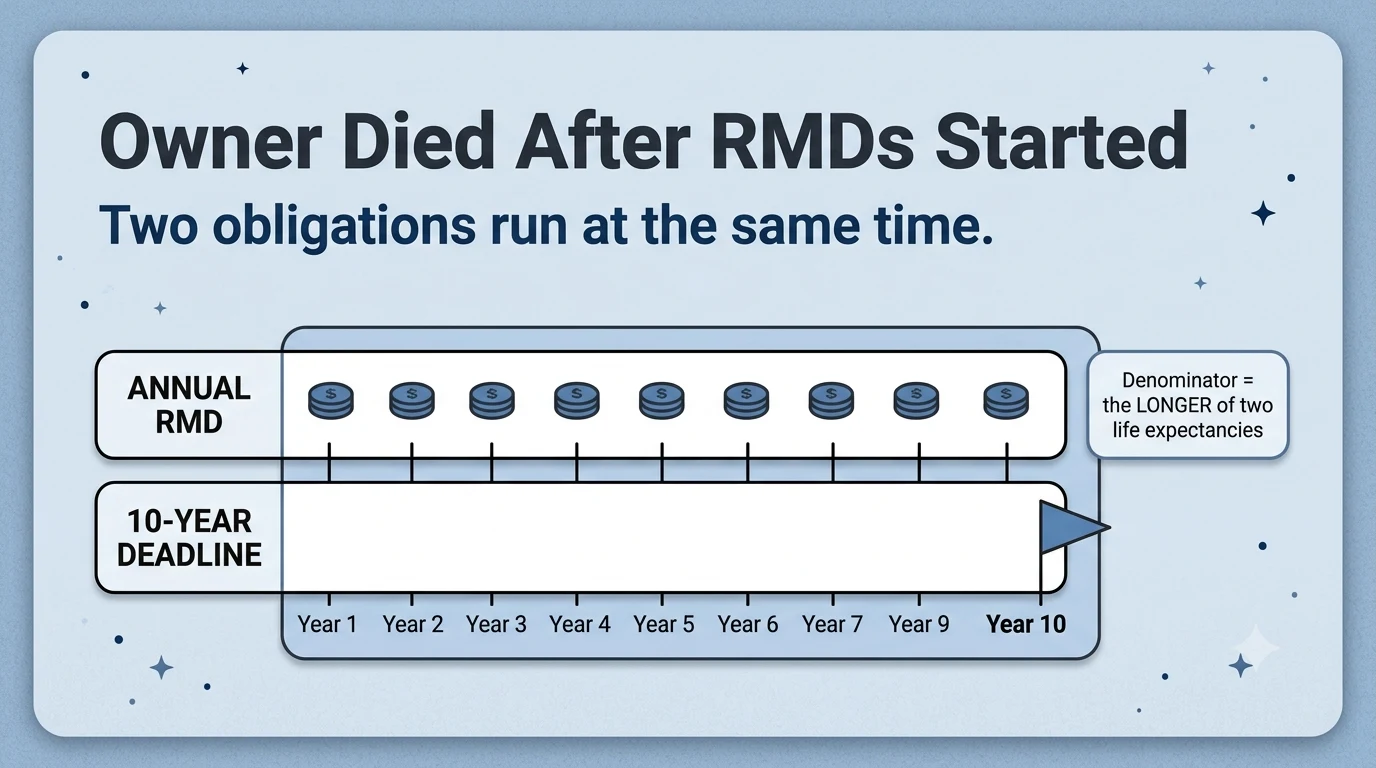
The post-death rule has two simultaneous requirements
When an IRA owner dies on or after the required beginning date, the annual-distribution rule does not stop merely because a non-spouse beneficiary is also subject to the SECURE Act 10-year rule. The tax code requires distributions to continue at least as rapidly as the method in effect at death, and the owner was already taking annual RMDs. For an ordinary designated beneficiary, the practical result is two separate obligations: calculate and take a beneficiary RMD for each applicable year after death, and fully distribute the remaining inherited account by the end of the calendar year containing the tenth anniversary of the owner’s death.
Those obligations should be tracked separately. A beneficiary can satisfy every annual RMD and still leave too much in the account for the year-10 deadline. Conversely, taking a large voluntary distribution does not eliminate the need to calculate the next year’s RMD under the rules then in effect.
The annual denominator is the longer of two life expectancies
Publication 590-B states that, when the owner died on or after the required beginning date and there is a designated beneficiary, post-death RMDs are based on the longer of the beneficiary’s single life expectancy or the owner’s remaining life expectancy. The 2024 final regulations express this as the greater of the two applicable denominators.
- Beneficiary side: for a non-spouse designated beneficiary, the initial life expectancy is generally determined from the Single Life Table using the beneficiary’s age in the calendar year following the owner’s death, then reduced by one for each later calendar year.
- Owner side: the owner’s remaining life expectancy is initially determined using the owner’s age in the year of death, then reduced by one for each later calendar year.
Using the greater denominator matters most when the beneficiary is older than the deceased owner. It can be wrong to assume the beneficiary’s age always controls.
The year-of-death RMD is a different calculation
If the owner had an RMD for the year of death and had not completed it before dying, the beneficiary is responsible for making sure that remaining owner RMD is distributed in the year of death. Publication 590-B says the year-of-death RMD is figured as though the owner lived for the entire year.
That amount is not the beneficiary’s first post-death RMD. The owner-side lifetime RMD uses the owner’s lifetime table and the balance relevant to that year. The beneficiary’s post-death schedule begins with the next calendar year and uses the post-death denominator rules described above.
- Check the owner's year-of-death RMDFind any unpaid amount for the year of death.
- Start the beneficiary calculation next yearCompare the beneficiary and owner life-expectancy tracks when required.
- Track the annual minimumUse the applicable denominator and prior-year-end balance.
- Track the year-10 cleanout separatelyThe remaining account must be fully distributed by December 31, 2035 in the example.
Worked example: owner age 82, beneficiary age 55
Assume an owner dies in 2025 at age 82 after the required beginning date and leaves a traditional IRA to a 55-year-old adult child who is not an eligible designated beneficiary. First, determine whether any part of the owner’s 2025 RMD remains unpaid. Then, for 2026, determine the beneficiary-side and owner-side remaining life expectancies under the applicable Single Life Table rules and use the longer life expectancy for the denominator. The inherited IRA must still be fully distributed by December 31, 2035.
The point of the example is not the specific factor, which must be taken from the current IRS table. It is the sequence: finish the owner’s year-of-death RMD if necessary, compute the beneficiary RMD under the longer-of rule, then separately monitor the year-10 deadline.
Why transition relief for 2021–2024 should not be projected forward
The IRS issued notices that provided excise-tax relief for certain beneficiaries who did not take annual post-death RMDs in 2021 through 2024 while the regulatory interpretation was being finalized. The final regulations apply for distribution calendar years beginning on or after January 1, 2025. A beneficiary reviewing a historical statement can therefore see years with no distribution and still need an annual RMD under the final rules going forward.
Historical relief should be checked against the specific notice and death-year facts. It is not a standing rule that annual beneficiary RMDs can be skipped.
Taking extra this year does not create an RMD credit
The final regulations state that an amount distributed above the RMD for one calendar year does not create a credit against a later year’s RMD. A larger withdrawal can reduce the account balance that feeds a future calculation, but the later year still has its own minimum-distribution test.
This is another reason to record the legal RMD and any additional voluntary distribution as two separate line items.
Two different tables are in play, one year apart
The owner's year-of-death RMD is a lifetime calculation and generally uses the Uniform Lifetime Table (Table III), the same table the owner used while alive. Starting the next calendar year, the beneficiary's post-death RMD switches to the Single Life Expectancy Table (Table I) for the beneficiary's own factor, compared against the owner's remaining life expectancy. Conflating the two—using Table III for the beneficiary's ongoing RMD, or Table I for the owner's final one—produces the wrong number in both years.
| Calculation | Owner's final-year RMD | Beneficiary's post-death RMD |
|---|---|---|
| When it applies | Year of the owner's death | Starting the next calendar year |
| Table role | Uniform Lifetime Table (Table III), generally | Single Life Expectancy Table (Table I) for the beneficiary track |
| Other track | Owner's lifetime calculation | Compare with the owner's remaining life expectancy when required |
You have less timing discretion in this branch, but not none
Because an annual RMD is mandatory here, the beneficiary cannot simply defer everything to year 10 the way a beneficiary in the pre-required-beginning-date branch can. But the annual minimum is usually small relative to the account, so there is still room to take more than the RMD in a low-income year and less (just the minimum) in a high-income year. The bracket-management approach applies to the discretionary amount above the RMD.
What to keep in the permanent file
- The owner’s date of death and required beginning date.
- The owner’s age in the year of death and the beneficiary’s age in the following year.
- The prior-year December 31 account balance used for each RMD.
- The owner-side and beneficiary-side life-expectancy factors considered.
- Amounts distributed for the owner’s year-of-death RMD versus later beneficiary RMDs.
- The final year-10 deadline and the balance remaining after each year.
Year 10 usually requires more than the annual minimum
In the final calendar year, an annual RMD may still be due, but satisfying that amount alone is not enough if money remains in the inherited account. The 10-year rule requires the entire remaining interest to be distributed by the deadline. A custodian dashboard that displays only the annual RMD can therefore understate the amount that must actually leave the account in year 10.