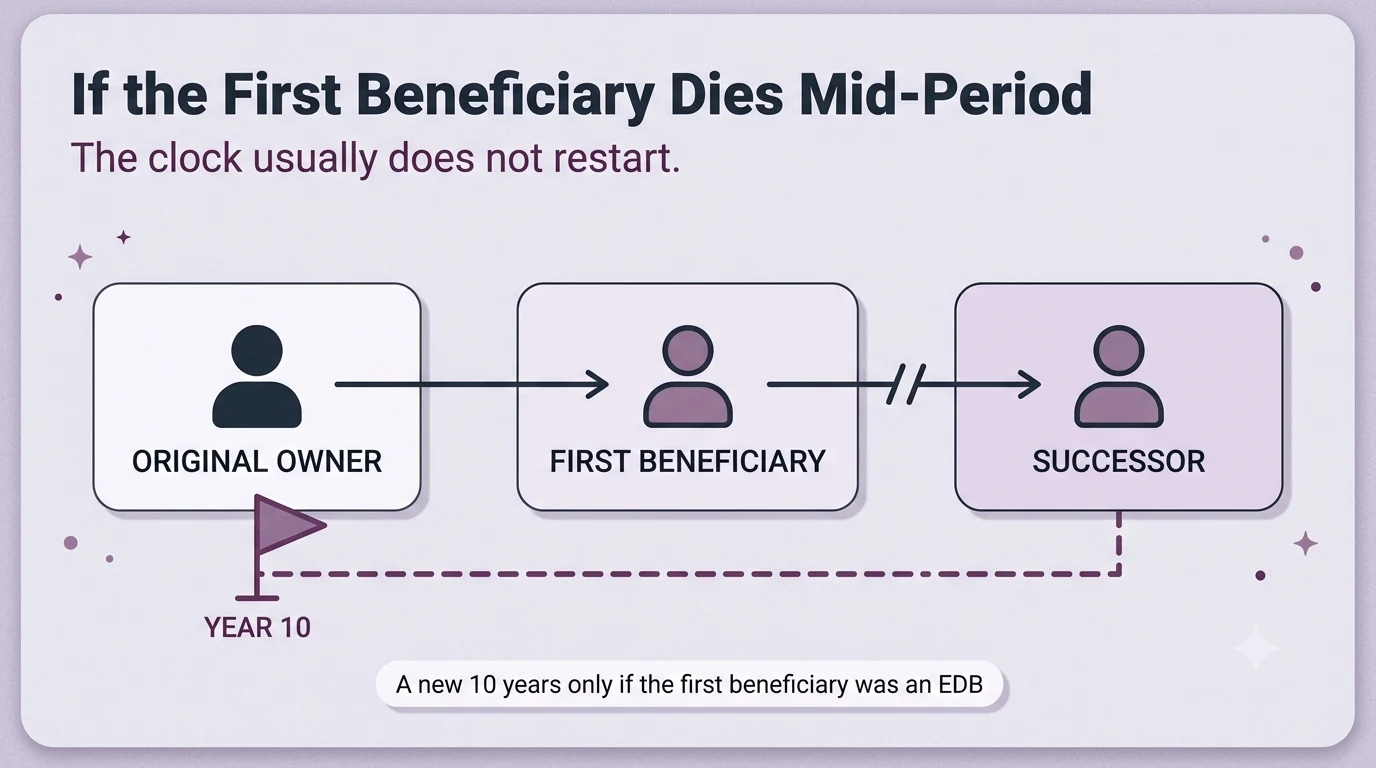
Successor beneficiaries do not automatically receive a fresh 10-year clock
When the first beneficiary dies, the next person in line is often called a successor beneficiary. Publication 590-B says beneficiaries of a deceased beneficiary generally continue the post-death RMD requirements and do not recalculate the inherited account using the successor’s own life expectancy.
The key question is what status the first beneficiary had. That determines whether the remaining account keeps the original owner’s year-10 deadline or receives a new 10-year deadline after the first beneficiary’s death.
The first beneficiary's category determines the controlling full-distribution deadline.
Case 1: the first beneficiary was an ordinary designated beneficiary already under the owner’s 10-year rule
If the original owner’s designated beneficiary was not an eligible designated beneficiary, the final regulations require full distribution by the end of the calendar year containing the tenth anniversary of the original owner’s death. The death of that ordinary beneficiary during the period does not replace that deadline with a new 10-year period.
Example: an owner dies in 2025 and leaves an IRA to an adult child who is an ordinary designated beneficiary. The owner-based deadline is December 31, 2035. If the child dies in 2029 and names a successor, the successor inherits the remaining account but still has to finish by December 31, 2035. The successor does not get until 2039 merely because 2029 is the second death.
- 2025Original owner dies; this starts the ordinary beneficiary's clock.
- 2029The first beneficiary dies during the period.
- December 31, 2035The successor still completes the account by the original deadline.
For an ordinary first beneficiary, the later death does not start another ten-year period.
If the owner died on or after the required beginning date, annual RMDs can continue through the successor
The final regulations require annual post-death distributions to continue when the original owner died on or after the required beginning date. They also state that an RMD is due for the calendar year in which the beneficiary dies and must be distributed during that year to the deceased beneficiary or to a successor beneficiary to the extent it had not already been taken.
So an ordinary beneficiary’s death does not erase the annual-RMD branch. The successor needs the original owner’s required-beginning-date status and the deceased beneficiary’s RMD history, not just the successor account’s opening date.
Case 2: the first beneficiary was an eligible designated beneficiary taking life-expectancy payments
A different rule applies when the first beneficiary was an EDB using life-expectancy treatment. The final regulations require the remaining interest to be fully distributed by the end of the calendar year containing the tenth anniversary of the EDB’s death.
The regulations also preserve continued annual distributions during that successor period when life-expectancy payments had already begun. The successor does not substitute the successor’s own age for the deceased EDB’s distribution history.
Case 3: the owner’s child qualified as an EDB because the child was under 21
The final regulations define age of majority as the child’s 21st birthday. If the child was an EDB solely because the child had not reached 21 at the owner’s death, the 10-year full-distribution period is measured from the child’s attainment of age 21. If life-expectancy distributions had begun, annual distributions generally continue during the later 10-year period.
If that child also independently qualifies as disabled or chronically ill and the applicable documentation rules are satisfied, the result can differ. The beneficiary category must therefore be established from the facts as of the owner’s death.
Case 4: a surviving spouse dies before the spouse’s delayed distributions begin
Surviving spouses have a special branch that can treat the spouse as if the spouse were the original owner for certain post-death rules when the spouse dies before distributions are required to begin. This is not the normal successor-beneficiary rule and is one reason generic “second beneficiary gets ten years” summaries can be wrong.
A two-death timeline is the minimum record set
- Original owner’s date of death.
- Original owner’s required beginning date.
- First beneficiary’s category: ordinary designated beneficiary, EDB, spouse, minor child, or other status.
- First beneficiary’s birth date if age matters.
- First beneficiary’s date of death.
- Annual RMDs already taken and the denominator history used.
- The controlling full-distribution deadline.
A successor account statement that says only “inherited in 2029” is not enough to establish the federal RMD schedule.
Account titling should preserve the chain of inheritance
A successor beneficiary generally should not cause the account to be retitled as though the successor inherited directly from the original owner. Custodian formats differ, but the paperwork should preserve enough information to show the original owner, deceased first beneficiary, and successor beneficiary.
Before moving the account, the successor should ask the receiving institution whether it can preserve the inherited registration and the existing deadline. A transfer is an administrative event; it does not reset the federal distribution period.
Name your own successor beneficiary as soon as you inherit
An inherited IRA lets the beneficiary name their own successor. If the beneficiary dies without one on file, the IRA agreement usually pays the account to the beneficiary's estate. An estate is a non-designated beneficiary, which can force the remaining balance out under the 5-year rule or the original owner's remaining life expectancy instead of a 10-year period, and it drags the account through probate. Filing a successor beneficiary designation with the custodian in the first weeks after inheriting is a five-minute step that protects the people who would inherit next.
File a successor beneficiary designation with the custodian in the first weeks after inheriting. Without one, the IRA agreement usually pays the estate, a non-designated beneficiary that can face the 5-year rule or the original owner's remaining life expectancy.
A successor can never be an eligible designated beneficiary of the original owner
Even if the successor is disabled, a minor, or close in age to the original owner, that does not matter. EDB status belongs only to a beneficiary named by the owner and measured at the owner's death. A successor steps into whatever schedule the first beneficiary was on, subject to the 10-year-from-the-EDB's-death rule where the first beneficiary was an EDB. The successor's own characteristics do not open a new life-expectancy option.
The practical rule to remember
There are two common clocks: an ordinary designated beneficiary’s clock is tied to the original owner’s death, while a successor to an eligible designated beneficiary can face a new 10-year deadline tied to the EDB’s death. The first beneficiary’s legal status—not simply the date the successor received the account—determines which clock applies.