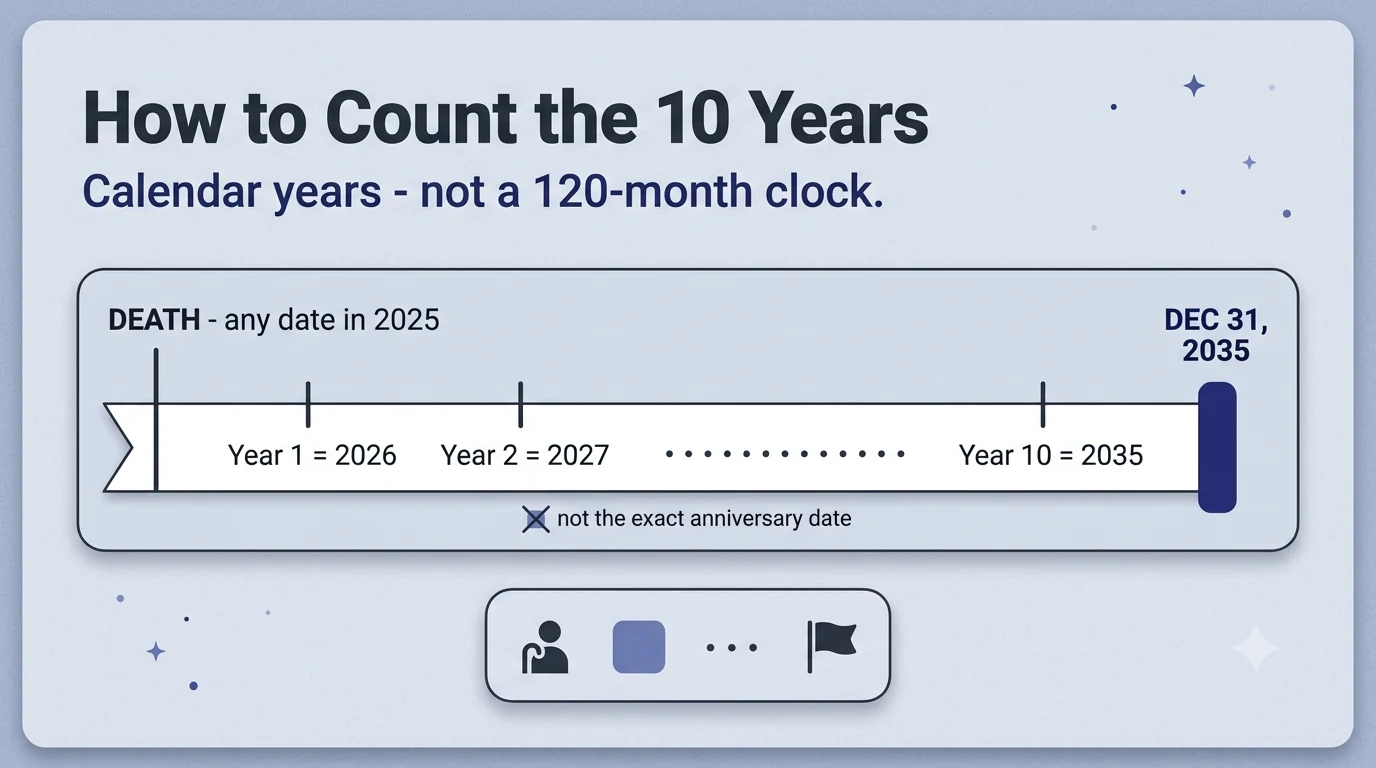
The counting rule uses calendar years, not a 120-month stopwatch
For an ordinary designated beneficiary subject to the 10-year rule, Publication 590-B requires the inherited IRA to be fully distributed by December 31 of the calendar year containing the tenth anniversary of the owner’s death. Another way to say the same thing is the end of the tenth calendar year following the calendar year of death.
The exact day and month of death do not create a matching day-and-month deadline ten years later.
Death in 2025 means a December 31, 2035 deadline
If the owner dies at any time in 2025, 2026 is the first calendar year after death and 2035 is the tenth. The outside full-distribution date is therefore December 31, 2035 when the ordinary 10-year rule applies.
A death on January 3, 2025 and a death on December 29, 2025 produce the same year-10 date. The exact date still matters for other estate and administrative issues, but not for choosing a July or December anniversary as the IRA deadline.
- 2025Owner dies; this is not year 1.
- 2026Year 1 begins.
- 2035Year 10; full distribution is due by December 31.
Quick reference for recent death years
| Owner’s year of death | Year 1 | Year 10 / full-distribution deadline |
|---|---|---|
| 2020 | 2021 | December 31, 2030 |
| 2021 | 2022 | December 31, 2031 |
| 2022 | 2023 | December 31, 2032 |
| 2023 | 2024 | December 31, 2033 |
| 2024 | 2025 | December 31, 2034 |
| 2025 | 2026 | December 31, 2035 |
| 2026 | 2027 | December 31, 2036 |
The table assumes the beneficiary is actually in the ordinary 10-year category. It does not determine whether annual RMDs are also required.
The year-10 date and the annual-RMD question are separate
If the owner died before the required beginning date, no annual distribution is required in years 1 through 9 solely because of the 10-year rule. If the owner died on or after the required beginning date, an ordinary designated beneficiary generally has annual post-death RMDs while the same year-10 deadline continues to run.
That means a deadline calculator using only the death year can correctly identify December 31, 2035 and still be incomplete about what must happen in 2026 through 2034.
Successor-beneficiary dates require a different starting event in some cases
If an ordinary designated beneficiary dies while already inside the original owner’s 10-year period, the original owner-based deadline generally remains in place. But when an eligible designated beneficiary taking life-expectancy distributions dies, the remaining interest is generally subject to a 10-year period measured from the EDB’s death.
A child who was an EDB because the child was under 21 creates another trigger: the later 10-year period is measured from the child’s 21st birthday. A successor should therefore identify the legal status of the first beneficiary before writing a date on the calendar.
Example: ordinary beneficiary dies in year 4
An owner dies in 2025 and an adult son is an ordinary designated beneficiary. The account’s outside date is December 31, 2035. The son dies in 2029 and leaves the inherited IRA to his daughter. The daughter succeeds to the remaining inherited account, but she does not get a new December 31, 2039 deadline merely because 2029 is when she received it. The original 2035 deadline continues to control.
Example: eligible designated beneficiary dies later
If the first beneficiary instead was an eligible designated beneficiary receiving life-expectancy payments and dies in 2029, the final regulations generally measure the full-distribution deadline by the tenth anniversary of that EDB’s death. Annual distributions can continue during that successor period where life-expectancy payments had already begun.
A surviving spouse's timeline is counted differently
This counting method is for a non-spouse designated beneficiary. A surviving spouse has separate options—treating the IRA as their own, or delaying the start of distributions until the year the deceased would have reached RMD age—that change the analysis entirely. If a widow or widower applies the non-spouse 10-year count from a general article, they can give up more favorable treatment. The spouse rules are outside this site's non-spouse focus, but the distinction is worth flagging before anyone marks a calendar.
The 5-year rule is not the 10-year rule with a shorter number
If the beneficiary is a non-designated beneficiary—an estate, a non-qualifying trust—the account follows the 5-year rule (death before the required beginning date) or the owner's remaining life expectancy (death on or after it), not the 10-year rule. The counting is similar for the 5-year version: death in 2025 means a December 31, 2030 deadline. But there is no election to switch into the 10-year framework, so a deadline table built for designated beneficiaries does not apply.
Plan terms can impose an earlier operational schedule
An employer plan or IRA agreement can offer distribution options that are narrower than the maximum federal timing flexibility. A beneficiary should therefore distinguish the federal outside deadline from the custodian or plan’s own processing rules.
If an institution displays an earlier date, ask whether it reflects a plan-document requirement, a beneficiary election, or a different classification rather than assuming either the dashboard or the federal rule is wrong.
Build the deadline into every annual worksheet
The best control is simple: put the owner’s date of death, the controlling 10-year trigger, and the final December 31 deadline at the top of every annual RMD or tax-planning worksheet. That prevents an account transfer, login change, or successor event from erasing the long-term deadline from view.
Record the owner's death or other controlling event and the final December 31 date. A plan or IRA agreement can set a narrower operational schedule.