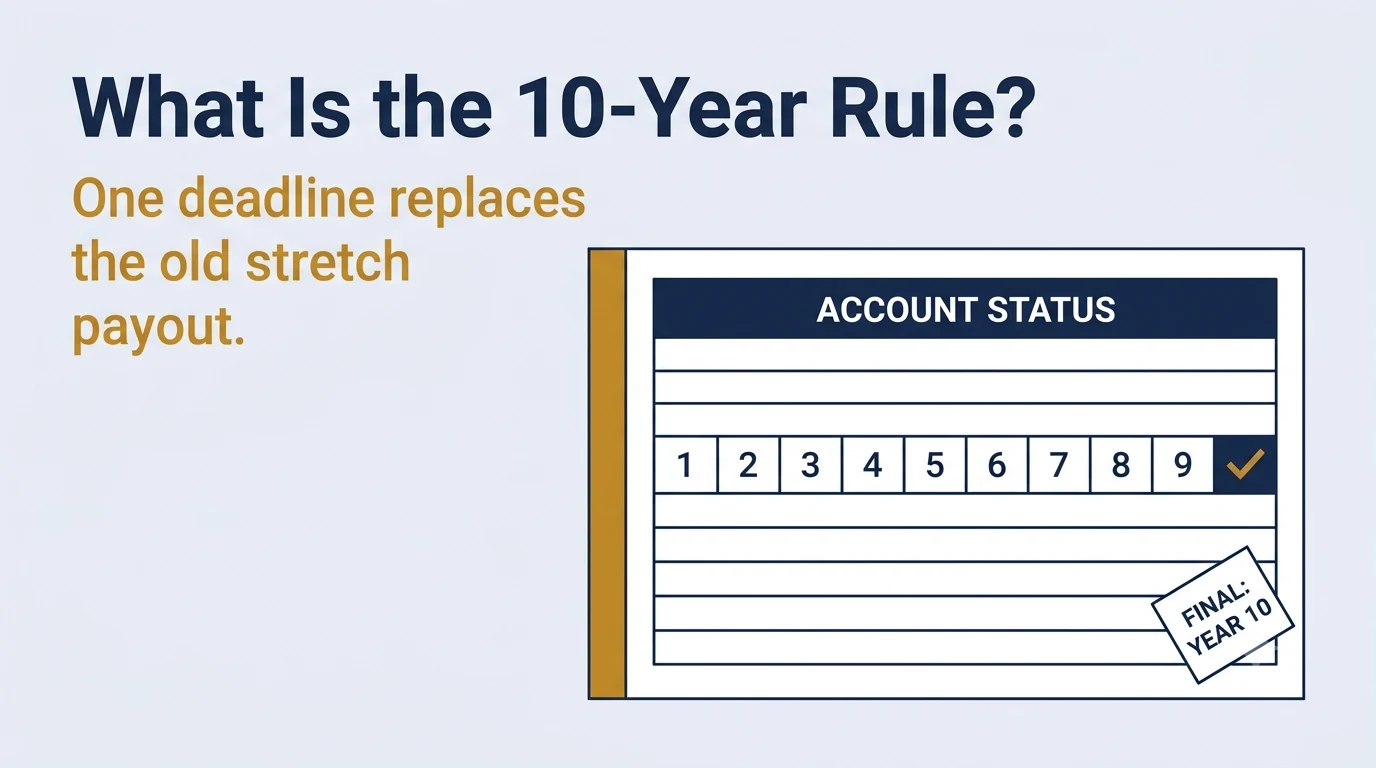
Start with the deadline, then ask whether annual RMDs also apply
For many people who inherit an IRA from someone other than a spouse and whose original owner died after 2019, the SECURE Act’s 10-year rule is the central distribution rule. In simple terms, the inherited account generally must be completely distributed by December 31 of the calendar year containing the tenth anniversary of the owner’s death. If the owner died in 2025, for example, the ten-year period ends on December 31, 2035.
That deadline does not answer every distribution question. The second issue is whether the original owner died before or on/after the owner’s required beginning date for RMDs. Under the final Treasury regulations that apply beginning in 2025, a non-eligible designated beneficiary of an owner who died on or after the required beginning date generally has annual beneficiary RMDs during the period and must still empty the account by the end of year 10.
- 2025Owner dies. The clock is tied to the calendar year of death.
- 2026Year 1 of the ten-year period.
- 2035Year 10 ends on December 31. The account must be completely distributed by then.
The example uses the article's own 2025 date; your own start year follows the year of the owner's death.
Who is usually in the 10-year group?
The rule commonly applies to an individual designated beneficiary who is not an “eligible designated beneficiary.” Examples often include an adult child, adult grandchild, sibling who is more than 10 years younger than the owner, or another named individual who does not fit an exception. The label matters more than the family relationship by itself.
Eligible designated beneficiaries include a surviving spouse, the owner’s minor child, a disabled or chronically ill individual, and an individual who is not more than 10 years younger than the owner. Those beneficiaries can have life-expectancy options that are not available to an ordinary designated beneficiary.
| 10-year group | Eligible designated beneficiary | |
|---|---|---|
| Typical examples | An adult child, an adult grandchild, a sibling more than 10 years younger than the owner, or another named individual | A surviving spouse, the owner's minor child, a disabled or chronically ill individual, or someone not more than 10 years younger than the owner |
| Distribution options | Generally must empty the account by the year-10 deadline | Can have life-expectancy options not available to an ordinary designated beneficiary |
| What decides it | Not fitting any exception category | Fitting one of the exception categories |
The label matters more than the family relationship by itself.
If the owner died before the required beginning date
Publication 590-B states that when the owner died before the required beginning date and the 10-year rule applies, no distribution is required in years 1 through 9 merely because of the 10-year rule. The beneficiary still has to empty the account by the year-10 deadline. A custodian or plan may impose operational rules, so the account agreement should be checked as well.
This is why the statement “every inherited IRA requires an RMD every year” is too broad. A beneficiary must identify the owner’s RMD status first.
If the owner died on or after the required beginning date
The final regulations retain the “at least as rapidly” concept. A designated beneficiary who is subject to the 10-year rule and inherits from an owner who died on or after the required beginning date generally must take annual beneficiary RMDs and also finish distributing the account by year 10. The annual amount is not simply one-tenth of the balance; it is calculated under the beneficiary RMD rules.
Transition notices provided relief for certain missed beneficiary RMDs through 2024, but that relief should not be treated as a permanent suspension of the annual-distribution rule. The final regulations apply for distribution calendar years beginning on or after January 1, 2025.
The owner's required beginning date, not the beneficiary's age, decides whether annual distributions also apply.
What the 10-year rule does not decide
- It does not determine whether a withdrawal is taxable; traditional and Roth inherited accounts can produce different tax results.
- It does not tell a beneficiary which year is personally “best” for a large withdrawal.
- It does not override plan-document choices in an inherited 401(k).
- It does not turn a non-spouse inherited IRA into the beneficiary’s own IRA.
A useful first-week checklist
Record the owner’s date of death, determine whether the owner had reached the required beginning date, confirm exactly how the beneficiary is named, identify the account type, and obtain the custodian’s beneficiary paperwork. Those facts usually determine which branch of the RMD rules must be researched next.
A worked classification example
Assume a 47-year-old daughter inherits her father’s traditional IRA after he dies in 2025. She is an individual designated beneficiary, she is not the surviving spouse, and nothing in the facts suggests she meets one of the other eligible-designated-beneficiary categories. The first conclusion is therefore that the 10-year rule applies. The next question is not her own age; it is whether her father died before or after his required beginning date.
If he died before that date, the 10-year rule gives her an outside deadline of December 31, 2035 without an annual distribution required merely because of the 10-year rule. If he died on or after that date, she generally has annual beneficiary RMDs in addition to the same final 2035 deadline. That one fact changes the cash-flow schedule even though the beneficiary, account, and year-10 date are otherwise identical.
What a custodian can tell you—and what remains your responsibility
Custodians can provide beneficiary forms, account registration, year-end balances, and often an RMD calculation. Those services are useful, but IRS guidance repeatedly places responsibility for satisfying RMD rules on the account owner or beneficiary. A beneficiary should therefore ask how a calculated amount was derived rather than saving only the final number.
- Ask which death date and required-beginning-date assumption the institution used.
- Ask whether the amount shown is the owner’s year-of-death RMD or the beneficiary’s post-death RMD.
- Ask whether the account is coded as traditional, Roth, or an inherited employer-plan transfer.
- Keep the December 31 prior-year balance used in the calculation.
Spreading the withdrawals usually beats a year-10 lump sum
For a traditional inherited IRA, every dollar withdrawn is ordinary income. Leaving a large balance untouched until year 10 stacks all of it onto one tax return, which can push the beneficiary into higher brackets, add the 3.8% net investment income tax to other income, and trigger a Medicare IRMAA surcharge two years later. A common approach is to withdraw enough each year to fill the beneficiary's current bracket without spilling into the next one, spreading the tax across the full period. This is a planning choice, not a legal requirement, and it should be run against the beneficiary's actual projected income each year.
| Spread across the period | One year-10 lump sum | |
|---|---|---|
| Tax return effect | The tax is spread across the full period | All of it is stacked onto one tax return |
| Brackets | Can fill the current bracket without spilling into the next | Can push the beneficiary into higher brackets |
| Other taxes | Check against actual projected income each year | Can bring the 3.8% net investment income tax into play, plus a Medicare IRMAA surcharge two years later |
A planning choice, not a legal requirement. Run it against projected income each year.
The 2025 tax law removed the old reason to accelerate
Before July 2025, many inherited-IRA articles advised front-loading withdrawals into 2024 and 2025 because the lower Tax Cuts and Jobs Act brackets were scheduled to expire after 2025. The One Big Beautiful Bill Act, signed July 4, 2025, made that bracket structure permanent and cancelled the scheduled reversion to higher rates. Advice that still assumes a 2026 rate increase is out of date. The bracket-management logic above still applies, but the urgency to compress withdrawals into two early years does not.
Why “withdraw one-tenth each year” is not the rule
The 10-year rule is a deadline for complete distribution; it is not a statutory ten-installment payment plan. When annual RMDs are required, those amounts are determined under beneficiary life-expectancy rules. When annual RMDs are not required, the beneficiary can have uneven withdrawals. Equal annual withdrawals may be a planning choice in some circumstances, but it should never be described as the legal formula.
What changes if the account is inherited from a spouse?
Spousal beneficiaries have special options that can include treating an inherited IRA as their own. Those rules can alter both the RMD schedule and account registration. This site’s 10-year-rule guides are written primarily for non-spouse beneficiaries; a surviving spouse should use spouse-specific IRS guidance before relying on a non-spouse example.