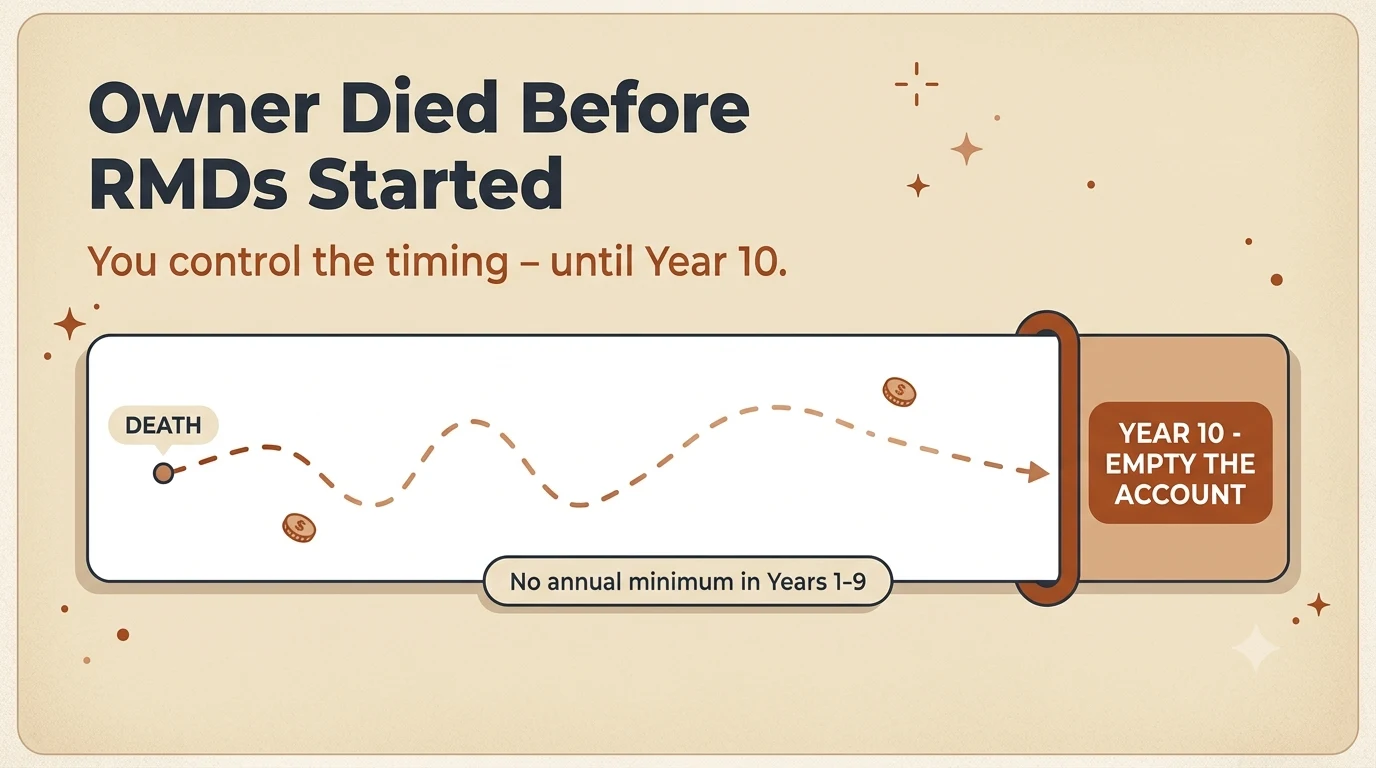
Why this fact changes the distribution pattern
For a non-spouse designated beneficiary who is not an eligible designated beneficiary, the 10-year rule generally applies. When the owner died before the required beginning date, the IRS rule is comparatively simple: the account must be emptied by the end of year 10, but the 10-year rule itself does not force a distribution in each of years 1 through 9.
Start with the deceased owner's RMD status, then confirm the beneficiary category.
Counting the ten years
The year of death is not year 1. If the owner died in 2025, 2026 is the first calendar year after death and 2035 is the calendar year containing the tenth anniversary. The inherited IRA must be fully distributed by December 31, 2035.
This calendar-year method matters because “ten years from the date of death” can sound like an exact anniversary-day deadline. The IRS description instead uses the end of the tenth calendar year following the calendar year of death.
- 2025Owner dies. This is the year of death, not year 1.
- 2026Year 1 begins in the first calendar year after death.
- 2035The full account is due by December 31.
The deadline follows calendar years, not the exact anniversary day.
No annual RMD does not mean no decisions
The beneficiary may choose to take nothing in an early year, take irregular withdrawals, or make larger distributions in selected years, subject to the final year-end deadline and any account terms. Traditional IRA withdrawals are generally taxable to the beneficiary to the extent they would have been taxable to the owner, so timing changes the year in which income appears.
A Roth inherited IRA is also treated as though the owner died before the required beginning date because Roth IRA owners have no lifetime RMDs. The 10-year deadline can still apply, but the tax character of withdrawals can be different.
Do not confuse the beneficiary’s age with the owner’s status
The owner’s required beginning date is an owner-side fact. The beneficiary might already be retired or older than the owner was; that does not automatically convert this branch into the post-required-beginning-date rule. The beneficiary’s own age can matter for life-expectancy calculations in other circumstances, but the first branch point is the deceased owner’s RMD status.
What to preserve in the file
Keep the death certificate, beneficiary designation information, account statements around the date of death, the inherited-account registration, and any communication showing the custodian’s calculation of the ten-year deadline. If the owner was near RMD age, keep documents showing whether a lifetime RMD was required for the year of death.
- Keep the death certificate and beneficiary designation information.
- Save account statements from around the date of death.
- Keep the inherited-account registration and the custodian's deadline calculation.
- If the owner was near RMD age, keep records showing whether an RMD was required for the death year.
- Confirm the owner was before the required beginning date instead of inferring it from no withdrawals.
Example: an adult child inheriting in 2024
Suppose an owner dies in 2024 before the required beginning date and leaves a traditional IRA to an adult son who is not an eligible designated beneficiary. The son’s ten-year period runs through December 31, 2034. The 10-year rule does not require a withdrawal in 2025 merely because 2025 is year 1. He could take a withdrawal, but it would be discretionary rather than a minimum imposed by the ten-year rule.
Year-of-death treatment is simpler in this branch
If the owner truly died before the required beginning date, there is no lifetime RMD due for the owner for the year of death. That removes one administrative item that exists when the owner dies after RMDs have begun. The beneficiary still must confirm that “before the required beginning date” is correct rather than assuming it from the absence of prior withdrawals.
Why beneficiaries may still choose earlier withdrawals
The law’s flexibility creates a planning problem rather than solving it. A beneficiary may have a temporary low-income year, may expect future income to rise, or may simply want to reduce the risk of forgetting the final deadline. Conversely, a beneficiary may value continued tax deferral. None of those considerations changes the rule; they are factors that can be modeled after the legal minimum is known.
How to confirm the owner really died before the required beginning date
The required beginning date is April 1 of the year after the owner turns 73 (for owners born 1951 through 1959) or 75 (born 1960 or later). An owner who died at 70 or 71 was plainly before that date. Near the line, two checks help: look for a Form 1099-R issued to the decedent for a prior year, which would indicate lifetime RMDs had started, and confirm the birth year against the age rule. Do not infer the branch only from the absence of withdrawals, because an owner can simply have chosen not to take a non-required distribution.
This branch assumes an ordinary designated beneficiary
The no-annual-RMD result described here is for a non-spouse designated beneficiary who is not an eligible designated beneficiary. If the beneficiary is an EDB—a minor child of the owner, a disabled or chronically ill individual, or someone not more than 10 years younger—and the owner died before the required beginning date, the beneficiary can generally take life-expectancy distributions instead, which often stretches well beyond 10 years. Classify the beneficiary before applying the 10-year framework.
Watch the final months of year 10
Waiting until December of the final year creates operational risk. Securities may need to be sold, trades need settlement, and a custodian may impose processing deadlines for checks or transfers. The tax-law deadline is December 31, but a practical plan should leave enough time for the institution to complete the distribution and report it in the correct calendar year.