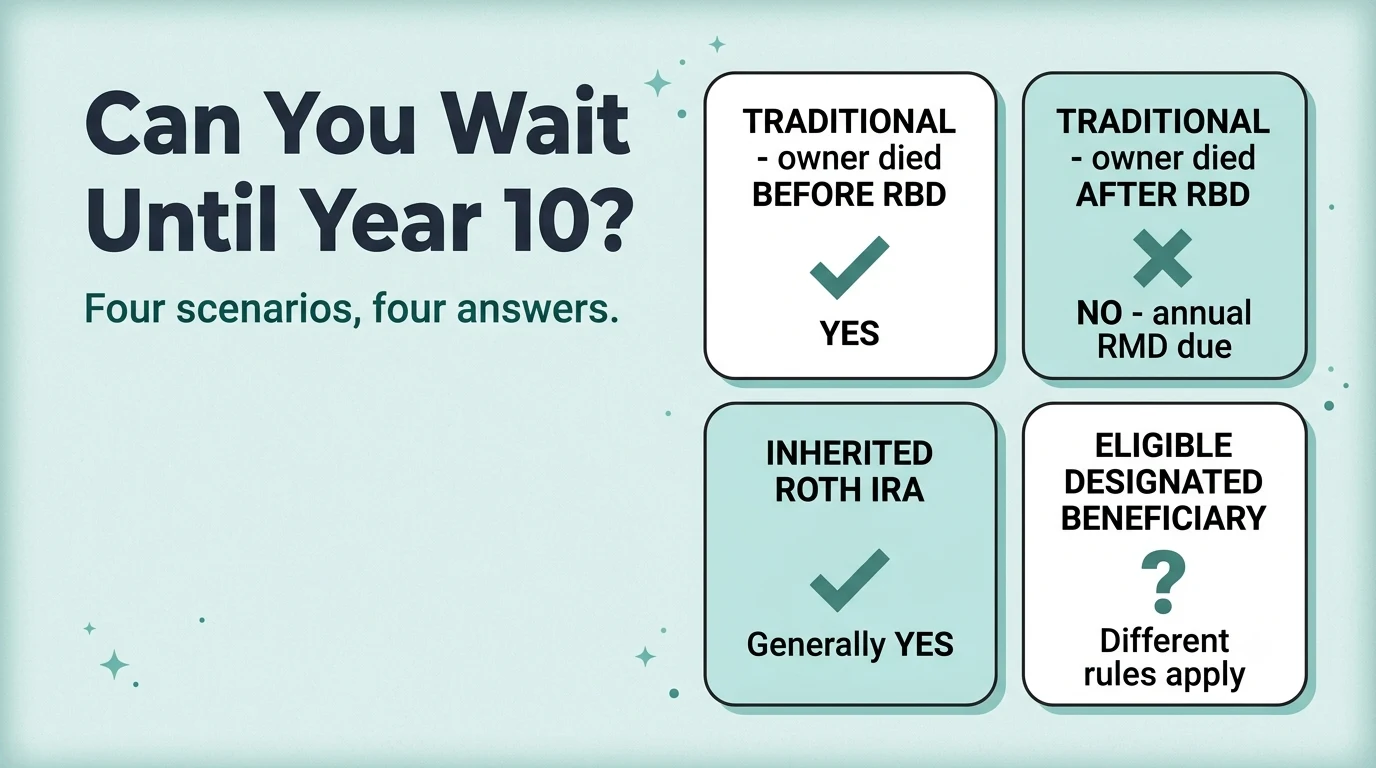
“Can I wait until year 10?” is best answered with scenarios, not one rule sentence
The legal ability to leave an inherited IRA untouched for several years depends on the account type, the original owner’s required-beginning-date status, and the beneficiary’s classification. Four common scenarios produce four different planning conversations.
Scenario 1: ordinary beneficiary, traditional IRA, owner died before the required beginning date
This is the clearest “yes, legally you can wait” scenario. Publication 590-B says that when the owner died before the required beginning date and the 10-year rule applies, no distribution is required for a year before the tenth year solely because of that rule. The account still must be fully distributed by the year-10 deadline.
That means a beneficiary can legally take $0 in some or all of years 1 through 9, subject to the IRA agreement and any separate rules that apply. The tax effect is another matter: allowing a large traditional IRA to compound until the final year can concentrate ordinary income into one tax return.
Scenario 2: ordinary beneficiary, traditional IRA, owner died on or after the required beginning date
Here the answer is no. The final regulations require continued annual post-death distributions while the 10-year clock is running. The beneficiary must take the annual minimum and still fully distribute the account by the final deadline.
The timing choice is therefore only about withdrawals above the annual minimum. A strategy that literally leaves the account untouched would fail the annual-RMD requirement.
Scenario 3: ordinary beneficiary, inherited Roth IRA
Because an original Roth IRA owner is treated as having died before the required beginning date for beneficiary RMD purposes, the ordinary non-spouse beneficiary generally does not have annual RMDs in years 1 through 9 under the 10-year rule. The inherited Roth still has to be emptied by year 10.
This can make deferral look attractive because qualified Roth distributions may be tax-free, but the Roth five-year qualification history still matters if the owner’s Roth was relatively new. The legal timing rule does not by itself guarantee that every early or late distribution is tax-free.
Scenario 4: beneficiary is an eligible designated beneficiary
An EDB can have life-expectancy treatment rather than the ordinary 10-year schedule. A surviving spouse has additional options, and an owner’s child under 21 can transition into a 10-year period after reaching age 21. A beneficiary who fits an EDB category should stop using an ordinary-beneficiary “wait until year 10” example and analyze the EDB rule instead.
Work through the questions in order; the table that follows lists the same four patterns.
A decision matrix
| Fact pattern | Annual distributions before year 10? | Outer deadline |
|---|---|---|
| Ordinary beneficiary; traditional IRA; owner died before RBD | Not required solely by the 10-year rule | End of year 10 |
| Ordinary beneficiary; traditional IRA; owner died on/after RBD | Generally yes | End of year 10 |
| Ordinary beneficiary; inherited Roth IRA | Generally no under the 10-year rule | End of year 10 |
| Eligible designated beneficiary | Depends on EDB category and election | May use life expectancy or a later 10-year trigger |
Waiting changes the concentration risk, not the statutory deadline
Suppose an adult child inherits a $300,000 traditional IRA in the no-annual-RMD branch. If the account grows while no distributions are taken, the final taxable withdrawal can be much larger than the original inheritance. The law may permit that pattern, but the beneficiary should compare the final-year concentration with multi-year alternatives using actual current tax rules.
This site does not choose a withdrawal pattern for the reader. The useful distinction is between what is legally permitted and what a particular tax projection shows.
Waiting until December of year 10 adds operational risk
A beneficiary who intentionally defers distributions should not interpret “December 31” as a reason to place a sell order on December 31. Securities may need to settle, the custodian may require forms or signature guarantees, bank links can fail, and inherited accounts can have additional review steps.
An internal deadline in November or early December gives room to resolve those problems while preserving the federal year-end requirement as the outside limit.
Securities may need to settle and custodians may require forms. Set an internal deadline in November or early December so the federal year-end deadline stays the outside limit.
A large final-year withdrawal can interact with more than the tax bracket
For a traditional inherited IRA, additional taxable income can affect marginal tax brackets, the taxable portion of Social Security benefits, Medicare IRMAA in a later premium year, and state income tax. A beneficiary who has legal flexibility should compare the whole return rather than use a “one-tenth each year” shortcut.
- Check which withdrawals are legally requiredKeep any annual RMD separate from optional amounts.
- List the rest of the tax returnInclude taxable income, Social Security, Medicare IRMAA, and state tax where relevant.
- Compare the current year with a later low-income yearA retirement or income gap can change the result.
- Recheck whether the account is Roth or traditionalThe Roth five-tax-year history and tax treatment may change the comparison.
When waiting until year 10 can genuinely make sense
Deferral is more defensible in a few situations: the account is small enough that a lump sum will not move the beneficiary into a higher bracket or across a Medicare or NIIT threshold; the beneficiary expects a much lower-income year later in the window (a planned retirement, a sabbatical, a gap between jobs) and wants to concentrate the withdrawal there; or the account is an inherited Roth, where every extra year of tax-free growth has real value. Outside those cases, a large traditional balance left untouched can cost more in year 10 than it saves.
What to recheck every year even if the planned distribution is zero
- Did a custodian transfer or beneficiary correction change the account registration?
- Did new information change the conclusion about the owner’s required beginning date?
- Is the year-10 deadline still recorded correctly?
- Has the account grown enough that the remaining years create a concentration problem?
- Have tax or Medicare rules changed enough to update the comparison?
A valid year-1 decision to wait should not become a ten-year autopilot setting.