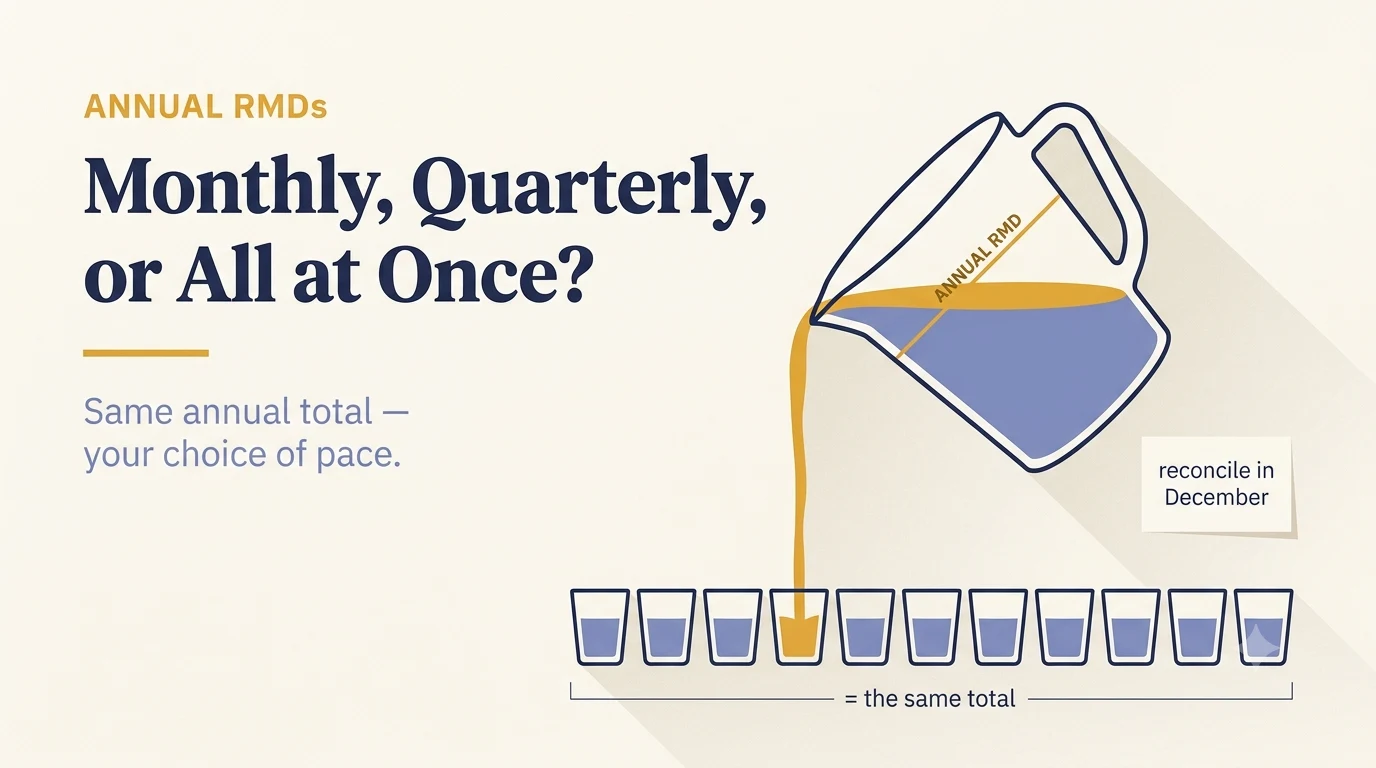
The RMD is an annual amount, not a required payment frequency
When an inherited IRA has an annual RMD, the tax rule generally specifies the amount that must be distributed for the calendar year and the deadline by which it must be taken. It does not require the beneficiary to receive that amount in one December payment. A beneficiary can generally take distributions during the year in monthly, quarterly, or irregular installments so long as the required annual amount is fully distributed by the applicable deadline.
Example: turning a $24,000 annual RMD into installments
If the calculated annual RMD is $24,000, a beneficiary could request twelve $2,000 monthly distributions, four $6,000 quarterly distributions, or another schedule totaling at least $24,000 for the year. The tax result is based on distributions actually received and reported during the calendar year, not on the label “monthly RMD.”
Why an installment plan still needs a December reconciliation
Automatic payments can fail after an account transfer, address change, insufficient cash position, or custodian processing problem. In November or early December, compare year-to-date distributions with the full annual RMD. Do not assume the scheduled amount equals the amount actually paid.
| Check | What to verify |
|---|---|
| Annual RMD | Calculation and denominator for the year |
| Payments received | Gross distributions posted in the current calendar year |
| Withholding | Federal/state withholding is part of the gross distribution; do not compare only net cash deposited |
| Remaining amount | Annual RMD minus gross distributions to date |
Withholding can make the bank deposit look too small
Suppose a $6,000 quarterly gross distribution has $600 withheld for federal income tax. The beneficiary receives $5,400 in the bank, but the gross $6,000 is the retirement-account distribution. When reconciling the RMD, use the institution’s gross distribution records rather than only the net deposits in a checking account.
A $6,000 quarterly gross distribution with $600 withheld puts $5,400 in the bank. The RMD is satisfied by the gross $6,000, so reconcile with the institution's gross records, not net deposits.
Installments do not change the year-10 deadline
If the beneficiary is also subject to the 10-year rule, the installment schedule addresses only the current year’s minimum. The inherited account still must be fully distributed by the end of year 10. A beneficiary who takes only small monthly minimums can still face a large final-year balance.
When a one-time payment may be operationally simpler
Some beneficiaries prefer a single annual distribution because it makes recordkeeping easier. Others use installments for cash-flow management. The tax rule does not choose between those preferences. The practical priority is to calculate correctly, complete the payment within the calendar year, and preserve the year-end records needed for the next year.
Market movement does not require monthly recalculation
Once the annual RMD is correctly calculated from the prescribed prior-year-end balance and denominator, monthly market changes do not normally cause the beneficiary to recalculate each installment. An automatic monthly schedule can divide the annual amount mechanically, with a year-end true-up for any failed or rounded payments.
Rounding can leave a small shortfall
If an annual RMD is $10,003 and the custodian schedules twelve payments of $833, the total is only $9,996. Ask whether the institution adjusts the final installment or calculate the difference yourself. A small administrative rounding error is still a shortfall until corrected.
Installments cannot start before the RMD year begins
A distribution counts toward the calendar year in which it is actually paid. A payment received in December 2026 satisfies the 2026 requirement; it cannot be applied to the 2027 RMD, even if the beneficiary intended it as a head start. The first installment of a given year's RMD has to fall on or after January 1 of that year.
One withholding rate usually applies across the whole installment schedule
A standing monthly or quarterly plan generally carries a single Form W-4R withholding election that applies to every payment until the beneficiary changes it. If a beneficiary wants heavier withholding on a large year-end true-up payment, that has to be requested as a separate election for that distribution rather than assumed to adjust automatically.
Transfers or account closures should trigger a schedule review
An automatic plan at the old custodian can stop the day assets move. Likewise, selling out one inherited IRA used for aggregated RMD payments can interrupt a standing instruction. Whenever the account structure changes, compare gross distributions already received with the full annual requirement and re-establish the remaining installments.
- Confirm the old custodian's automatic schedule stopped or continued as expected.
- Compare gross distributions already received with the annual RMD.
- Check for payments lost to a transfer, address change, or processing issue.
- Re-establish any remaining installments at the new custodian.
- Save the year-end reconciliation and withholding election.