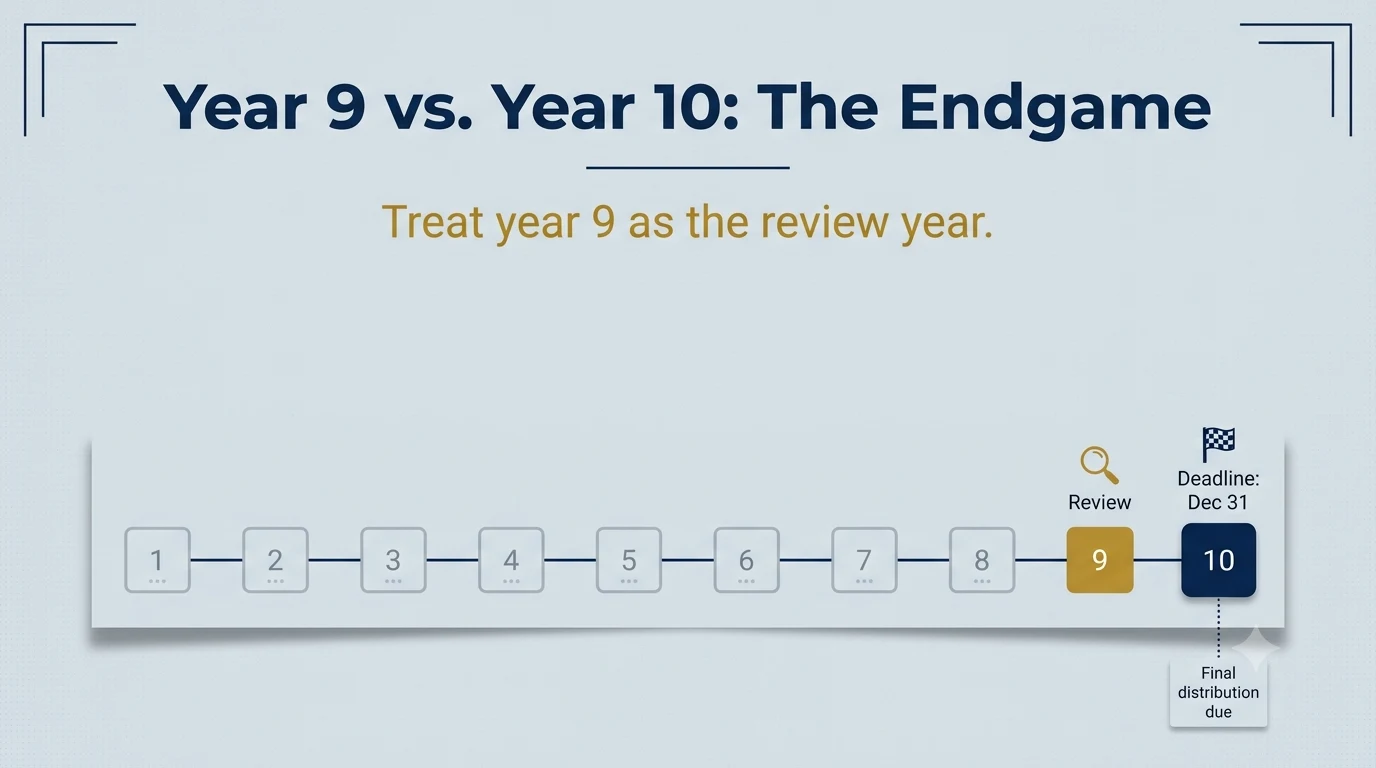
Year 9 is the planning year; year 10 is the completion year
For an ordinary designated beneficiary subject to the 10-year rule, the account generally must be fully distributed by December 31 of the calendar year containing the tenth anniversary of the owner’s death. The easiest way to avoid a last-minute failure is to treat year 9 as a formal pre-close review rather than waiting until the final December.
Year 9: verify the clock from the death record
Recalculate the final year from the owner’s date of death instead of trusting an account nickname such as “year 9 inherited IRA.” If the owner died in 2026, year 1 is 2027 and the final distribution deadline is December 31, 2036. A mid-period custodian transfer or successor beneficiary event does not automatically restart that original clock for an ordinary 10-year beneficiary.
Year 9: estimate the balance that could remain
Use the current account value, expected year-9 distributions, and a range of plausible market outcomes. The purpose is not to predict investment returns precisely; it is to see whether a six-figure final-year distribution is possible so taxes, withholding, and liquidity can be planned before the deadline year begins.
Year 10: satisfy any annual minimum and then finish the account
If annual beneficiary RMDs apply because the owner died on or after the required beginning date, the beneficiary still has the annual RMD obligation in the final period. But taking only that minimum is not enough if money remains. By the final deadline, the inherited account must be completely distributed under the 10-year rule.
Do not wait until the last trading day
Securities may need to be sold, trades must settle, cash must become available, and the custodian may have year-end processing cutoffs. A December 31 tax deadline does not mean every institution will accept a complex liquidation request at 3 p.m. on December 31 and complete it that day.
Year-9 / Year-10 checklist
| Year 9 | Year 10 |
|---|---|
| Reconfirm original death year and final deadline | Confirm annual RMD, if any |
| Project remaining traditional/Roth balance | Schedule distributions early enough to settle |
| Model federal tax, Social Security and IRMAA effects if relevant | Reconcile gross distributions and withholding |
| Locate basis/Form 8606 records | Verify account reaches zero by deadline |
| Review beneficiary/successor records | Save final statement and 1099-R |
Roth accounts still need the deadline review
An inherited Roth IRA can have tax-free qualified distributions, but the 10-year cleanout rule can still apply to an ordinary non-spouse beneficiary. “Tax-free” does not mean “no distribution deadline.”
Successor beneficiaries: check which death starts your clock
If you inherited from an original owner, year 10 is measured from that owner's death. If you inherited as a successor from a first beneficiary who was an eligible designated beneficiary using life-expectancy payments, your 10-year deadline generally runs from the first beneficiary's death instead, and annual payments that had begun continue. A successor who assumes the original owner's date controls can miscount the final year by several years in either direction.
Pair a large final distribution with offsetting tax items
If year 9 projects a large taxable year-10 lump from a traditional inherited IRA, look for ways to absorb it. Bunching several years of charitable gifts into that year, making a qualified charitable distribution if the beneficiary has reached the QCD age, timing the distribution into a year with lower other income, or spreading it across the end of year 9 and the start of year 10 (two tax years) can all reduce the marginal cost. The deadline cannot move, but the tax year the income lands in is partly controllable.
What to keep after the account closes
Retain the final statement showing a zero balance, transaction confirmations, Form 1099-R, withholding records, and any basis or Roth qualification documentation used on the final return. Closing the brokerage account should not mean deleting the tax file.
Run a tax-document inventory in year 9
Ten years is long enough for records to disappear. Before the final year, locate the decedent’s Form 8606 basis records, Roth five-year history, prior RMD worksheets, and any successor-beneficiary documentation. Reconstruct missing information while former custodians and the estate’s tax preparer may still have archives.
Use multiple distribution dates if one transaction would create operational risk
The account does not have to remain untouched until one final December withdrawal. In year 10, a beneficiary can schedule distributions earlier in the year and then perform a smaller final reconciliation. That reduces the risk that a rejected wire, unsettled trade, or holiday cutoff leaves money behind after December 31.
Zero means zero for the account subject to the final deadline
Do not rely on a screen showing “available cash $0” while fractional shares, dividends, or unsettled positions remain. Ask the custodian for a final closing statement and confirm whether any residual sweep will be distributed in the same tax year. A tiny late residual can create a recordkeeping problem even if the main balance was paid.
- Check for cash, shares, and unsettled positionsAvailable cash at zero does not prove the account has no assets.
- Ask whether residual sweep amounts remainConfirm whether any remainder will be distributed in the same tax year.
- Obtain the final closing statementKeep proof of the ending balance.
- Retain confirmations and tax recordsSave Form 1099-R, withholding, and basis or Roth support.