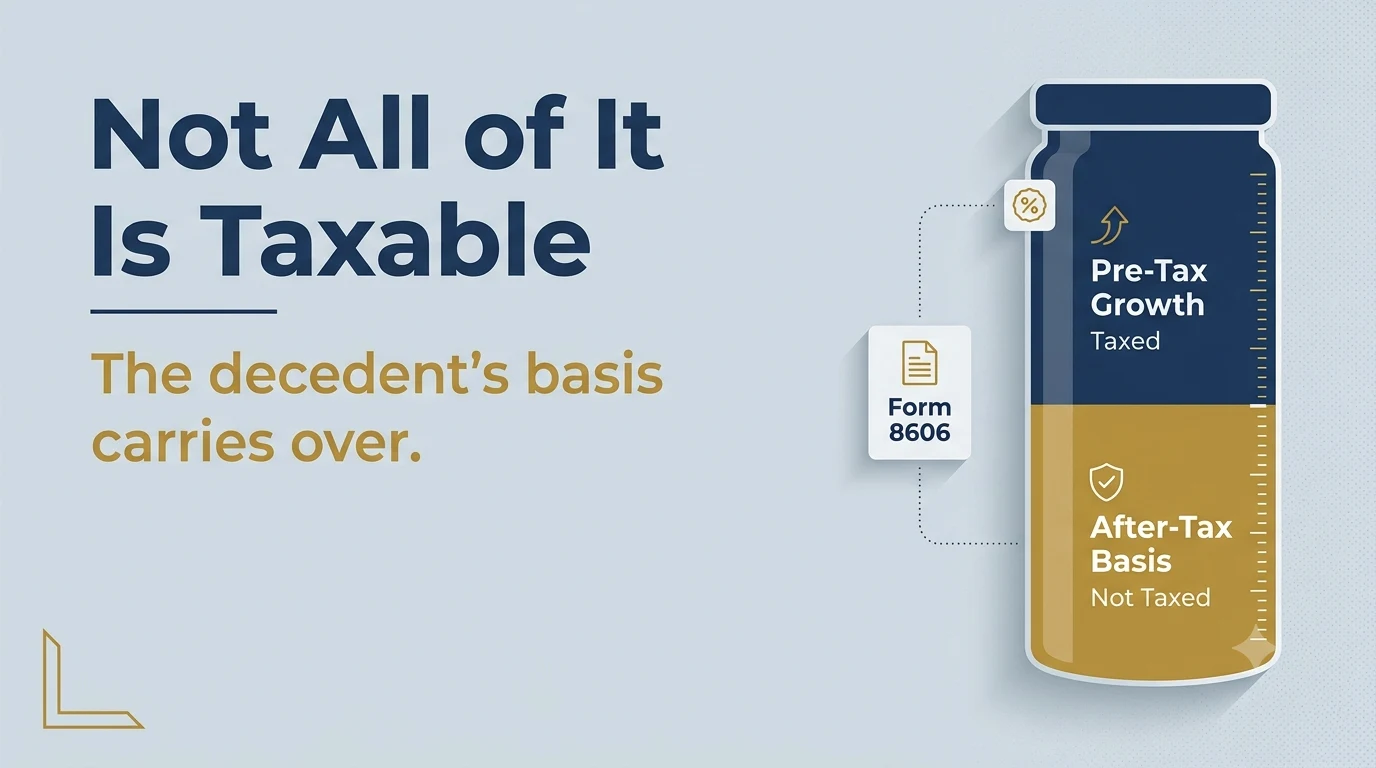
Inherited basis is a record-keeping and reporting problem
Publication 590-B says that if a traditional IRA owner had basis from nondeductible contributions, the basis remains with the inherited IRA. The Form 8606 instructions say a beneficiary who receives a distribution from an inherited traditional IRA that has basis may need to file Form 8606. The practical problem is therefore record reconstruction and tax-return reporting—not simply deciding whether traditional IRA withdrawals are “usually taxable.”
Step 1: prove that inherited basis exists
Start with the decedent’s prior Forms 8606. The last filed form can show remaining basis carried forward, but earlier returns may be needed if the record is incomplete. Also collect Forms 5498, Forms 1099-R, year-end IRA statements, and tax-preparer workpapers if available.
A custodian’s screen or Form 1099-R does not necessarily contain the decedent’s full nondeductible-contribution history across prior custodians.
Step 2: keep the decedent’s basis in its own tax file
Publication 590-B says a nonspouse beneficiary cannot combine inherited basis with basis in the beneficiary’s own traditional IRAs or with basis in traditional IRAs inherited from other decedents. The 2025 Form 8606 instructions reinforce this by requiring a separate Form 8606 for IRAs inherited from each decedent when more than one inherited decedent has to be reported.
| IRA group | Form 8606 treatment |
|---|---|
| Beneficiary’s own traditional IRAs | Keep outside inherited-decedent basis |
| Inherited traditional IRAs from Mother | Mother basis file / Form 8606 as required |
| Inherited traditional IRAs from Father | Separate Father basis file / separate Form 8606 as required |
Step 3: do not treat basis as a tax-free bucket that comes out first
Inherited basis does not mean the beneficiary can simply withdraw the basis dollars before taxable dollars. Form 8606 applies basis-allocation rules to determine the nontaxable and taxable portions of distributions. A note saying “$30,000 basis, therefore first $30,000 is tax free” is not a substitute for the form.
Step 4: reconcile Form 1099-R with Form 8606
Form 1099-R reports the gross distribution and may report a taxable amount, but the beneficiary’s basis records can affect the final taxable portion reported on the income-tax return. Keep the gross amount from the 1099-R, the Form 8606 calculation, and the final taxable amount together so a later reviewer can see why the numbers differ.
Example: one decedent, two inherited traditional IRAs
Assume a beneficiary inherits two traditional IRAs from the same decedent and the decedent had documented unrecovered basis. The beneficiary receives distributions from both inherited accounts during the year. The basis analysis belongs to that decedent’s inherited-IRA tax file; it should not be combined with the beneficiary’s personal IRA basis. Use the current Form 8606 and instructions to determine the taxable and nontaxable portions for the year rather than assigning a fixed tax-free percentage to one account.
Step 5: carry the remaining basis forward
After a year in which inherited basis is used, retain the completed Form 8606 and supporting worksheet. The Form 8606 instructions use prior-year form amounts to establish basis in later years. Losing the completed form can turn a future distribution into a reconstruction project.
Multiple beneficiaries need coordinated records, not duplicate claims
When more than one beneficiary receives inherited traditional IRA interests from the same owner, the remaining basis must be tracked consistently with the beneficiary interests and applicable tax rules. Each beneficiary should obtain documentation showing the basis attributable to that inherited interest rather than assuming the entire decedent-level basis belongs to each person.
Because allocation can depend on facts outside a single custodian’s records, this is a point where the executor or decedent’s tax preparer may have information that the brokerage does not.
The pro-rata formula, with numbers
Form 8606 spreads basis across a distribution in proportion to how much basis the account holds. The nontaxable fraction is roughly the remaining basis divided by the year-end account value plus the distributions taken that year. Example: an inherited traditional IRA has $24,000 of basis and, after a $30,000 distribution, a $170,000 year-end value. The denominator is $200,000, so 12% of the $30,000 distribution—$3,600—is nontaxable and $26,400 is taxable. The remaining basis carried forward is $24,000 minus $3,600, or $20,400. A large year-10 distribution recovers a larger slice of basis in that year because the denominator shrinks as the account empties.
Reconstructing basis when the records are gone
If the decedent's Forms 8606 cannot be found, the beneficiary has to substantiate any nontaxable amount claimed. The IRS generally accepts a reconstruction built from the decedent's tax returns showing nondeductible contributions (the returns themselves, or account transcripts), Forms 5498 reporting contributions, and contemporaneous statements. Without support, the safer filing position is to treat the distribution as fully taxable, which is a real cost—so it is worth asking the executor, the decedent's tax preparer, and the IRS transcript service early rather than at the year-10 deadline.
RMD compliance and Form 8606 answer different questions
The RMD worksheet asks how much must leave the inherited account. Form 8606 asks how much of a distribution is taxable when basis exists. A distribution can count toward an RMD even though part of it is a nontaxable recovery of basis. Keep both calculations rather than letting the tax-basis worksheet replace the RMD record.
Year-10 risk: a large final distribution magnifies bad recordkeeping
If a beneficiary reaches the final 10-year deadline with a large balance, missing basis records can matter most in the year with the largest gross distribution. Reconstruct the decedent’s Form 8606 history early instead of waiting until the account must be emptied.
Return-preparation packet
- Decedent’s historical Forms 8606 and supporting statements.
- Forms 5498 or year-end statements supporting IRA values where needed.
- Beneficiary’s Forms 1099-R for the tax year.
- Separate inherited-decedent Form 8606 when required.
- Completed basis worksheet and remaining basis carried forward.
- Separate RMD worksheet showing the required distribution was satisfied.