IRMAA is a Medicare premium adjustment driven by tax-return income
Income-Related Monthly Adjustment Amounts, or IRMAA, can increase Medicare Part B and Part D costs for beneficiaries whose modified adjusted gross income exceeds the applicable thresholds. Social Security uses federal tax-return information to make the determination.
A taxable inherited traditional IRA distribution can increase adjusted gross income and therefore can raise the MAGI used for IRMAA. The inherited-IRA rule itself does not change; Medicare is a second system that can be affected by the same distribution.
For 2026 premiums, Social Security generally looks to tax year 2024
SSA’s 2026 Medicare premium guidance says it generally uses the most recent federal tax return supplied by the IRS, usually the return filed in 2025 for tax year 2024. If the 2024 return is unavailable, SSA can use older information and later update the determination.
This creates the familiar two-year relationship: a large taxable distribution in one tax year can affect Medicare premiums in a later year rather than immediately.
2026 provides a concrete threshold example
For 2026, SSA lists the first IRMAA threshold above modified adjusted gross income of $109,000 for an individual filer and above $218,000 for a married couple filing jointly. The standard Part B premium is $202.90 per month in 2026, with additional Part B and Part D amounts at higher MAGI levels.
Those figures are useful only as a dated example. A beneficiary making a ten-year inherited-IRA plan should replace them with the official thresholds for the premium year being modeled.
IRMAA MAGI is not simply the taxable amount of the IRA withdrawal
Form SSA-44 instructions describe MAGI for this purpose as adjusted gross income from Form 1040 plus tax-exempt interest income. A taxable inherited IRA distribution can raise AGI, but it is only one input. Wages, pensions, interest, dividends, capital gains, and other items can also affect the total.
That is why there is no reliable permanent “safe inherited IRA withdrawal” amount without considering the rest of the return.
Required RMDs come first
If an inherited IRA RMD is legally required, concern about Medicare premiums does not authorize the beneficiary to skip it. The RMD is the compliance floor. IRMAA analysis is relevant to additional voluntary withdrawals and to how aggressively the beneficiary reduces the remaining account before the final year-10 deadline.
Keeping those two numbers separate prevents a Medicare-cost projection from being mistaken for a legal distribution limit.
Example: a one-time distribution can affect a later premium year
Assume a Medicare beneficiary takes a large taxable inherited traditional IRA distribution in 2026. The distribution belongs on the 2026 tax return and can increase 2026 MAGI. Under the usual two-year lookback pattern, that income can be relevant to a 2028 IRMAA determination, subject to the SSA rules and data available for that premium year.
The example is about timing. It does not assume the beneficiary will cross a threshold, because that depends on filing status, total MAGI, and the threshold schedule in effect for 2028.
- 2024 tax yearFor 2026 premiums, SSA generally looks to the 2024 return.
- 2026 tax yearA taxable inherited IRA withdrawal can raise this year's MAGI.
- 2028 premiumsUnder the usual two-year lookback, 2026 income can affect this premium year.
SSA-44 is for specified life-changing events, not simply for “one-time income”
SSA allows a beneficiary to request a lower IRMAA determination when a qualifying life-changing event reduces household income. The current SSA-44 lists events such as marriage, divorce or annulment, death of a spouse, work stoppage, work reduction, loss of income-producing property, loss of pension income, and certain employer settlement payments.
An inherited IRA withdrawal by itself is not one of the listed life-changing events. A beneficiary should not assume that a large one-time distribution can automatically be removed from the IRMAA calculation simply because it will not recur.
Amended or corrected tax information uses a different SSA process
SSA guidance also permits a new determination in situations involving an amended tax return, corrected IRS information, or use of a more recent tax year when older information was used. Those paths are distinct from a life-changing-event request.
A beneficiary who believes an IRMAA notice is based on the wrong tax information should review the notice and the current SSA instructions rather than trying to force the situation into Form SSA-44.
| Situation | Possible route | What it does not mean |
|---|---|---|
| A qualifying life-changing event reduces income | Request a lower IRMAA determination with SSA-44 | A one-time inherited IRA withdrawal alone is not a listed event |
| Amended or corrected tax data | Use SSA's process for corrected information or a newer tax year | This is separate from the life-changing-event request |
| Large IRA distribution only | Include it in the relevant MAGI planning | Do not assume it can automatically be removed from IRMAA |
A useful two-column planning worksheet
| Tax-year side | Medicare-premium side |
|---|---|
| Taxable inherited IRA distribution | Potential later IRMAA premium year |
| Other AGI items | SSA MAGI threshold for that premium year |
| Tax-exempt interest | Part B and Part D adjustment amounts |
| Required RMD vs optional withdrawal | Whether any qualifying SSA reassessment event actually applies |
This makes the timing lag visible and discourages the mistake of comparing a current-year withdrawal only with a current-year Medicare bill.
The full 2026 tier structure and the cliff
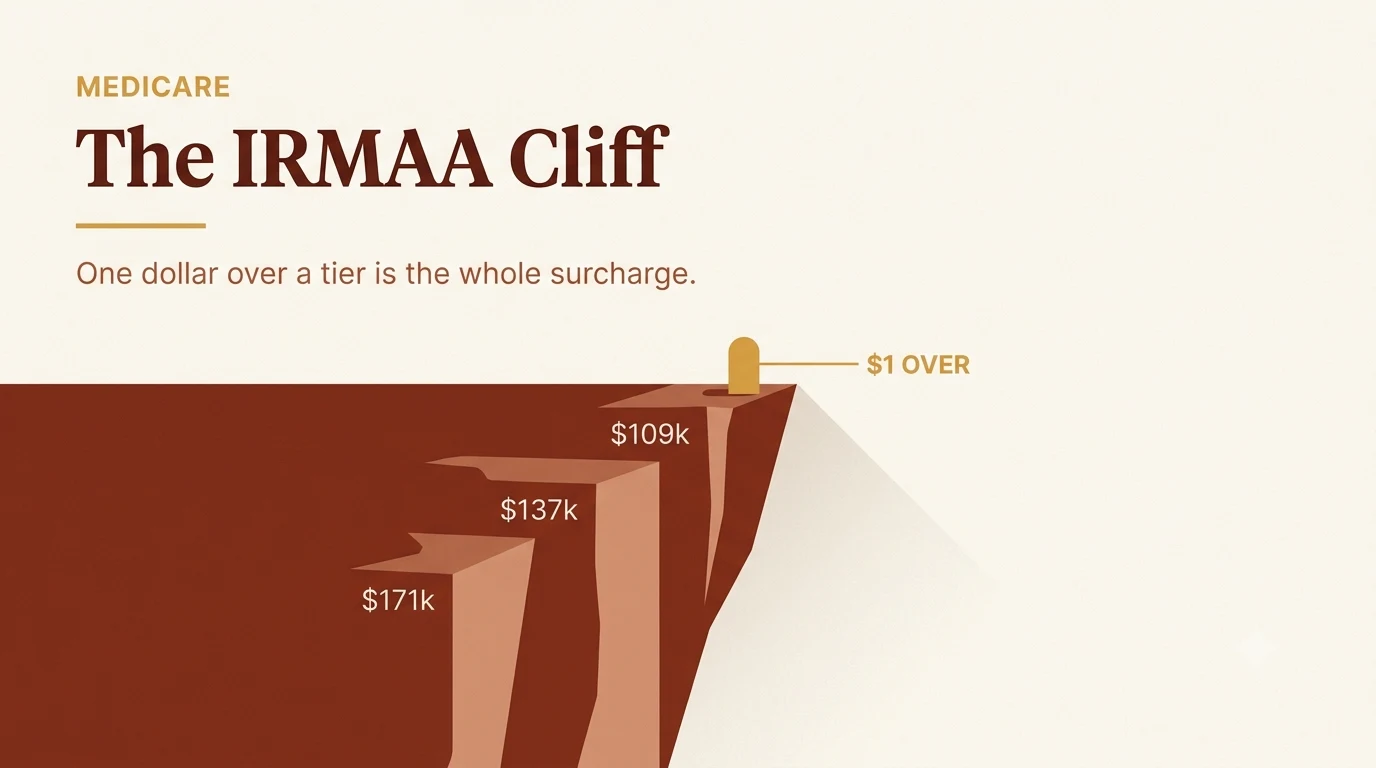
For 2026, IRMAA is based on 2024 MAGI. Above $109,000 single / $218,000 joint the surcharge begins, and it steps up through several tiers to a top tier that starts at $500,000 single / $750,000 joint, where the total Part B premium reaches roughly $689.90 a month. IRMAA is a cliff: crossing a tier by a single dollar applies the full surcharge for that tier for the whole year. A large inherited-IRA distribution that lands $500 over a threshold can cost far more in Medicare premiums than a distribution planned $1,000 under it.
Spreading a distribution to stay under a tier — worked example
Assume a single Medicare beneficiary has $95,000 of other MAGI and needs to clear a $120,000 traditional inherited IRA over the remaining years. Taking it all in one year pushes MAGI to $215,000, several IRMAA tiers up, affecting premiums two years later. Splitting it into roughly $12,000–$13,000 a year keeps MAGI near $107,000–$108,000, below the first surcharge threshold entirely. The account still empties on schedule; the Medicare cost is a fraction of the lump-sum version.
The article's worked example: $95,000 of other MAGI and a $120,000 traditional inherited IRA; single filer, 2026 threshold.
Inherited IRA income is not itself net investment income
A traditional inherited IRA distribution is ordinary income and is not directly subject to the 3.8% net investment income tax. But it does raise modified adjusted gross income, and if that pushes MAGI over the NIIT threshold ($200,000 single / $250,000 joint), the beneficiary's other investment income—interest, dividends, capital gains—can become subject to the 3.8% tax. A large withdrawal can therefore create a NIIT bill on income that has nothing to do with the IRA.
- Separate the legally required RMD from optional withdrawals.
- Match each tax year with the Medicare premium year it may affect.
- Include other AGI items and tax-exempt interest in the MAGI estimate.
- Check whether a listed SSA reassessment route actually applies.
- Update thresholds and premiums from current official tables each year.
Use current SSA and Medicare tables every year
IRMAA thresholds and premium amounts change. For a beneficiary with several years left before the inherited IRA must be emptied, the most reliable process is to update the Medicare side annually using SSA or Medicare.gov and to keep the federal RMD deadline in a separate compliance schedule.