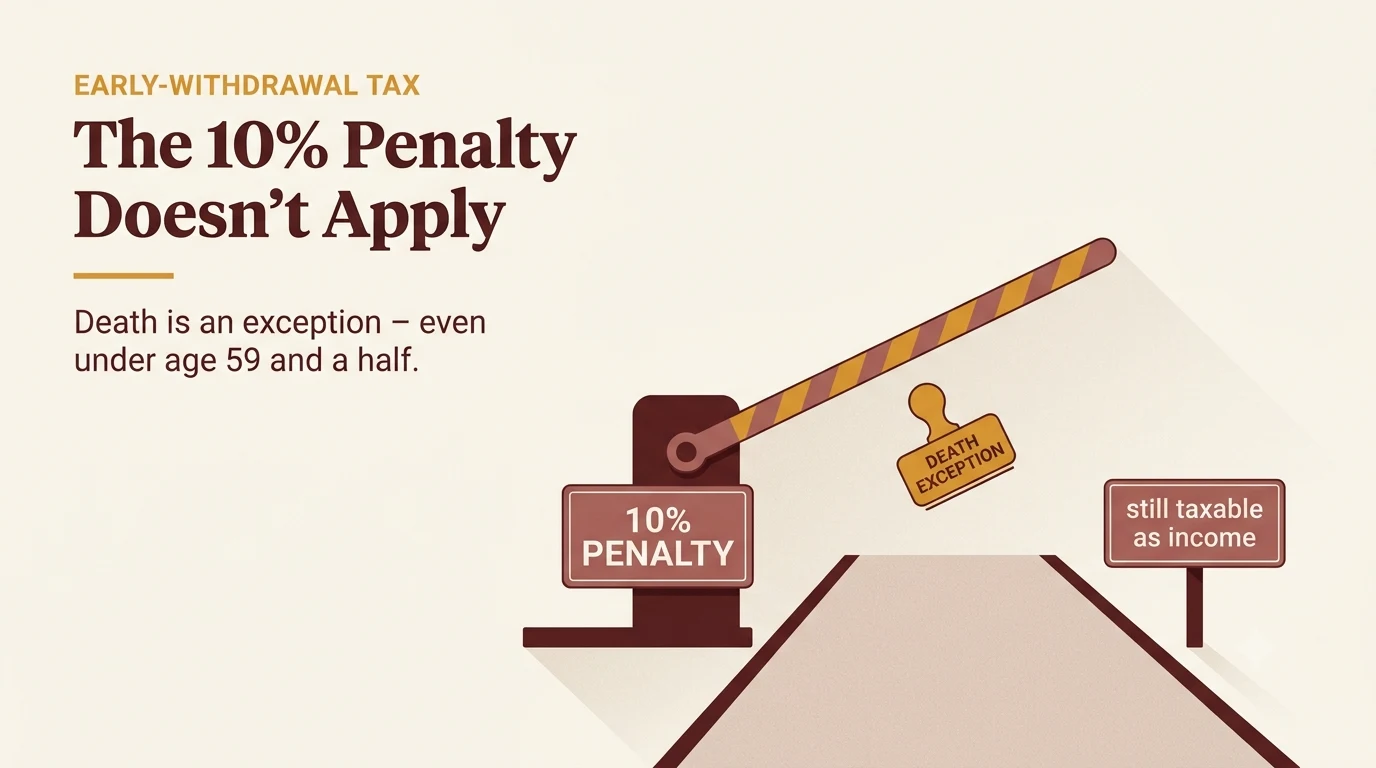
The beneficiary’s age under 59½ is usually not the problem people expect
IRA owners commonly associate distributions before age 59½ with an additional 10% tax. Death is an exception. Publication 590-B explains that distributions made to a beneficiary or estate on or after the owner’s death are not subject to the additional 10% tax on early distributions merely because the beneficiary is young.
Example: a 35-year-old adult child
A 35-year-old daughter inherits her mother’s traditional IRA and takes a $25,000 beneficiary distribution. The distribution can be included in taxable income to the extent it would have been taxable to the owner, but the daughter’s age alone does not trigger the usual 10% early-distribution additional tax because the payment is made after the owner’s death.
Income tax and the 10% additional tax are different questions
| Question | Inherited traditional IRA |
|---|---|
| Is the distribution potentially taxable income? | Yes, generally to the extent it would have been taxable to the decedent |
| Does beneficiary age under 59½ automatically add the 10% early-distribution tax? | Generally no for a distribution after the owner’s death |
| Can withholding still apply? | Yes |
Why inherited-account registration still matters
The death exception is tied to a beneficiary distribution after the owner’s death. A non-spouse beneficiary should keep the account properly registered as inherited rather than trying to move it into a personal IRA. A later distribution from the beneficiary’s own IRA can be analyzed under different rules.
Form 1099-R often signals the death distribution
IRS instructions for Form 1099-R use distribution code 4 for a death distribution, including certain payments to beneficiaries. The code is useful evidence of how the payer reported the transaction, but the taxpayer should still compare the form with the actual account and beneficiary facts.
When a beneficiary still has to file Form 5329
If the payer codes box 7 of Form 1099-R as 4 for death, the beneficiary usually does not need to file Form 5329 to claim the exception—the coding already tells the IRS the additional tax does not apply. The form becomes necessary when a 1099-R is miscoded, for example with code 1 (early distribution, no known exception). In that case the beneficiary reports the distribution and uses Form 5329, Part I, with exception code 04 for death, to override the additional 10% tax. Keeping the death certificate and inherited-account records supports that entry.
A surviving spouse who rolled the IRA into their own can lose the exception
The death exception is tied to a distribution taken from an account that is still inherited. A surviving spouse who elects to treat the IRA as their own—or rolls it into their existing IRA—converts it into an ordinary owned IRA. A later withdrawal from that account before the spouse reaches 59½ is tested under the normal early-distribution rules, and the death exception no longer applies. A spouse who may need the money before 59½ sometimes keeps the account as an inherited IRA specifically to preserve the exception.
A surviving spouse who treats the IRA as their own is tested under the normal early-distribution rules before 59½. A spouse who may need the money earlier sometimes keeps the account as an inherited IRA to preserve the death exception.
Do not confuse this exception with RMD penalty rules
The absence of a 10% early-withdrawal tax does not mean an inherited IRA has no penalties. A missed required minimum distribution can be subject to a separate excise tax under the RMD rules. The death exception answers only the early-distribution-tax question.
The exception continues even if the beneficiary is much younger than the owner
A 25-year-old beneficiary does not need to wait until age 59½ to take a required or discretionary distribution from a properly inherited IRA merely to avoid the additional 10% early-distribution tax. In fact, a 10-year beneficiary may be required to empty the account decades before reaching 59½.
Moving inherited money into your own IRA can change the later analysis
For a non-spouse beneficiary, such a move is generally not allowed in the first place. For a spouse who validly treats an inherited IRA as his or her own, a later distribution from the spouse’s own IRA can be tested under the normal early-distribution rules. That is one reason spouse examples should not be copied into a non-spouse guide.
Separate three possible taxes on the worksheet
- Regular income tax on the taxable portion of the beneficiary distribution.
- The 10% additional tax on early distributions, generally avoided under the death exception for beneficiary payments.
- The separate RMD excise tax if a required amount is not distributed on time.
Using separate lines prevents the phrase “no penalty” from being misunderstood as “no tax.”