Most traditional inherited IRA withdrawals are taxable, but “gross distribution” is not always “taxable distribution”
Publication 590-B says beneficiaries of a traditional IRA must include taxable distributions in gross income. If the deceased owner’s IRA contained only deductible contributions and tax-deferred earnings, that usually makes the distribution taxable to the beneficiary as ordinary income.
The analysis changes when the owner had basis from nondeductible traditional IRA contributions. That after-tax basis can make part of a beneficiary distribution nontaxable.
The owner’s basis stays with the inherited IRA
Publication 590-B specifically states that if a beneficiary inherits a traditional IRA from a person who had basis because of nondeductible contributions, the basis remains with the IRA. The beneficiary does not lose it merely because the owner died.
For a non-spouse beneficiary, that inherited basis also stays separate from the beneficiary’s own traditional IRA basis and from basis in traditional IRAs inherited from other decedents. This is a major recordkeeping point: a person who inherits from two parents can end up with separate basis calculations tied to each decedent.
Form 8606 is the key reporting document when inherited basis exists
The Form 8606 instructions say a beneficiary who receives a distribution from an inherited traditional IRA that has basis may need to file Form 8606. They also state that if a person must file Form 8606 for IRAs inherited from more than one decedent, a separate Form 8606 is filed for each decedent.
This prevents a beneficiary from blending the father’s nondeductible basis, the mother’s nondeductible basis, and the beneficiary’s personal IRA basis into one pool.
Do not assume basis comes out first
Inherited basis does not normally mean the beneficiary can simply withdraw “the tax-free part first.” Traditional IRA basis is recovered under the pro-rata rules. The taxable and nontaxable portions depend on the relevant basis, distributions, and account values used on Form 8606.
That is why an example such as “the IRA has $20,000 of basis, so the first $20,000 is tax-free” is generally misleading. The beneficiary should use the current Form 8606 instructions rather than a first-in-first-out shortcut.
- Find the decedent's remaining basisUse the final Form 8606 and earlier records if needed.
- Keep each decedent's basis separateDo not blend personal IRA basis or basis inherited from another person.
- Apply the pro-rata calculationUse the relevant basis, distributions, and account values on Form 8606.
- Report the taxable portionKeep the tax calculation separate from the RMD amount that had to leave the account.
The Form 8606 calculation separates taxable income from recovery of inherited basis.
Example: inherited IRA with documented nondeductible basis
Assume a beneficiary inherits a traditional IRA worth $180,000 and the decedent’s final Form 8606 shows $24,000 of remaining basis. The beneficiary later takes a $30,000 distribution. The distribution is not automatically $30,000 taxable, but it is also not automatically $24,000 tax-free. The beneficiary must apply the Form 8606 basis calculation using the required year-end values and distribution amounts.
The useful conclusion is that the $24,000 basis is an input to a pro-rata computation, not a coupon that can simply be attached to the first withdrawal.
Having inherited basis does not normally let a beneficiary withdraw the tax-free part first. The taxable and nontaxable portions depend on the Form 8606 calculation.
Why the decedent’s old Forms 8606 can be more important than the new 1099-R
A custodian typically knows what it distributed, but it may not have the complete history of nondeductible contributions made at prior institutions. Form 1099-R therefore does not by itself prove how much inherited basis remains.
Beneficiaries should ask the executor, surviving family members, tax preparer, or document archive for prior Forms 8606. If those records cannot be found, reconstructing basis can become difficult because the taxpayer has to support the nontaxable amount claimed.
- Collect the decedent's final and earlier Forms 8606.
- Save year-end IRA statements and transfer statements.
- Keep each beneficiary Form 1099-R.
- File a separate Form 8606 for each decedent when required.
- Keep RMD calculations and distribution confirmations with the basis records.
Withholding does not determine the taxable amount
Federal or state withholding taken from an inherited IRA distribution is only a tax payment. It does not establish the final amount included in income. A beneficiary can have 20% withheld from a distribution that is less than 100% taxable, or no withholding from a distribution that later produces substantial tax.
The tax return, not the withholding election, resolves the taxable portion.
RMD compliance and basis accounting run in parallel
An RMD is measured by the distribution rules. Basis determines how much of a distribution is taxable. A distribution can count toward an RMD even though part of it is a nontaxable recovery of basis. The beneficiary should therefore maintain two separate worksheets: one for the amount that had to leave the account and another for the taxable/nontaxable allocation.
The distribution stacks on top of everything else on the return
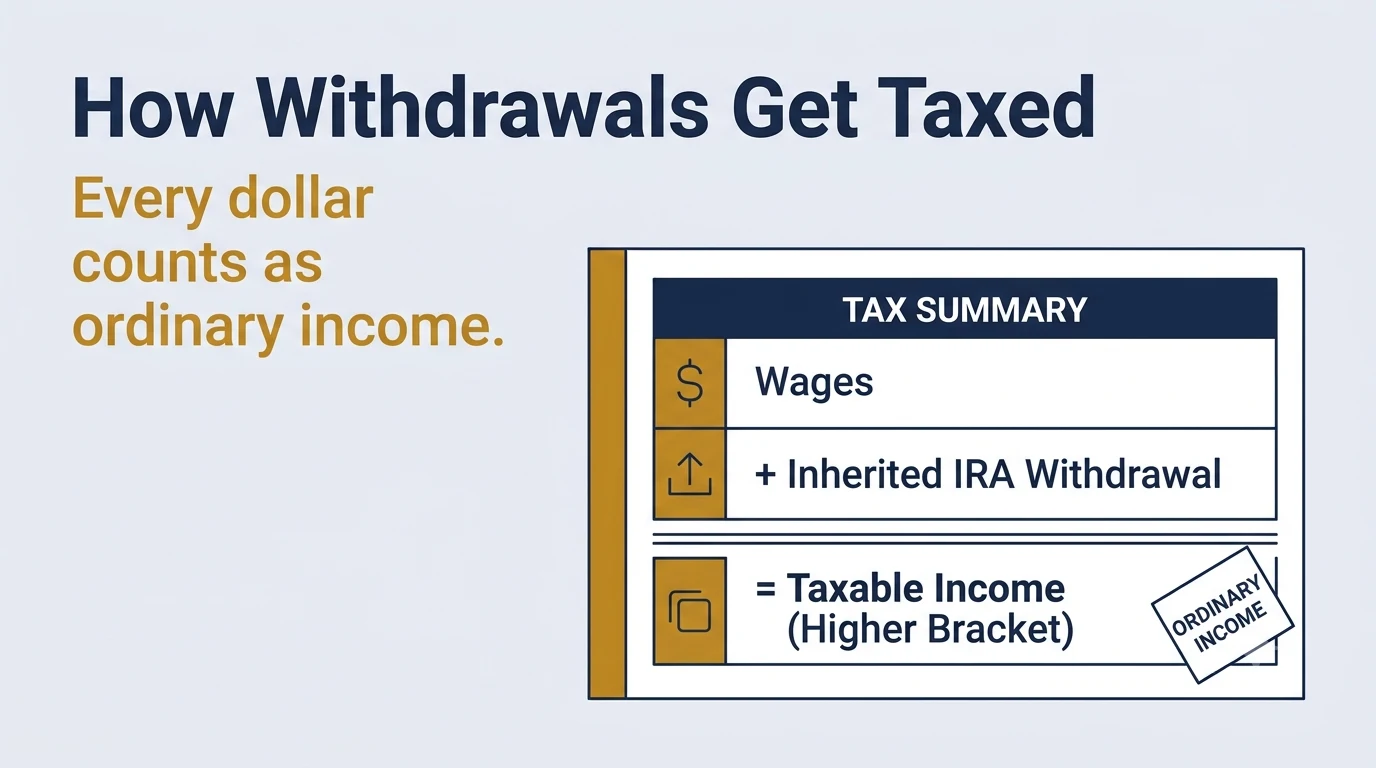
A traditional inherited IRA distribution is ordinary income that lands on top of the beneficiary's wages, self-employment income, pensions, and taxable Social Security. It is taxed at the beneficiary's marginal rate for the bracket it fills, not at a flat rate the custodian withheld. It also raises adjusted gross income, which can reduce or eliminate deductions and credits that phase out with income, increase the taxable share of Social Security benefits, and push modified AGI toward Medicare IRMAA and net investment income tax thresholds. Modeling only the bracket understates the real cost of a large withdrawal.
The IRD deduction, in plain terms
If federal estate tax was actually paid on the decedent's estate and the IRA was part of the taxable estate, the beneficiary can generally deduct the portion of that estate tax attributable to the IRA as an itemized deduction, spread across the years the beneficiary reports the IRA income. This is the income-in-respect-of-a-decedent deduction. It only applies where federal estate tax was paid—rare given the high exemption—but when it applies it can meaningfully reduce the tax on inherited-IRA withdrawals. The executor's estate tax return (Form 706) supplies the figure.
State income tax varies widely
Federal rules are only half the picture. Several states have no income tax at all. Some states that do tax income fully exempt inherited-IRA distributions—Pennsylvania, for example, does not tax IRA distributions paid to a beneficiary by reason of the owner's death. Others give a limited retirement-income exclusion; New York exempts only the first $20,000 per person, so distributions above that are taxed. And a handful tax the distribution in full. A beneficiary who plans to move during the 10-year window, or who lives in a different state than the decedent did, should check the resident state's rule for each year a distribution is taken.
A few states also impose an inheritance tax up front
Separate from income tax, Pennsylvania and New Jersey impose an inheritance tax measured on the account value at death, based on the beneficiary's relationship to the owner. Pennsylvania's rate for an adult child is 4.5% with no exemption threshold, and it is generally due within nine months of death regardless of when distributions are taken. This is a one-time transfer tax the beneficiary or estate pays on top of the federal and state income tax on later withdrawals.
Estate-tax deduction can be a separate issue
Publication 590-B notes that a beneficiary may in some cases be able to claim a deduction for estate tax attributable to income in respect of a decedent. That is a separate tax issue from IRA basis and should not be mixed into the Form 8606 calculation. Where federal estate tax was actually paid, Publication 559 and professional tax review may be relevant.
| Tax type | What it covers | Key detail from this article |
|---|---|---|
| Federal income tax | Taxable traditional IRA distributions | Ordinary income stacks on top of wages and other income. |
| State income tax | State treatment of IRA distributions | Rules vary by state; Pennsylvania exempts certain distributions, while New York exempts only the first $20,000 per person. |
| State inheritance tax | Transfer tax measured on the account value at death | Pennsylvania and New Jersey impose it; Pennsylvania's adult-child rate is 4.5%, generally due within nine months. |
| Estate-tax (IRD) deduction | A deduction for estate tax attributable to IRA income | It applies only where federal estate tax was actually paid. |
A durable record set for a traditional inherited IRA
- the decedent’s last Form 8606 and earlier Forms 8606 if needed to verify basis;
- year-end IRA statements and transfer statements;
- the beneficiary’s Forms 1099-R;
- the beneficiary’s separate Form 8606 for that decedent when required;
- RMD calculations and distribution confirmations; and
- the year-10 deadline if the beneficiary is subject to the 10-year rule.
Keeping those records together protects both sides of the problem: proving the RMD was satisfied and proving that any nontaxable basis was reported correctly.