A taxable inherited IRA withdrawal changes the whole return, not one isolated “IRA bracket”
Taxable distributions from a traditional inherited IRA are generally included in ordinary income. The marginal tax rate that applies to the next dollar depends on the beneficiary’s taxable income, filing status, deductions, and other items on the same return.
There is no separate tax bracket just for inherited IRA money. The distribution is layered onto the rest of the beneficiary’s federal tax picture.
Marginal brackets mean only the top slice moves into the next rate
A common planning error is to assume that crossing a bracket threshold causes the entire withdrawal—or the entire year’s income—to be taxed at the higher rate. Federal individual rates are marginal. Only the taxable income that falls inside a higher band is taxed at that band’s rate.
For 2026, the IRS publishes the current tax-rate schedules. A beneficiary comparing optional withdrawals should use the schedule for the actual tax year rather than a bracket table saved years earlier.
Hypothetical 2026 example: one withdrawal can span two marginal brackets
Assume a single beneficiary expects $70,000 of taxable income before an optional inherited traditional IRA withdrawal and is using the 2026 federal rate schedule. A $50,000 additional taxable withdrawal would not all be taxed at one rate. Part of the added income would fall within the 22% band and the rest could extend into the 24% band, depending on the beneficiary’s final taxable income and other return items.
This is only a bracket illustration. It does not include credits, deductions, capital-gain interactions, state taxes, Medicare, or Social Security calculations.
Required annual RMDs are the floor; planning applies to the amount above the floor
If the original owner died on or after the required beginning date, an ordinary designated beneficiary generally has annual beneficiary RMDs during the 10-year period. Those amounts are mandatory even if the beneficiary would prefer a different tax year.
Tax timing can still matter for voluntary withdrawals above the RMD and for how much of the account is left for later years. The compliance number and the planning number should therefore be shown separately.
Social Security taxation can change as other income rises
Publication 915 explains that the taxable portion of Social Security benefits depends on the beneficiary’s benefits and other income. Up to 85% of benefits can be taxable in some circumstances. A taxable inherited IRA withdrawal can increase the income used in that calculation, so the cost of an additional withdrawal is not always captured by multiplying the withdrawal by one marginal tax rate.
This interaction is relevant only to beneficiaries receiving Social Security, but it is common enough to include in a multi-year comparison.
Capital gains use a separate rate structure that still depends on total taxable income
Long-term net capital gains can be taxed at rates different from ordinary income, yet the applicable capital-gain rate depends in part on overall taxable income. A year with a large asset sale can therefore change the tax result of an inherited IRA withdrawal even though the IRA distribution itself is ordinary income.
IRS Topic 409 and the current rate schedules should be used when a comparison includes large investment gains rather than assuming the two categories are independent.
Medicare IRMAA uses a different income test and a later premium year
For Medicare beneficiaries, a taxable inherited IRA distribution can also increase modified adjusted gross income used for IRMAA. Social Security generally uses tax information from two years before the Medicare premium year when available. The effect can therefore appear later than the income-tax bill.
This is not a reason to skip a required RMD. It is another factor to include when comparing additional voluntary withdrawals.
State income tax can change even when the federal RMD rule does not
Federal beneficiary rules follow the account and death facts, not the beneficiary’s state of residence. State taxation of retirement distributions can differ. A beneficiary who expects to move during a 10-year period can therefore face the same federal deadline but a different state-tax result in different years.
Because state rules are jurisdiction-specific, this site does not generalize a federal example into a state-tax recommendation.
A practical multi-year comparison should show more than one number
| Year | Required RMD | Optional withdrawal | Other taxable income | Notes to check |
|---|---|---|---|---|
| Year A | Legal minimum | Scenario amount | Wages/pension/investments | Current tax brackets; Social Security |
| Year B | Legal minimum | Scenario amount | Lower or higher income | Capital gains; deductions |
| Year C | Legal minimum | Scenario amount | Retirement-year income | IRMAA lookback; state residency |
The point is to compare complete tax years, not to divide the inherited account by ten and assume the result is efficient.
The bracket-fill method, step by step
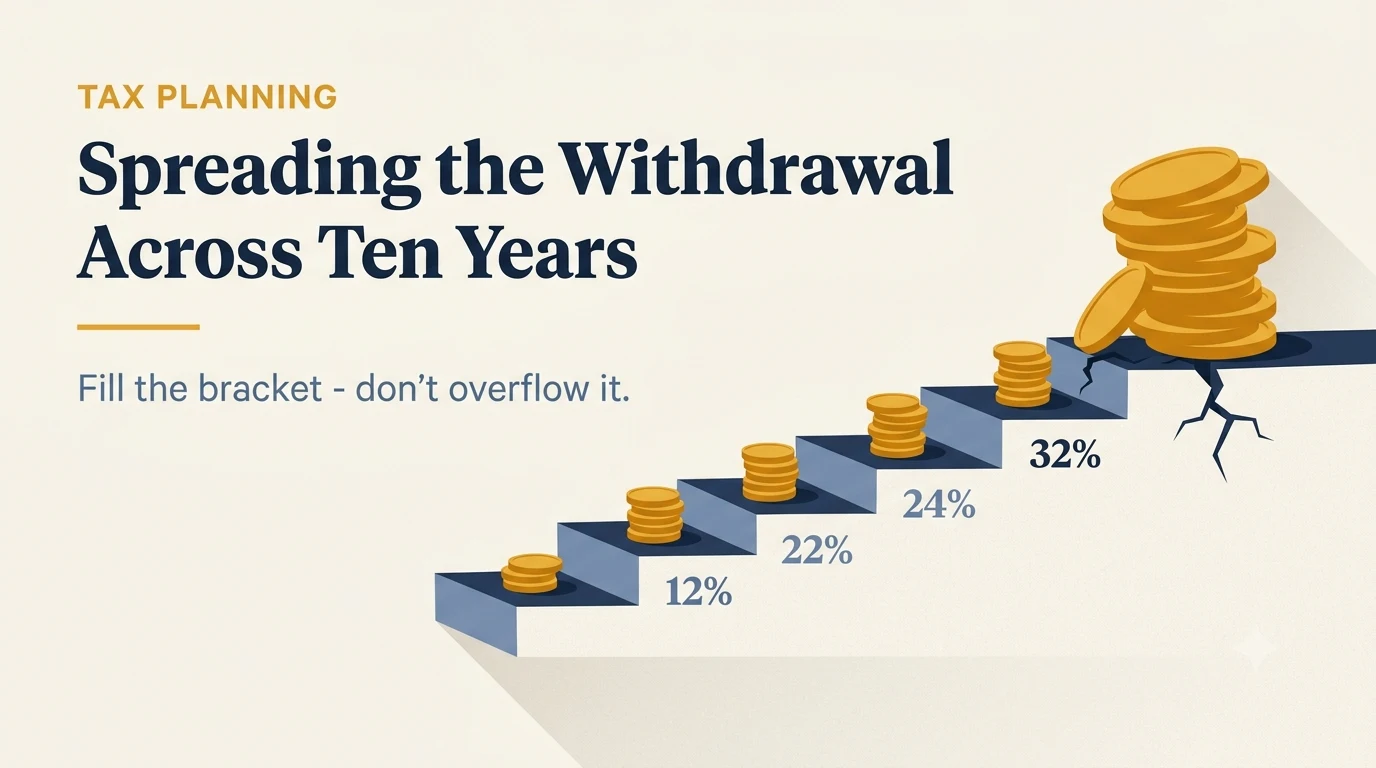
The most widely used framework for a traditional inherited IRA under the 10-year rule works like this. First, project the beneficiary's taxable income for the year without any inherited-IRA withdrawal. Second, find the top of the tax bracket that income sits in—for 2026 the 22% bracket, for example, runs to roughly the low six figures for a single filer. Third, withdraw an amount that brings taxable income up to, but not past, that ceiling. Repeat each year, and take whatever remains in the final year. The goal is to avoid a year-10 lump that spills into the 32% or 35% bracket when the same money could have come out at 22% or 24% spread over the period.
- Project taxable income without an IRA withdrawalDo this for the year in question.
- Find the top of the bracket that income sits inUse the current-year schedule for your filing status.
- Withdraw up to that ceiling, not past itAim to avoid spilling into a higher bracket.
- Repeat each year and take the remainder in the final yearThe goal is to avoid a year-10 lump taxed at a much higher rate.
A smoothing approach for a traditional inherited IRA under the 10-year rule; it still needs current tax figures.
The 2025 law changed the calculus
The One Big Beautiful Bill Act, signed July 4, 2025, made the current seven-bracket structure permanent and cancelled the higher rates that had been scheduled to return in 2026. Planning advice that says to accelerate inherited-IRA withdrawals into 2024 or 2025 to beat a rate increase no longer reflects the law. Bracket-filling still makes sense as a way to smooth income; the specific urgency to compress it into the last pre-sunset years does not.
Watch the cliffs, not just the brackets
Brackets are marginal—only the dollars above a threshold are taxed at the higher rate. Several other items are cliffs. Medicare IRMAA jumps the full surcharge the moment MAGI crosses a tier (the 2026 top tier begins at $500,000 for individuals and $750,000 for couples, based on 2024 income). The net investment income tax and certain phaseouts behave similarly. A withdrawal plan that only watches the marginal bracket can still cross a cliff that costs more than the bracket difference.
Refresh the projection instead of locking a ten-year schedule on day one
Tax brackets, deductions, Medicare thresholds, account values, and the beneficiary’s own income can change. The legal year-10 deadline remains anchored to the controlling death or beneficiary event, but a tax projection prepared in year 1 can be obsolete by year 5.
A strong process keeps the RMD compliance file stable and updates the tax-planning model with current-year official figures.