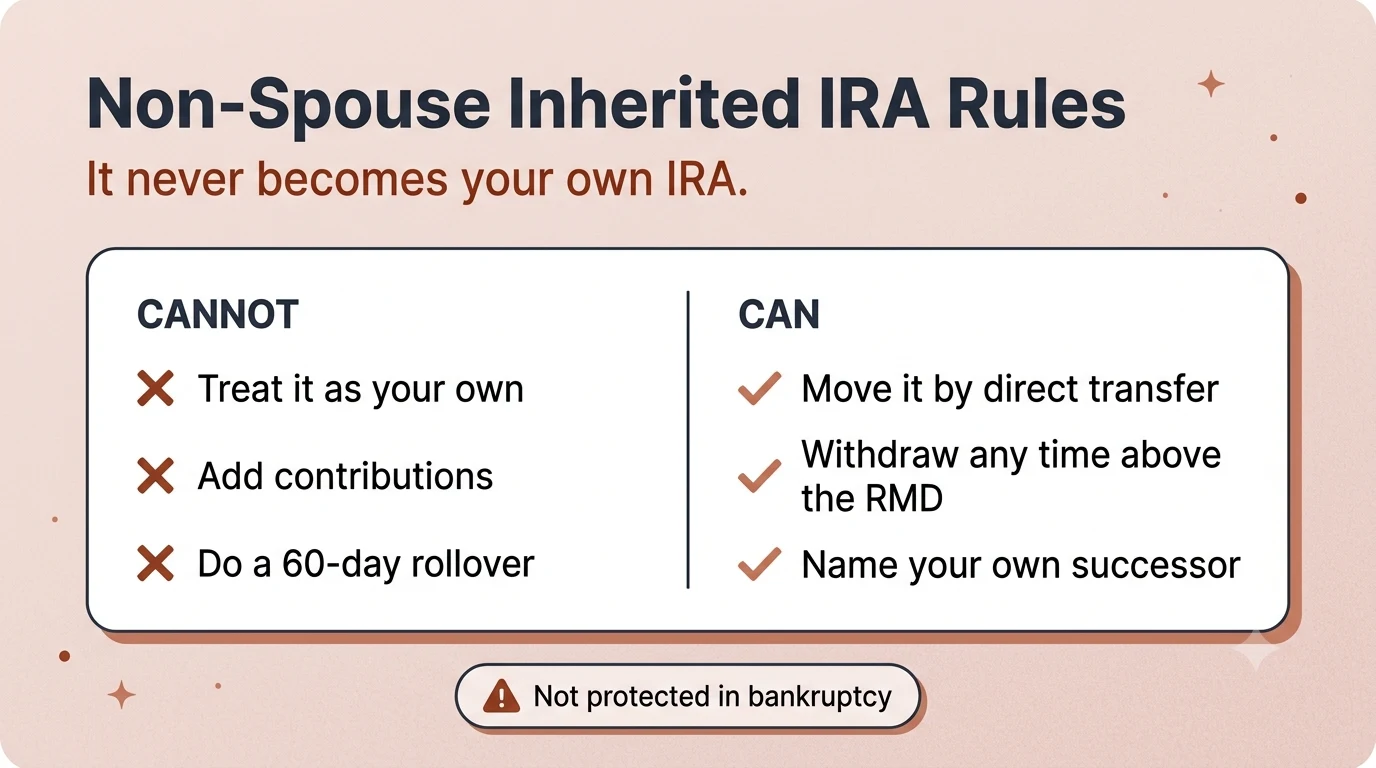
A non-spouse inherited IRA stays an inherited account
Publication 590-B makes an important distinction: a person who inherits a traditional IRA from someone other than a spouse cannot treat that inherited IRA as the person’s own IRA. The beneficiary cannot make regular contributions to it, and ordinary rollover rules that apply to one’s own IRA do not apply in the same way.
Trustee-to-trustee movement is different from a personal rollover
An inherited IRA can generally be moved by trustee-to-trustee transfer to another inherited IRA that is properly titled for the same deceased owner and beneficiary. That is different from receiving the money personally and attempting a 60-day rollover. The inherited-account registration must be preserved.
RMD obligations follow the inherited status
Moving an inherited IRA to another custodian does not restart the ten-year clock and does not erase an annual beneficiary RMD. The death date and beneficiary status travel with the account for RMD purposes. A transfer is administrative; it is not a new inheritance event.
- Confirm the receiving account is inheritedUse the same deceased owner and beneficiary registration.
- Arrange a direct trustee-to-trustee transferKeep the assets moving between custodians.
- Carry forward the death date and RMD historyA transfer does not restart the deadline or erase an annual RMD.
- Reconcile any later distributionA transfer and a payment to you have different tax treatment.
Do not mix inherited accounts casually
IRS Form 5329 instructions explain that inherited IRA RMDs may be aggregated only in limited circumstances. Inherited IRAs from the same decedent can have aggregation rules, while accounts inherited from different decedents cannot simply be combined to satisfy one another’s RMDs. The legal owner/beneficiary history matters.
What a clean account title should communicate
Financial institutions use their own formatting, but inherited IRA registration generally needs to reflect that the original owner is deceased and that the account is maintained for the beneficiary. Before initiating a transfer, ask both custodians how the inherited registration will appear and whether the receiving account is coded for the same decedent.
Keep the tax character separate from the transfer mechanics
A direct transfer between custodians can preserve tax deferral, but later distributions from a traditional inherited IRA are generally taxable to the beneficiary to the extent they would have been taxable to the owner. Administrative movement of the account does not make future distributions tax-free.
Why a check payable to the beneficiary can create a problem
A non-spouse inherited IRA does not have the same 60-day rollover flexibility as the beneficiary’s own IRA. If the goal is to move custodians while preserving inherited status, the safer structure is a trustee-to-trustee transfer in which the beneficiary does not take constructive possession of the assets. Before authorizing a check, confirm exactly who the payee will be and how the receiving institution will register the account.
Do not add personal contributions
Publication 590-B states that a non-spouse beneficiary cannot make contributions to the inherited IRA. The account is a distribution vehicle for the decedent’s retirement assets, not an additional contribution account for the beneficiary. Personal retirement savings should go to the beneficiary’s own eligible retirement account under the rules that apply to that account.
Only a legal spouse gets spousal options
The spouse-versus-non-spouse line is a legal one. A domestic partner, a fiancé or fiancée, an ex-spouse, or someone the owner treated as family is a non-spouse beneficiary no matter how close the relationship was. Spousal options—treating the IRA as one's own, delaying distributions to the year the deceased would have reached RMD age, using the Uniform Lifetime Table—are available only to a surviving spouse who was married to the owner at death.
What a non-spouse beneficiary can and cannot do
| Cannot | Can |
|---|---|
| Treat the inherited IRA as their own | Move it by direct trustee-to-trustee transfer to another inherited IRA |
| Make contributions to it | Take distributions at any time, in any amount at or above the RMD |
| Use a 60-day rollover | Name a successor beneficiary |
| Defer distributions the way a spouse can | Split a multi-beneficiary IRA into a separate inherited account |
An inherited IRA is not protected in bankruptcy
In Clark v. Rameker (2014), the U.S. Supreme Court held that a non-spouse inherited IRA is not exempt from creditors in bankruptcy because it is not the beneficiary's own retirement fund—the beneficiary can withdraw it at any time. A regular IRA has a large federal bankruptcy exemption; an inherited IRA generally does not. A few states that use their own exemptions have enacted specific protection for inherited IRAs—Florida, Missouri, North Carolina, and Texas are the commonly cited examples—so the answer depends on where the beneficiary lives. A beneficiary with real creditor exposure should not assume the account is shielded simply because it holds retirement money.
A non-spouse inherited IRA is generally not exempt from creditors in bankruptcy (Clark v. Rameker). Some states provide their own protection, so a beneficiary with creditor exposure should not assume the account is shielded.
A trust named as beneficiary can restore protection
If asset protection matters, the answer is usually decided before the owner dies, not after. An IRA left to a properly drafted see-through accumulation trust for the beneficiary can keep the money outside the beneficiary's bankruptcy estate while still qualifying for the post-death RMD rules. A conduit trust, which passes every distribution straight through, offers less protection. This is an estate-planning decision for the original owner and their attorney.
Account renaming does not change the tax history
A custodian may format the title differently—such as including “deceased,” “beneficiary,” or “inherited”—but the underlying history must remain clear. If an account is transferred, save the outgoing and incoming statements together so a later custodian or tax preparer can see that the assets came from the same decedent.
Separate the transfer from the distribution decision
A trustee-to-trustee transfer moves assets without necessarily creating taxable income. A distribution to the beneficiary is different: it may be taxable and can count toward an RMD. When reviewing an account statement, make sure a transaction labeled “transfer” was not actually processed as a reportable distribution.
- Ask both custodians how the inherited account will be titled.
- Confirm the receiving account names the same decedent and beneficiary.
- Check who a transfer check is payable to before authorizing it.
- Save outgoing and incoming statements together.
- Make sure a transaction labeled "transfer" was not processed as a reportable distribution.