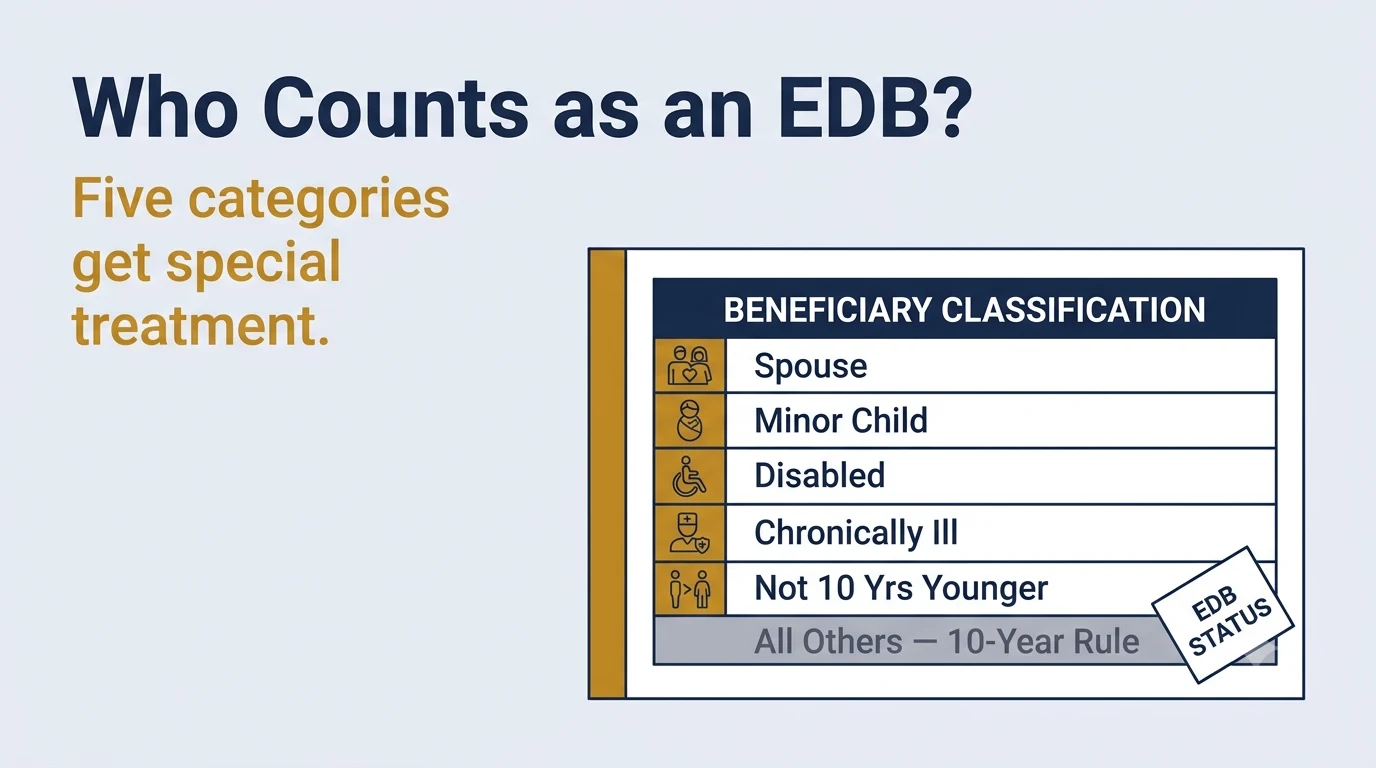
Eligible designated beneficiary is a defined tax category
An eligible designated beneficiary (EDB) is one of five people the post-SECURE Act rules let take life-expectancy — “stretch” — distributions from an inherited IRA instead of the 10-year rule: a surviving spouse; the account owner’s minor child, until age 21; a person who is disabled; a person who is chronically ill; and any beneficiary not more than 10 years younger than the owner. The category is narrower than “designated beneficiary” — a person can be a designated beneficiary without being an EDB — and it is fixed as of the original owner’s date of death.
The classification is determined as of the original owner’s death. It should be resolved before anyone chooses a withdrawal schedule.
The five EDB categories
The final regulations identify five principal categories:
- the owner’s surviving spouse;
- a child of the owner who has not reached the regulatory age of majority;
- an individual who is disabled under the tax definition;
- an individual who is chronically ill under the tax definition; or
- an individual who is not more than 10 years younger than the owner.
These are legal categories, not informal descriptions. “Minor,” “disabled,” and “chronically ill” have specific definitions for this purpose.
| EDB category | Who qualifies | What to check or document |
|---|---|---|
| Surviving spouse | The owner's surviving spouse | Confirm the beneficiary designation and spouse status at the owner's death. |
| Owner's child under 21 | The owner's child who has not reached age 21 | Confirm the child relationship and 21st birthday. |
| Disabled | A person meeting the tax definition of disability | At age 18 or older, check the substantial-gainful-activity standard; under 18, the marked-and-severe-limitations standard, as of the owner's death. |
| Chronically ill | A person meeting the chronic-illness definition | Check IRC section 7702B(c)(2) and certification by a licensed health care practitioner. |
| Not more than 10 years younger | A beneficiary not more than 10 years younger than the owner | Compare the owner's and beneficiary's exact dates of birth. |
For this rule, age of majority is 21
The 2024 final regulations state that an individual reaches the age of majority on the individual’s 21st birthday. The minor-child EDB category is also limited to a child of the deceased owner. A young grandchild, niece, nephew, sibling, or unrelated beneficiary does not qualify under the minor-child category merely because that person is under 21.
The regulations use the tax-law definition of “child,” which includes a stepchild, adopted child, and eligible foster child. Once a child who qualified only because of age reaches 21, the remaining account becomes subject to a 10-year full-distribution deadline measured from that event. If life-expectancy payments had begun, the final regulations generally continue annual distributions during that later 10-year period as well.
Disability is tested as of the owner’s death
For a beneficiary who is age 18 or older, the final regulations generally use a standard based on inability to engage in substantial gainful activity because of a medically determinable physical or mental impairment expected to result in death or to be of long-continued and indefinite duration. For a beneficiary under 18, the regulations use a marked-and-severe-functional-limitations standard.
A Social Security disability determination that establishes disability as of the owner’s death can also satisfy the regulatory rule. A condition that first becomes disabling after the owner dies does not retroactively make the beneficiary an EDB as of the death date.
Chronic illness also has a defined standard
The chronically ill category incorporates the long-term-care definition in Internal Revenue Code section 7702B(c)(2), with regulatory documentation rules. One branch of that definition involves inability to perform at least two activities of daily living without substantial assistance for an indefinite period reasonably expected to be lengthy in nature. The final regulations require certification by a licensed health care practitioner for the chronic-illness category.
Because these definitions are technical, a beneficiary should not rely on a custodian’s casual verbal statement such as “you probably qualify.” The supporting records should match the category claimed.
Plan beneficiaries can face an October 31 documentation deadline
The final regulations require documentation of disability or chronic illness to be provided to the plan administrator by October 31 of the calendar year following the owner’s death, or October 31, 2025 if later, for the regulatory situations covered by that rule. The documentation requirements are especially important for employer plans and see-through trust planning.
An IRA beneficiary should still preserve medical and classification records even where the custodian’s administrative process differs, because the tax result can depend on the beneficiary’s status as of the owner’s death.
The “not more than 10 years younger” category is pure date arithmetic
This category is often misunderstood as a family-relationship rule. It is not. The final regulations determine it from the two dates of birth. A beneficiary can be older than the owner, the same age, or up to 10 years younger and satisfy this category even if the person is a friend or sibling rather than a spouse.
For example, if the owner was born October 1, 1953, the final regulations illustrate that a beneficiary born on or before October 1, 1963 is not more than 10 years younger.
Why a surviving spouse needs a separate decision tree
A surviving spouse can have options that do not exist for other EDBs, including the possibility of treating an inherited IRA as the spouse’s own. Spouse-specific commencement rules can also apply. For that reason, a spouse should not use an adult-child example as a substitute for the spouse rules even though both people may technically fall within the EDB definition.
The status is locked at the owner's death
EDB classification is a snapshot taken on the owner's date of death, and it generally cannot be acquired afterward. A beneficiary who becomes disabled two years later does not become an EDB for that account. A disclaimer by another beneficiary can change who is counted, but it does not upgrade the survivors' category. This is why the beneficiary designation in force at death, the owner's and beneficiary's birth dates, and any contemporaneous medical evidence are the documents that decide the outcome.
The age-gap category is the one people miss
Four of the five categories track intuition—spouse, minor child, disabled, chronically ill. The fifth, an individual not more than 10 years younger than the owner, catches people off guard because it has nothing to do with family. A close friend, an unmarried partner, a sibling nine years younger, or a beneficiary older than the owner can all qualify. It is decided purely by comparing the two dates of birth, and it is often the reason a beneficiary who assumed the 10-year rule applied actually gets life-expectancy treatment.
Use status at the original owner's death, then compare birth dates for the age-gap category.
A classification worksheet prevents the most expensive category mistake
- Who was named as beneficiary on the owner’s death date?
- Is that person an individual, or is an estate, charity, or trust involved?
- If an individual, does one of the five EDB categories apply as of the death date?
- If the category is the owner’s child by age, what is the 21st birthday?
- If disability or chronic illness is claimed, what records support it and what documentation deadline applies?
- If the age-gap category is claimed, what are the exact birth dates?
Only after those facts are settled should the beneficiary determine whether life-expectancy payments, a 10-year rule, or a spouse-specific option controls the distribution schedule.