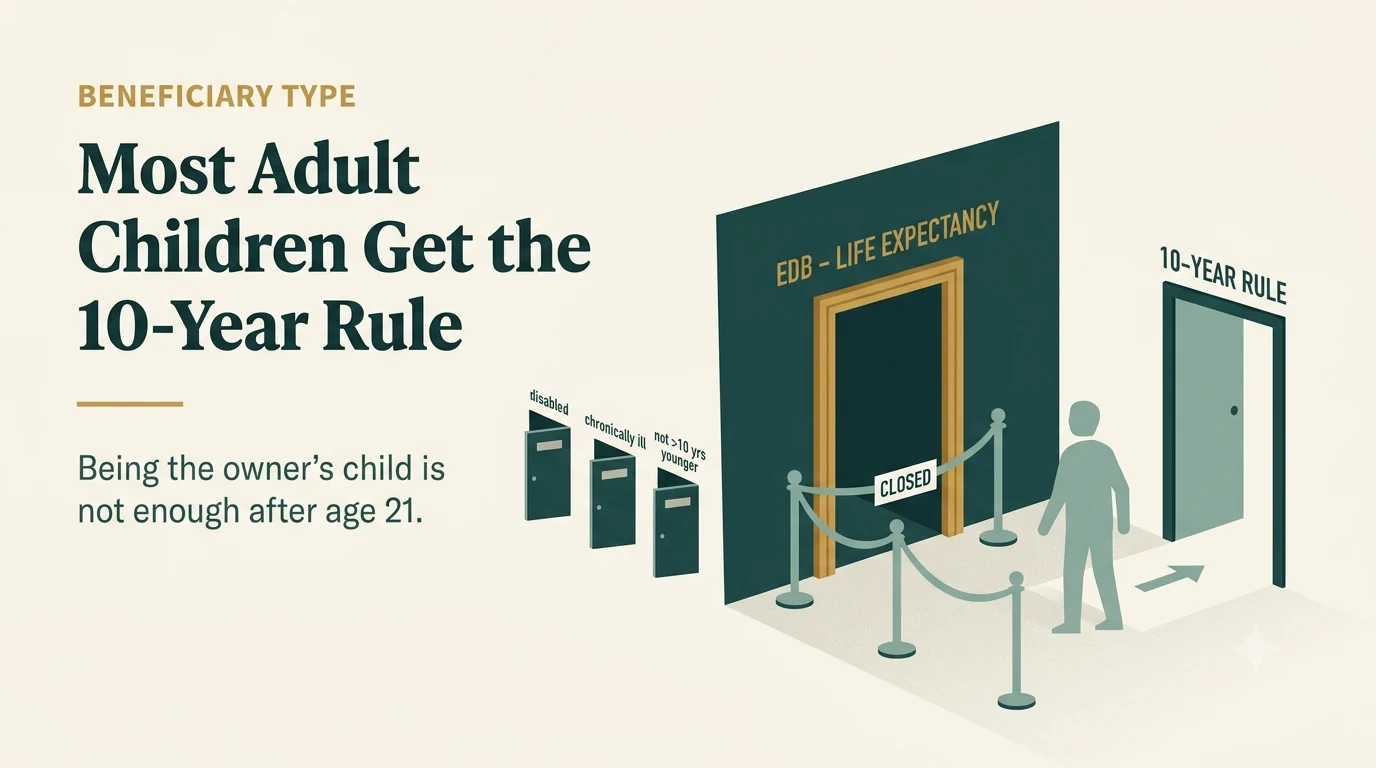
“Child” is not enough; the child must fit an eligible-designated-beneficiary category
An adult son or daughter can be the named individual beneficiary of a parent’s IRA and still be an ordinary designated beneficiary rather than an eligible designated beneficiary (EDB). That distinction drives whether life-expectancy treatment is available or the SECURE Act 10-year rule is the controlling framework.
The final RMD regulations define the minor-child EDB category by reference to a child of the deceased owner who has not reached age 21. Once the child is already 21 or older on the owner’s date of death, that minor-child category is unavailable. The adult child must then qualify under a different EDB category—disabled, chronically ill, or not more than 10 years younger than the owner—or the ordinary 10-year rule generally applies.
Example: a 45-year-old daughter inheriting from a 78-year-old parent
Assume a parent dies in 2026 at age 78 and leaves a traditional IRA to a 45-year-old daughter. She is a designated beneficiary because she is a named individual, but she is 33 years younger than the owner. If she is not disabled or chronically ill, she does not fit an EDB exception. The result is the 10-year rule.
Because the owner died after reaching the required beginning date, the analysis does not stop at “empty by year 10.” Under the final regulations, an ordinary designated beneficiary in this fact pattern generally must also take annual beneficiary RMDs during the 10-year period. The final distribution deadline is still December 31 of the year containing the tenth anniversary of the owner’s death.
Example: an adult child can still be an EDB for a reason unrelated to being the owner’s child
Change the facts: the daughter is age 69 when her 78-year-old parent dies. She is only nine years younger. Even though she is far beyond the minor-child age rule, the separate “not more than 10 years younger” EDB category may apply. An adult child can therefore be an EDB, but not merely because the beneficiary is the owner’s son or daughter.
The planning takeaway: most adult children get 10 years, so plan the drawdown
Because an adult child is almost never an EDB, the practical reality for most families is that the child has a 10-year window and, if the parent died after starting RMDs, an annual minimum on top of it. There is no life-expectancy stretch to fall back on. That makes the tax-planning question—how to spread a traditional IRA across those years to manage brackets, Medicare IRMAA, and the net investment income tax—the main decision, rather than the classification question.
The owner’s required beginning date is a separate question
Beneficiary classification answers one branch of the decision tree. The owner’s RMD status answers another. For an ordinary adult child subject to the 10-year rule, the owner’s death before the required beginning date generally means no annual distribution is required merely because of the 10-year rule in years 1 through 9. Death on or after the required beginning date generally brings annual beneficiary RMDs into the picture as well.
That distinction is explained in more detail in Do You Have to Take an Inherited IRA RMD Every Year?.
Do not use the beneficiary’s own retirement age as the legal trigger
A 35-year-old, 50-year-old, and 65-year-old adult child can all be ordinary designated beneficiaries. The beneficiary’s age can affect tax planning, Medicare timing, or the life-expectancy denominator in a fact pattern where annual RMDs are required, but the beneficiary does not escape the inherited-account rules by being under age 59½ or by not yet being retired.
Do not confuse the 10% early-distribution tax with the 10-year rule
The 10-year rule controls how long an inherited account can remain undistributed. The 10% additional tax on early IRA distributions is a different rule. Distributions made to a beneficiary because of the IRA owner’s death are generally exempt from that 10% additional tax, even when the beneficiary is younger than 59½. Taxable traditional-IRA distributions can still be included in ordinary income.
A practical classification worksheet for an adult child
| Question | Why it matters |
|---|---|
| Was the beneficiary under 21 on the parent’s date of death? | If yes, the minor-child EDB category may apply. |
| Was the beneficiary disabled as of the date of death? | A separate EDB category may apply. |
| Was the beneficiary chronically ill as of the date of death? | A separate EDB category may apply. |
| Is the beneficiary no more than 10 years younger than the owner? | A separate EDB category may apply even for an adult child. |
| If none apply, was the owner before or after the required beginning date? | This determines whether annual RMDs generally accompany the 10-year deadline. |
Records worth preserving before the first distribution
Keep the owner’s date of birth and date of death, the beneficiary’s date of birth, the beneficiary designation, the prior-year-end account statement, and any records relevant to disability or chronic illness. Those documents support the classification rather than relying on a custodian screen that simply labels the account “inherited.”
For most adult children, the core conclusion is simple but easy to state incorrectly: being the owner’s child does not by itself create life-expectancy treatment after age 21. The specific EDB categories control.
- Save the owner's and beneficiary's dates of birth and death date.
- Keep the beneficiary designation.
- Document any disability or chronic illness that existed at the owner's death.
- Compare exact birth dates for the not-more-than-10-years-younger test.
- Save the prior-year-end statement and owner RBD information.