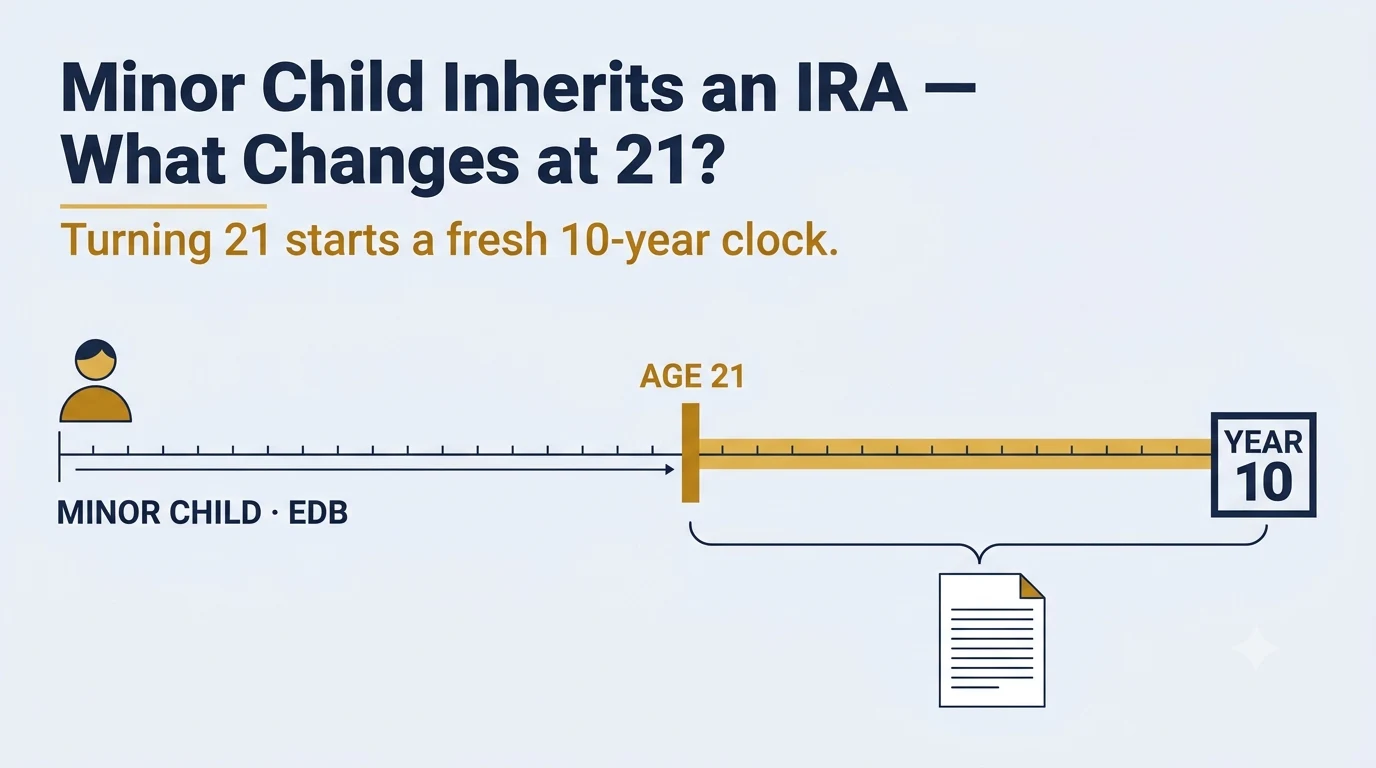
The age-21 rule creates a two-stage distribution timeline
A child of the deceased IRA owner who has not reached age 21 at the owner’s death can be an eligible designated beneficiary. That status matters because the child may receive life-expectancy treatment while still within the minor-child category instead of being placed immediately into the ordinary 10-year rule.
The final regulations set age 21 as the age of majority for this RMD rule. When the child reaches 21, the account does not become the child’s own IRA. Instead, a 10-year full-distribution period begins, ending on December 31 of the calendar year containing the tenth anniversary of the child’s 21st birthday.
Example: owner dies when the child is 17
Assume a parent dies in 2026 and the named beneficiary is the parent’s 17-year-old child. The child qualifies as an EDB by reason of being the owner’s minor child. If the child turns 21 in 2030, the transition rule points to a final deadline in 2040: the calendar year containing the tenth anniversary of reaching age 21.
That is very different from treating the child as an ordinary designated beneficiary from 2026 and ending the account in 2036. The age-21 transition is why the beneficiary’s exact birth date belongs in the permanent RMD file.
- 2026Owner dies; the 17-year-old child may qualify as an EDB.
- Before age 21Life-expectancy payments may apply, with annual calculations.
- 2030Example child reaches age 21; the 10-year period begins.
- 2040Example's full-distribution deadline is December 31 of this year.
Life-expectancy payments before age 21 still require an annual calculation
Where life-expectancy payments apply, Publication 590-B uses the Single Life Expectancy table for a nonspouse eligible designated beneficiary. The denominator is established under the beneficiary rules and then reduced as required in later years. The annual amount is not a straight percentage and is not one-tenth of the account.
If the owner died on or after the required beginning date, the “longer of” rule can also matter. A beneficiary should identify the owner’s remaining life expectancy and the child’s applicable life expectancy rather than assuming the child’s table number is automatically the only denominator.
Turning 21 changes the outer deadline, not the account title
The inherited IRA should remain an inherited account. Reaching age 21 does not authorize a nonspouse beneficiary to retitle the IRA as the beneficiary’s own account, contribute new money, or use a normal 60-day rollover. The transition changes the RMD framework; it does not erase the original owner’s death from the account history.
A child who is also disabled or chronically ill needs a second classification review
If the child was disabled or chronically ill as of the owner’s death, the child may qualify under an EDB category that continues beyond age 21. The final regulations specifically address this overlap. For employer plans, timely documentation of the disability or chronic illness can be essential to continuing that status after majority. The regulations generally require the documentation by October 31 of the year following the year of the employee’s death, subject to the rules in the final regulations.
IRA custodians are treated differently under the final regulations: the specified disability/chronic-illness documentation does not have to be furnished to the IRA custodian for the RMD rule. That does not make the underlying status irrelevant; it means the federal documentation delivery rule differs between a plan administrator and an IRA custodian.
Do not confuse a grandchild with the owner’s minor child
The age-21 transition applies to a child of the employee or IRA owner, using the final regulation’s definition of child. A young grandchild is not automatically in this category merely because the beneficiary is a minor. A separate guide covers that distinction because it can move the deadline by many years.
Build the timeline in two columns
| Before age 21 | After age 21 |
|---|---|
| EDB status can allow life-expectancy treatment | 10-year full-distribution clock begins |
| Annual RMD calculations may apply | Annual RMD obligations can continue depending on the governing rule |
| Track the child’s age and denominator | Track the December 31 year-10 deadline |
| Account remains inherited | Account still remains inherited |
Avoid the “nothing until 31” shortcut
It is unsafe to say that a minor child can simply leave the account untouched until ten years after turning 21. The life-expectancy phase can have annual distribution requirements, and the post-majority period can carry forward annual obligations depending on the facts. The safe workflow is year-by-year: calculate the required amount, record the distribution, then separately monitor the final full-distribution deadline.
- Record the owner's date of death and required beginning date status.
- Save the child's exact birth date and the year the child turns 21.
- Keep annual life-expectancy calculations and distributions.
- If disability or chronic illness may apply, preserve status evidence from the death date.
- For an employer plan, confirm required documentation timing with the administrator.