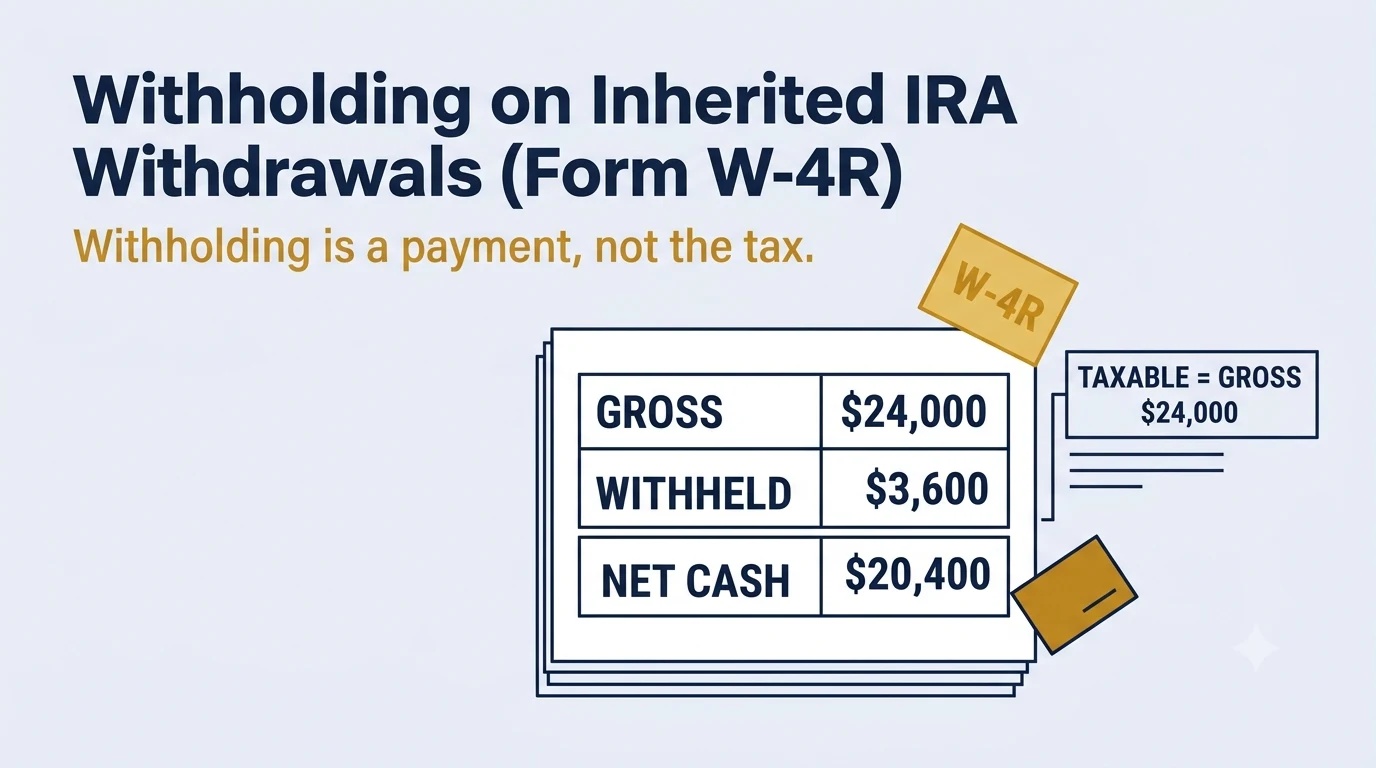
Inherited IRA cash distributions can have federal income tax withheld
For nonperiodic retirement distributions, federal withholding rules often use Form W-4R. IRS Publication 505 explains that a nonperiodic payment from an IRA is generally subject to 10% withholding unless the recipient elects a different permitted rate or, where allowed, elects no withholding. The exact choice depends on the payment type and current rules.
Withholding does not determine how much tax the withdrawal creates
If a beneficiary withdraws $80,000 from a fully taxable inherited traditional IRA and elects $8,000 of federal withholding, the taxable distribution is not reduced to $72,000. The gross $80,000 is the retirement distribution; the $8,000 is a tax payment credited on the return.
Why the default rate may be too high or too low
The beneficiary’s final tax depends on other wages, pensions, Social Security, deductions, filing status, credits, and the taxable character of the inherited account. A flat withholding percentage cannot know that full picture. Large one-time withdrawals are especially likely to require a separate tax projection.
Use Form W-4R for the payment you are actually requesting
Form W-4R is designed for withholding from nonperiodic payments and eligible rollover distributions. Read the form instructions for the specific payment. Do not copy an old election automatically if the size or type of inherited-IRA distribution has changed.
- Estimate the taxable distributionAccount for basis and whether the account is traditional or Roth.
- Review the full-year tax pictureInclude other income, deductions, credits, and filing status.
- Read Form W-4R for this paymentThe permitted election depends on payment type and current rules.
- Save the election and final Form 1099-RReconcile gross distribution, withholding, and net cash.
Gross RMD vs net cash received
| Item | Example |
|---|---|
| Gross inherited IRA distribution | $24,000 |
| Federal withholding | $3,600 |
| Net cash deposited | $20,400 |
| Amount counted as distribution from the retirement account | $24,000 |
Coordinate withholding with estimated-tax rules
A beneficiary taking a large distribution late in the year may prefer withholding, estimated payments, or a combination. Publication 505 explains both systems. Because underpayment rules depend on timing and safe-harbor calculations, the best method cannot be chosen solely from the inherited-IRA balance.
Save the election and the final 1099-R
Keep the W-4R or electronic withholding instruction, the gross-distribution confirmation, and Form 1099-R. Those three records make it easier to explain why the bank deposit differs from the taxable retirement distribution and tax withheld.
A percentage election should be tested against the distribution’s marginal impact
Suppose a beneficiary normally falls in a lower bracket but takes a six-figure inherited traditional IRA distribution. Ten percent withholding can be far below the eventual federal tax attributable to that additional income. Conversely, a largely nontaxable inherited Roth distribution may not call for the same withholding. Model the taxable amount first.
Why the current W-4R asks for a whole percentage
The redesigned Form W-4R replaced the older allowance-style entry with a single field for a whole-number withholding rate from 0% to 100%. If a beneficiary returns the form blank or never completes one, the payer applies the 10% default to the taxable amount of a nonperiodic IRA distribution. A beneficiary generally cannot elect a rate below 10%—including 0%—for a payment delivered outside the United States or its territories. Within the United States, 0% is permitted, but only as an affirmative election on the form.
Elected withholding is credited as if paid evenly through the year
Federal income tax withheld from a retirement distribution is reported in box 4 of Form 1099-R and flows to the withholding line of Form 1040. Unlike an estimated payment, withholding is generally treated as paid ratably across the whole year even when it was actually taken from a single December distribution. That timing feature is why increasing withholding on a late-year inherited-IRA withdrawal can sometimes cure an underpayment position that a fourth-quarter estimated payment would not fully fix.
Withholding does not reduce the RMD you are credited with taking
If an inherited IRA has an $8,000 required distribution and the beneficiary elects 20% withholding, the custodian sends $1,600 to the IRS and $6,400 to the beneficiary, but the full $8,000 counts as the distribution for RMD purposes. A beneficiary who needs $8,000 of spendable cash after tax has to request a larger gross distribution. Confirm the gross figure on the transaction confirmation, because an RMD is measured by the gross amount that left the retirement account, not the net deposit.
The article's example of an $8,000 required distribution with 20% withheld.
State withholding needs its own instruction
Form W-4R addresses federal withholding. States can have separate forms, mandatory rules, or no tax on certain retirement income. A beneficiary should not assume a federal election automatically solves the state tax-payment problem.
Late-year withholding and estimated payments have different mechanics
Withholding is generally credited as tax withheld for the year, while estimated payments are tied to payment dates and installment rules. For a large late-year distribution, that distinction can affect underpayment analysis. Publication 505 is the right place to compare the two methods rather than choosing purely by convenience.