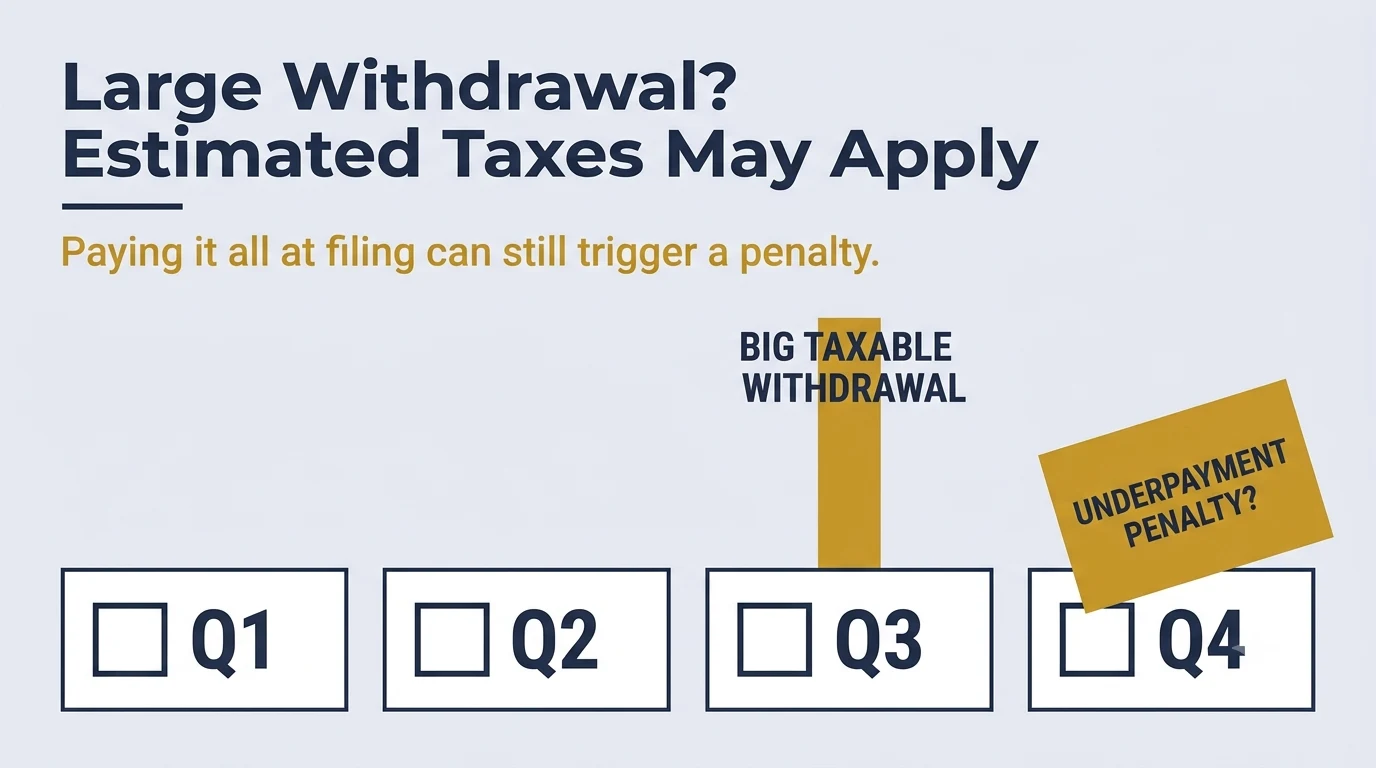
Tax due in April and underpayment during the year are separate issues
A beneficiary who takes a large taxable inherited-IRA distribution may owe more federal income tax than normal withholding covers. The federal system generally expects tax to be paid during the year through withholding and/or estimated tax payments. Publication 505 explains the estimated-tax and underpayment framework.
Example: a year-10 cleanout creates a one-time income spike
Assume a beneficiary normally has enough wage withholding to cover annual tax, but in October must withdraw a large remaining traditional inherited-IRA balance. Waiting until the next April to pay all additional tax can create an estimated-tax underpayment issue even if the return is ultimately filed and paid on time.
Start with a projection, not a percentage guess
- Estimate total taxable retirement distributions for the year.
- Add wages, pensions, taxable Social Security, interest, and other income.
- Estimate deductions and credits.
- Compare expected total tax with withholding already paid.
- Review current-year safe-harbor and installment rules in Publication 505.
Withholding can be operationally useful late in the year
Federal income tax withheld from retirement distributions is generally credited as withholding on the tax return. Depending on the taxpayer’s facts, additional withholding from a distribution can be a practical way to increase tax paid during the year. That does not make a fixed withholding rate universally correct.
Estimated payments have calendar deadlines
Estimated tax is generally paid in installments during the year. A beneficiary should use the current Form 1040-ES instructions and Publication 505 rather than assuming one April deadline. If income is uneven—such as a large late-year inherited-IRA withdrawal—the annualized-income method may be relevant and is worth discussing with a tax professional.
The federal safe harbors, stated precisely
Publication 505 generally lets a taxpayer avoid the underpayment penalty by paying, through withholding and timely estimates, the smaller of: 90% of the current year's tax, or 100% of the prior year's tax. The prior-year figure rises to 110% if the prior-year adjusted gross income was more than $150,000 ($75,000 if married filing separately). A large inherited-IRA withdrawal often makes the prior-year safe harbor the easier target, because last year's tax was calculated before the distribution existed.
Pay through withholding and timely estimates the smaller of the first two, or the third if prior-year income was high.
Quarterly deadlines and the annualized method
Estimated tax is due in four installments, generally April 15, June 15, September 15, and January 15 of the following year. If a large inherited-IRA distribution lands in the fourth quarter, equal installments would overstate the tax owed for the first three periods. The annualized-income installment method on Form 2210, Schedule AI, lets the taxpayer match required payments to when the income was actually received, though it requires dated distribution records and more computation.
| Payment method | Withholding | Estimated payments |
|---|---|---|
| How timing is credited | Generally treated as paid ratably through the year | Tied to payment dates and installment rules |
| Late-year distribution | Additional withholding can sometimes help an underpayment position | A fourth-quarter estimate may not fully fix earlier installment timing |
| What to review | W-4R election and gross distribution | Form 1040-ES, Publication 505, and payment dates |
State taxes are a separate calculation
Federal withholding or estimated payments do not settle state obligations. State treatment of retirement income varies, as do state withholding forms and estimated-tax requirements. Keep the federal inherited-IRA tax worksheet separate from any state projection.
Which state gets to tax the distribution
A distribution is generally taxed by the state where the beneficiary is a resident in the year it is received, not the state where the decedent lived or where the custodian is located. Federal law bars a former state from taxing a nonresident's retirement-plan distributions, so a beneficiary who moves to a no-income-tax state during the 10-year window can shift the state-tax treatment of the remaining withdrawals. A move planned for its own reasons can therefore change the timing math; a move made solely to avoid tax should be a genuine change of domicile, not just a mailing address.
State estimated-tax rules do not always mirror the federal ones
States that levy income tax set their own estimated-payment thresholds, safe harbors, and due dates. Some follow the federal quarterly calendar; others differ. A beneficiary taking a large inherited-IRA distribution in a taxable state should confirm the state's underpayment rule for that year rather than assuming that meeting the federal safe harbor also covers the state.
Records for the tax projection
| Record | Purpose |
|---|---|
| Year-to-date paystub/pension statement | Existing income and withholding |
| Inherited IRA distribution plan | Expected gross taxable distribution |
| Prior-year return | Safe-harbor reference and recurring items |
| W-4R / estimated payment confirmations | Proof of tax paid during year |
Safe-harbor analysis should use the actual prior-year tax, not the refund amount
A prior-year refund does not mean the taxpayer met every current-year safe harbor automatically. The comparison generally uses tax shown on the prior return and current-year withholding/estimated payments under rules in Publication 505. Pull the actual return rather than remembering whether a refund arrived.
Uneven inherited distributions can justify an annualized-income calculation
If no large IRA withdrawal occurs until November, a taxpayer may not have had the income in the first three quarters that would justify equal estimated payments. The annualized-income installment method can sometimes reflect when income was actually received. It is more work and should be supported with dated distribution records.
A year-10 payout should be projected before the year starts
When a large remaining balance is visible in year 9, the beneficiary can estimate federal withholding or quarterly payments before the mandatory cleanout year begins. Waiting until the final distribution posts can leave fewer practical ways to manage tax payments without underpayment surprises.
- Year 9Estimate the remaining balance and possible taxable withdrawal.
- Before year 10Compare withholding and estimated-payment choices using the expected tax picture.
- During year 10Track actual distribution dates and tax payments.
- Tax filingReconcile withholding, estimates, and actual income.