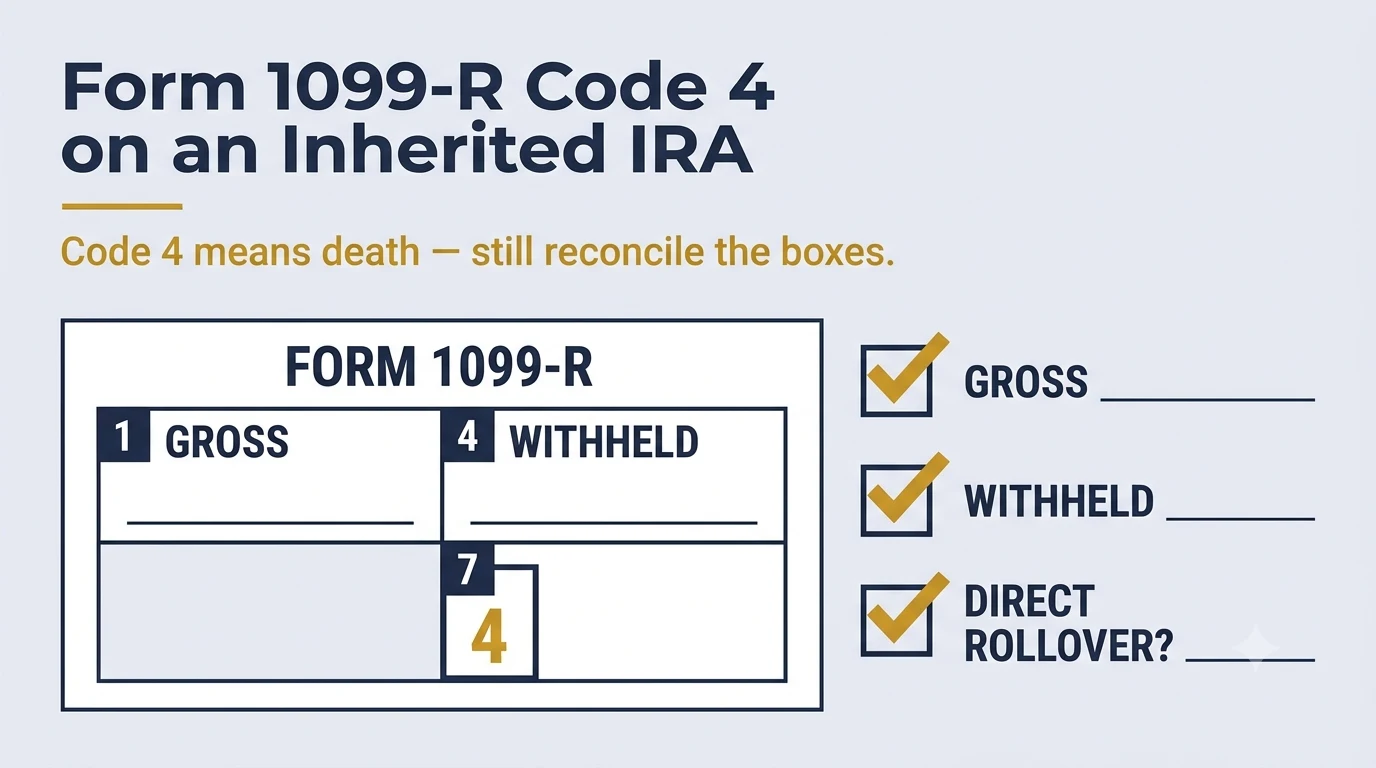
Code 4 generally tells the IRS the distribution is connected with death
Instructions for Form 1099-R identify distribution code 4 as “Death.” It is used for distributions to beneficiaries after a participant or IRA owner dies, subject to the form’s detailed coding rules. For an inherited IRA beneficiary, code 4 is therefore a common entry in box 7.
Read more than box 7
| Form field | Why it matters |
|---|---|
| Box 1 – Gross distribution | Starting point for reconciling what left the retirement account |
| Box 2a – Taxable amount | May or may not be fully determined by payer; basis can matter |
| Box 4 – Federal income tax withheld | Tax prepayment, not a reduction of the gross RMD amount |
| Box 7 – Distribution code | Code 4 generally indicates death/beneficiary distribution |
| IRA/SEP/SIMPLE checkbox | Helps identify whether the payment is from an IRA category |
Example: net bank deposit is not the gross distribution
If box 1 shows $30,000 and box 4 shows $3,000 withheld, the beneficiary may have received only $27,000 in cash. For RMD reconciliation and tax reporting, the gross retirement distribution is still $30,000; the $3,000 withholding is treated as federal tax paid on the beneficiary’s behalf.
The article's example: for RMD reconciliation and tax reporting the gross amount is the distribution.
Direct rollovers can use more than one code
The Form 1099-R instructions contain special coding for direct rollovers by non-spouse designated beneficiaries to inherited IRAs, including combinations involving code G and code 4 in appropriate circumstances. A beneficiary who moved an employer-plan account should not assume every code-4 form represents cash received personally.
Why box 2a can require more work
If the deceased owner had after-tax basis in a traditional IRA, the beneficiary may inherit that basis treatment. A payer may not have enough information to compute the taxable amount exactly. Keep any Form 8606 and basis records from the decedent rather than assuming box 1 is always fully taxable.
The IRA/SEP/SIMPLE checkbox decides which rulebook applies
When that box is checked, the payment came from an IRA-type account, and the inherited-IRA distribution, aggregation, and basis rules apply. When it is blank, the payment is from a qualified employer plan such as a 401(k), and the plan's own rules govern the RMD and any rollover. A beneficiary who holds both an inherited IRA and an inherited plan account from the same decedent should sort the forms by this checkbox before doing any RMD math, because the two cannot be aggregated with each other.
Codes that can appear alongside 4
| Box 7 | Typical meaning for a beneficiary |
|---|---|
| 4 | Death distribution paid to the beneficiary |
| 4 and G | Death distribution moved by direct rollover, often to an inherited IRA |
| 4 and B | Death distribution from a designated Roth account in an employer plan |
| 4 and K | Death distribution that includes hard-to-value assets |
The combination tells the beneficiary whether cash was actually received or the balance was moved, which changes what belongs on the return.
Reconcile before filing
- Match every 1099-R to a specific inherited account and decedent.
- Compare box 1 with the custodian’s transaction history.
- Confirm withholding in boxes 4 and state boxes.
- Investigate any code inconsistent with the transaction you requested.
- Retain direct-rollover confirmations and inherited-account opening records.
One inheritance can generate more than one Form 1099-R
If an inherited account moves between institutions or a beneficiary receives distributions from both an employer plan and a new inherited IRA in the same year, multiple Forms 1099-R can arrive. Do not enter only the form from the custodian holding the account on December 31. Reconcile every payer against the full transaction history.
Correct a reporting mismatch with the payer before inventing a tax-return workaround
If the form shows a distribution code inconsistent with a documented death distribution or direct rollover, contact the payer and ask whether it will issue a corrected Form 1099-R. Keep written evidence of the requested correction. The tax return should reflect the actual transaction, but a mismatched information return can trigger avoidable IRS correspondence.
Keep decedent basis records beside the form
Code 4 identifies the reason for distribution; it does not prove that box 1 is fully taxable. When inherited traditional IRA basis exists, the beneficiary’s Form 8606 work can change taxable income even though the death code is correct.