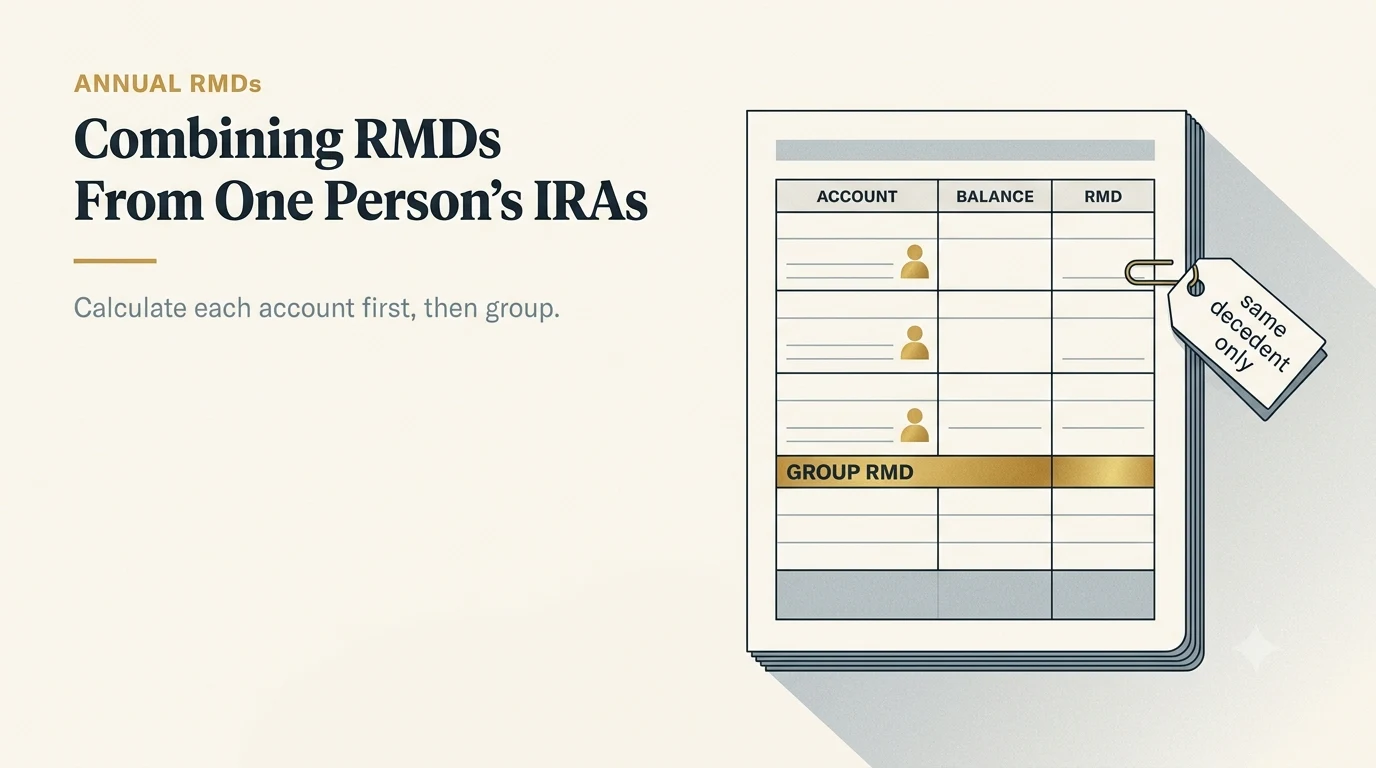
Calculate each account separately, then reconcile the group
IRS Form 5329 instructions allow certain inherited IRA RMDs to be satisfied across inherited IRAs from the same decedent. The useful workflow is to calculate each account separately first, then reconcile the eligible group after distributions post. This page turns that rule into a year-by-year worksheet.
Step 1: create one row per inherited IRA
| Account | Decedent | Prior Dec. 31 balance | Denominator | Calculated RMD |
|---|---|---|---|---|
| Inherited IRA A | Mother | $240,000 | 30.0 | $8,000 |
| Inherited IRA B | Mother | $120,000 | 30.0 | $4,000 |
| Same-decedent total | Mother | — | — | $12,000 |
Do not start by adding the balances together. The account-level RMD calculation stays visible even when the resulting minimums may later be satisfied from one or more eligible accounts.
Step 2: record where the cash actually came from
| Distribution date | Source account | Gross amount | Same-decedent group credited |
|---|---|---|---|
| March 15 | Inherited IRA B | $5,000 | Mother |
| September 20 | Inherited IRA A | $7,000 | Mother |
| Total credited | — | $12,000 | Mother |
In this example, the $12,000 group minimum is satisfied even though the withdrawals did not mirror the $8,000/$4,000 account-level calculations. The worksheet still preserves those calculations for audit and reconciliation.
Step 3: reconcile before year end
Add the gross distributions that are eligible to satisfy the same-decedent inherited-IRA group and compare them with the calculated group minimum. Do not use withholding-net amounts. If a $5,000 gross distribution had $500 withheld, the distribution is still $5,000 for the retirement-account distribution record.
Step 4: carry forward each account separately
Aggregation does not merge the accounts for next year’s math. Each inherited IRA still has its own December 31 balance, transfer history, basis records, and tax form. For the next calendar year, update every row with the new year-end balance and the denominator required for that account.
Three-year worksheet structure
| Year | IRA A RMD | IRA B RMD | Group minimum | Gross distributions credited | Shortfall |
|---|---|---|---|---|---|
| 2027 | Calculate | Calculate | A + B | Reconcile | 0 or amount due |
| 2028 | Recalculate | Recalculate | A + B | Reconcile | 0 or amount due |
| 2029 | Recalculate | Recalculate | A + B | Reconcile | 0 or amount due |
The point is to prevent a valid aggregation rule from becoming a reason to stop doing account-level calculations.
Aggregation is permitted, not required — which account you draw from is a choice
The same-decedent rule lets a beneficiary satisfy the group minimum from one or more of the eligible accounts, but it does not force a particular source. A beneficiary who wants to keep one inherited account invested longer can take the full group RMD from the account they intend to spend down first, as long as the gross distributions credited to the group meet the calculated total. Record which account actually paid, because the tax form follows that account.
A beneficiary can satisfy the group minimum from one or more eligible accounts, for example from the account they plan to spend down first. Record which account actually paid, because the tax form follows that account.
Keep Roth inherited IRAs in their own permitted group
Form 5329 instructions separately address inherited Roth IRAs from the same decedent. Do not assume a traditional inherited IRA distribution can satisfy an inherited Roth IRA obligation simply because the decedent is the same. Label the tax category in the worksheet before grouping accounts.
Or skip the worksheet: consolidate same-decedent accounts into one
Aggregation is a way to manage multiple accounts, but a beneficiary can also eliminate the bookkeeping by combining them. Two inherited traditional IRAs from the same decedent can be merged into a single inherited IRA by trustee-to-trustee transfer, as long as the surviving registration keeps the decedent and beneficiary identifiers. After consolidation there is one balance, one denominator, and one RMD. The limits still apply: a traditional inherited IRA cannot be merged with an inherited Roth, and accounts from different decedents must stay separate.
Do not add the beneficiary’s own IRA or another decedent
A nonspouse inherited IRA is not the beneficiary’s personal IRA. Likewise, an inherited IRA from a father belongs to a different decedent group than an inherited IRA from a mother. Use one worksheet tab per decedent and keep the beneficiary’s own IRAs outside those inherited groups.
Year-end closeout checklist
- Account-level RMD calculation saved for every inherited IRA.
- Decedent name and date of death shown on every row.
- Gross distributions reconciled to custodian confirmations.
- Same-decedent group minimum fully satisfied.
- Traditional and Roth inherited groups not mixed.
- December 31 balances saved for next year.
- Year-10 deadline retained even if one account was emptied.
That is the practical difference between merely knowing the aggregation rule and having records that prove the rule was applied correctly.