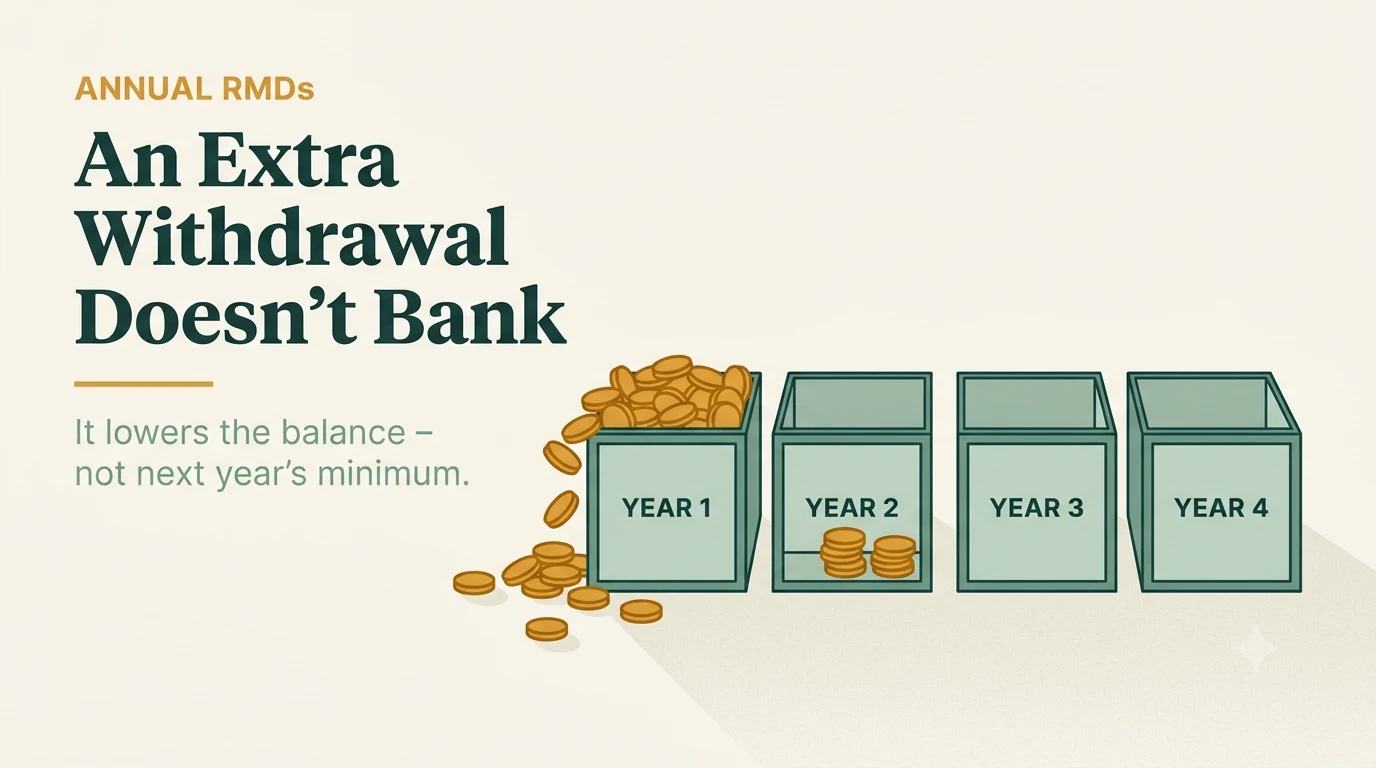
An extra distribution changes the balance, not the future minimum requirement
If an inherited IRA requires an annual RMD and the beneficiary withdraws more than the required amount, the excess does not become a prepaid RMD for the next calendar year. Publication 590-B explains that a distribution in excess of the minimum required for one year cannot be applied to the RMD for a later year.
That rule is easy to confuse with the economic effect of the withdrawal. Taking extra money out can leave a smaller December 31 balance, and that smaller balance may reduce the next year’s dollar RMD. But the next year still has its own minimum-distribution requirement.
Example: $20,000 required, $50,000 withdrawn
Suppose the beneficiary’s 2027 inherited-IRA RMD is $20,000 and the beneficiary withdraws $50,000. The 2027 requirement is satisfied. The additional $30,000 is simply an extra 2027 distribution. It does not mean the beneficiary can subtract $30,000 from the 2028 RMD.
For 2028, the beneficiary starts a new calculation using the applicable prior-year-end balance and denominator. The lower balance resulting from the $50,000 withdrawal may matter, but there is no “RMD credit” line carried into 2028.
Why this matters inside the 10-year rule
A beneficiary may intentionally take more than the annual minimum to reduce the balance before year 10. That can be a valid cash-flow choice, but it should be tracked as a discretionary distribution rather than as an advance payment of later RMDs. Annual minimums and the final cleanout deadline are separate constraints.
Use a two-column ledger
| Annual compliance column | 10-year balance column |
|---|---|
| Calculated RMD for the year | Beginning balance |
| Actual distributions during the year | Total distributions, including excess over RMD |
| Shortfall, if any | Ending balance after market movement and distributions |
| RMD satisfied? yes/no | Years remaining before final deadline |
Do not confuse an excess RMD with a rollover-eligible amount
For a non-spouse beneficiary, an inherited IRA has special rollover restrictions. The fact that a withdrawal exceeds the RMD does not automatically make it eligible to be put back into the inherited IRA or rolled into the beneficiary’s own IRA. Treat the distribution and rollover questions separately.
Year-end review
- Confirm the current year’s minimum was fully distributed by the deadline.
- Record the total amount distributed, not just the minimum.
- Save the December 31 balance for the next calculation.
- Recalculate the remaining year-10 balance rather than assuming annual RMDs will empty the account.
Emptying most of the account does not let you skip a later year's minimum
If the owner died on or after the required beginning date, every year in which a balance remains has its own annual RMD. A beneficiary who withdraws 80% of the account in year 3 still has an annual minimum for years 4, 5, and so on, calculated on the smaller remaining balance. The requirement stops only when the account reaches zero or the year-10 cleanout is complete.
If the owner died on or after the required beginning date, a beneficiary who withdraws 80% of the account in year 3 still has an annual minimum for each later year, figured on the smaller balance. It stops only when the account reaches zero or the year-10 cleanout is complete.
A larger early withdrawal shifts tax, and that is the real decision
Because there is no banking mechanism, the choice to take more than the minimum is purely a tax-timing decision. Pulling extra in a low-income year can keep the beneficiary out of a higher bracket than a forced year-10 lump sum would create, and it can reduce exposure to the Social Security and Medicare IRMAA thresholds later. Record any amount above the minimum as a discretionary distribution so the following year's tax projection starts from accurate figures.
An extra distribution can still be useful for the 10-year cleanout
No carryforward credit does not mean extra withdrawals are pointless. If the inherited traditional IRA is projected to leave $300,000 for year 10, a beneficiary might intentionally distribute more in earlier years to reduce the final-year concentration. That is a planning choice about the remaining balance and tax timing, not a legal prepayment of future annual RMDs.
Keep “required” and “discretionary” amounts separate on Form 1099-R reconciliation
The year-end Form 1099-R reports the gross distribution; it does not label which dollars were RMD and which were discretionary. Your own worksheet should do that. For example, if $50,000 was distributed against a $20,000 minimum, record $20,000 as the current-year requirement satisfied and $30,000 as an additional distribution. That makes future-year review much clearer.
Excess distributions cannot cure a different decedent’s RMD
Taking more than required from one inherited IRA also does not automatically satisfy a shortfall in an inherited IRA from a different decedent. Aggregation rules have boundaries. Extra dollars should never be treated as a floating credit that can be assigned later wherever a shortfall appears.
An excess distribution from one inherited IRA does not automatically satisfy a different decedent's RMD. Aggregation rules have boundaries, so record which account paid each amount.