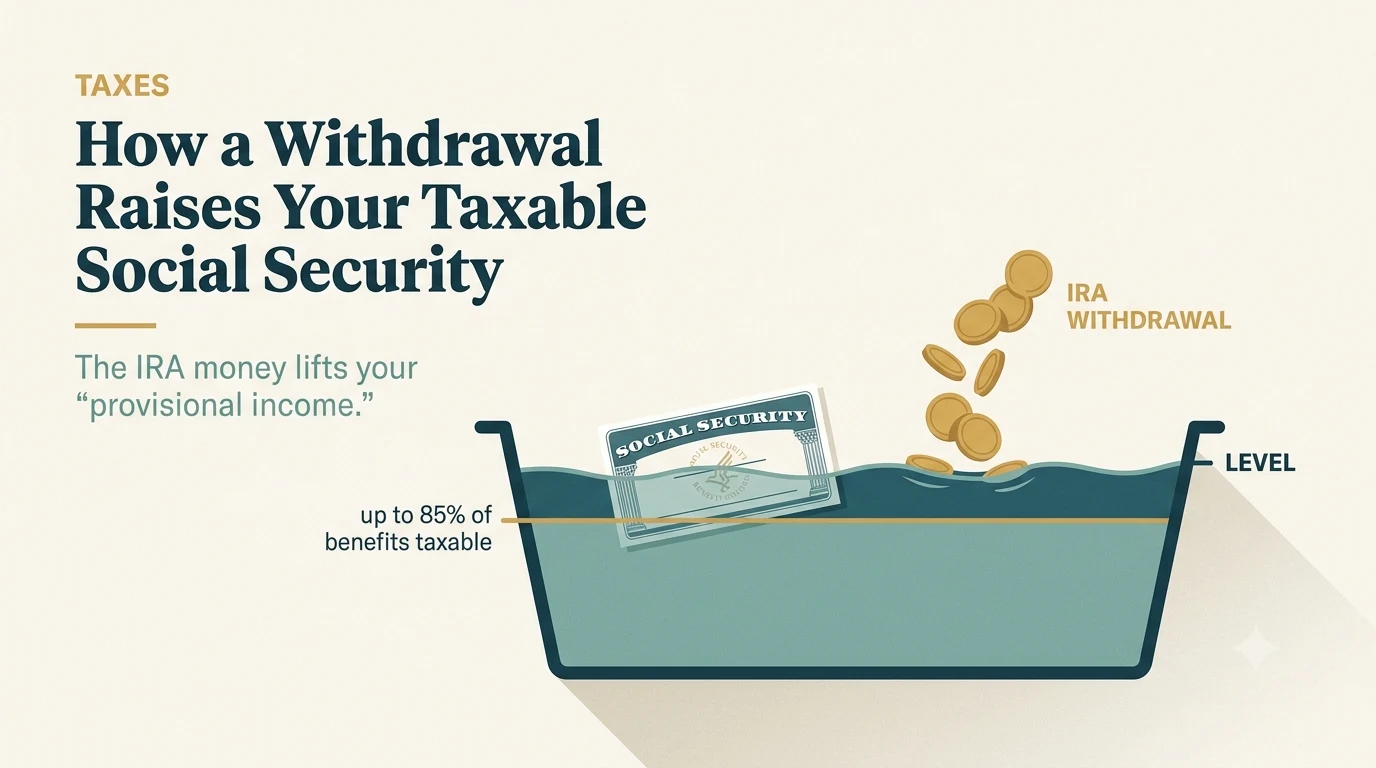
The inherited IRA distribution can change a second income line
A taxable traditional inherited-IRA withdrawal is included in adjusted gross income. For someone receiving Social Security, that additional income can also affect the formula that determines how much of Social Security benefits is taxable. Publication 915 explains the federal calculation.
Do not describe the effect as a special “Social Security tax”
The issue is not that the IRA withdrawal imposes a new tax directly on the Social Security check. Instead, the withdrawal can increase the beneficiary’s combined/provisional income under the Social Security taxation formula, which can cause a larger portion of Social Security benefits to be included in taxable income.
Example: compare two distribution years
A retired beneficiary receives the same Social Security benefit every year. In one year, the beneficiary takes only a modest inherited-IRA RMD. In another, the beneficiary takes a large discretionary distribution to reduce the year-10 balance. The larger IRA distribution can increase adjusted gross income and may also increase taxable Social Security, creating a larger-than-expected change in total taxable income.
Use Publication 915’s worksheet, not a flat percentage assumption
People often repeat that “85% of Social Security is taxable.” That is a maximum inclusion concept, not a statement that everyone automatically includes 85%. The actual amount depends on filing status and the income calculation in Publication 915.
Build a distribution comparison with three outputs
| Scenario | Inherited IRA taxable amount | Taxable Social Security | Total projected taxable income |
|---|---|---|---|
| Smaller withdrawal | Model actual amount | Use Pub. 915 worksheet | Recalculate |
| Larger withdrawal | Model actual amount | Re-run worksheet | Recalculate |
IRMAA is a separate Medicare calculation
For Medicare beneficiaries, modified adjusted gross income can also affect income-related monthly adjustment amounts, generally using tax information from two years earlier. Do not combine the Social Security taxation calculation and IRMAA threshold test into one rule; they use different formulas and agencies.
There are two thresholds, and a large withdrawal can cross both
Publication 915 uses base amounts to decide how much Social Security is taxable. For a single filer, up to 50% of benefits can become taxable once combined income passes the first base amount, and up to 85% once it passes the second; married-filing-jointly filers have their own higher base amounts. A retiree whose income normally sits below the first threshold can, in a single large-distribution year, move past both thresholds at once, taking taxable Social Security from near zero to the 85% maximum inclusion.
The effect can push the marginal rate above the stated bracket
Because each additional dollar of inherited-IRA income can also cause another fraction of a dollar of Social Security to be included in taxable income, the true marginal cost of part of the withdrawal can exceed the nominal bracket rate for that range. This is sometimes called the Social Security “tax torpedo.” It is a reason to compare a steady multi-year withdrawal pattern against a single large year-10 distribution rather than assuming the tax cost scales evenly with the amount withdrawn.
Each added dollar of inherited-IRA income can pull more Social Security into taxable income, so the true cost of part of a withdrawal can exceed the nominal bracket rate. Compare a steady multi-year pattern with a single large year-10 distribution.
The RMD rule comes first
Tax modeling cannot justify taking less than a required minimum or missing the final 10-year deadline. Determine the legal minimum and final distribution date first, then compare discretionary withdrawal amounts within the choices the law permits.
Tax-exempt interest also belongs in the Social Security worksheet
Publication 915’s combined-income framework can include items that do not appear as ordinary taxable income in the same way, including tax-exempt interest. A retiree with municipal-bond income should not model the inherited IRA in isolation when estimating how much Social Security becomes taxable.
Married filing separately can have very different treatment
The Social Security taxation worksheet has special rules for certain married taxpayers filing separately, particularly depending on whether spouses lived together during the year. Do not apply single-filer thresholds from a generic article to that filing status.
A small, shrinking group of states also tax Social Security benefits
The federal calculation is only one layer. A shrinking group of states, with several having repealed the tax in recent years, include some portion of Social Security benefits in state taxable income, often with their own income thresholds. In those states, a large inherited-IRA withdrawal can raise state taxable Social Security in addition to the federal effect. A beneficiary who lives in one of them, or expects to move to one during the 10-year window, should model the state worksheet separately rather than assuming the federal result is the whole story.
Some states exempt the inherited-IRA distribution entirely
Working the other direction, several states either have no income tax or fully exempt IRA distributions paid to a beneficiary because of the owner's death. Pennsylvania is the clearest example. A beneficiary in such a state faces only the federal Social Security and bracket effects, which can make a steady multi-year withdrawal schedule easier to manage than it would be for a beneficiary in a full-tax state.
Model the final-year distribution before December
If a traditional inherited IRA could require a large year-10 withdrawal, rerun the Publication 915 worksheet with that projected distribution while there is still time to consider earlier-year discretionary withdrawals. The legal deadline cannot be moved, but the balance entering year 10 may be influenced by prior distributions.