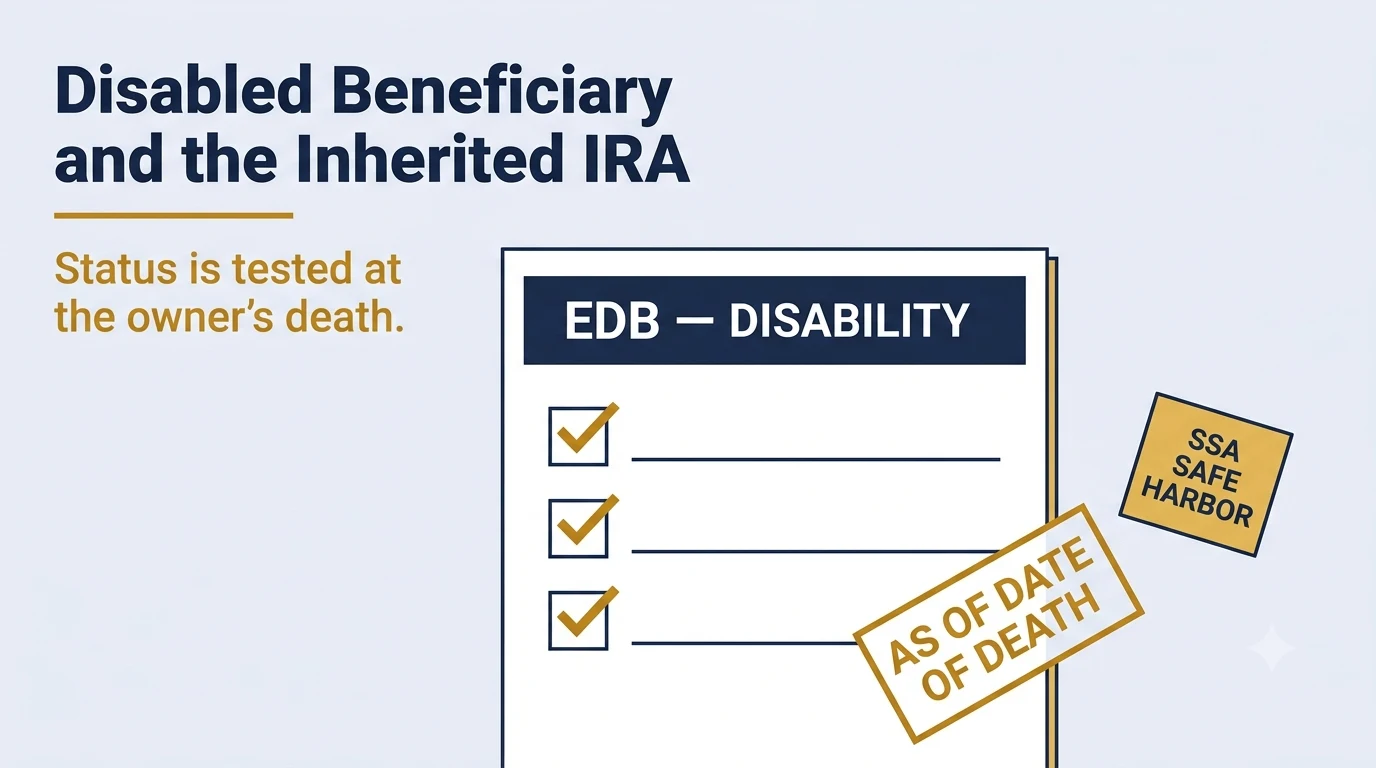
Disability is tested as of the account owner’s date of death
A designated beneficiary can be an eligible designated beneficiary if the individual was disabled when the employee or IRA owner died. The final regulations do not use a casual definition such as “has a disability” or “receives accommodations.” They apply a federal standard tied to substantial gainful activity for adults and a separate functional standard for beneficiaries under age 18.
The timing matters. A serious impairment that begins years after the owner’s death does not retroactively change the beneficiary’s status on the death date.
For a beneficiary age 18 or older, the standard is demanding
For a beneficiary who is at least 18 on the owner’s date of death, the regulations look to whether the individual is unable to engage in substantial gainful activity because of a medically determinable physical or mental impairment that can be expected to result in death or to be long-continued and indefinite.
This is much narrower than a general statement that the beneficiary has a diagnosed condition. The record should support the federal definition that applies to the EDB rule.
A Social Security disability determination can provide a safe harbor
The final regulations provide a useful safe harbor: if the Commissioner of Social Security has determined that the individual was disabled under the referenced Social Security standard as of the owner’s date of death, the individual is deemed disabled for this RMD purpose. The safe harbor is not the exclusive route. A beneficiary can still satisfy the general regulatory standard without a Social Security determination.
Beneficiaries under age 18 use a different standard
For a beneficiary younger than 18 at the owner’s death, the regulations use a test based on a medically determinable physical or mental impairment producing marked and severe functional limitations, with the required expected duration or death standard. This avoids forcing the adult substantial-gainful-activity test onto a child.
| Comparison | Age 18 or older | Under age 18 |
|---|---|---|
| Functional test | Unable to engage in substantial gainful activity | Marked and severe functional limitations |
| Impairment | Medically determinable physical or mental impairment | Medically determinable physical or mental impairment |
| Evidence route | Social Security determination can provide a safe harbor | General regulatory standard applies |
Employer plans have an October 31 documentation deadline
For a qualified plan or similar employer plan, the final regulations generally require documentation of disability by October 31 of the calendar year following the year of the employee’s death, or October 31, 2025 if later under the transition language. The regulations contemplate documentation from a licensed health care practitioner and explain that it need not contain an exhaustive medical file.
A family dealing with a 401(k) or 403(b) should therefore ask the plan administrator for its required submission process well before the deadline.
IRA custodians are treated differently
The final regulations state that the specified federal disability documentation does not have to be provided to the IRA trustee, custodian, or issuer for this determination. That does not mean evidence should be discarded. The beneficiary still needs a defensible basis for claiming EDB treatment and may need records for tax return preparation or a later IRS question.
- Owner's deathDisability is tested as of this date.
- By October 31 next yearFor an employer plan, submit documentation by the applicable deadline.
- Later yearsKeep annual RMD worksheets; EDB status does not remove distribution duties.
Disabled status can extend treatment beyond the age-21 minor-child transition
Suppose the owner’s 16-year-old child qualifies as the owner’s minor child and is also disabled at the owner’s death. Ordinarily, the minor-child category would transition to a 10-year clock at age 21. But if the child also qualifies under the disability category, that second EDB status can continue beyond age 21, subject to the applicable documentation rules.
Life-expectancy treatment still requires annual compliance
EDB status is not a waiver from distributions. It can permit life-expectancy treatment under the beneficiary RMD rules. The applicable denominator and the owner’s required-beginning-date status still have to be analyzed. If the beneficiary later dies before the account is fully distributed, the successor-beneficiary rules generally impose a 10-year limit on the remaining interest.
If the beneficiary is not receiving Social Security disability
The SSDI safe harbor is convenient but not the only route. A beneficiary who is not on SSDI—because they never applied, were denied on non-medical grounds, or have income above the SSDI limits despite a serious impairment—can still qualify by meeting the general regulatory standard. That means assembling a physician's statement addressing inability to engage in substantial gainful activity because of a medically determinable impairment expected to be long-continued and indefinite, framed as of the owner's date of death. Start that documentation early; a retrospective opinion is harder to obtain years later.
A beneficiary who is not receiving Social Security disability can still qualify under the general standard. Ask for a physician's statement framed as of the owner's date of death; a retrospective opinion is harder to obtain years later.
Coordinating EDB treatment with a special needs trust
Families often want the inherited IRA to fund a special needs trust rather than pay the disabled beneficiary directly, to protect means-tested public benefits. That can work, but the trust has to be drafted to meet the applicable multi-beneficiary trust rules so the disabled beneficiary's EDB status is preserved through the trust. A conduit trust—which passes every IRA distribution straight to the beneficiary—usually defeats the benefits-protection goal. This is a decision to make with a special needs planning attorney before the owner dies, not after.
A file that supports the classification should be date-specific
- Owner’s date of death and date of birth.
- Beneficiary’s date of birth.
- Medical or Social Security evidence showing status as of the death date.
- Plan-administrator submission and proof of delivery, if an employer plan is involved.
- Annual RMD worksheets and prior-year-end balances.
The strongest inherited-account file does not merely state “beneficiary is disabled.” It shows why the beneficiary fits the regulatory category on the date that matters.