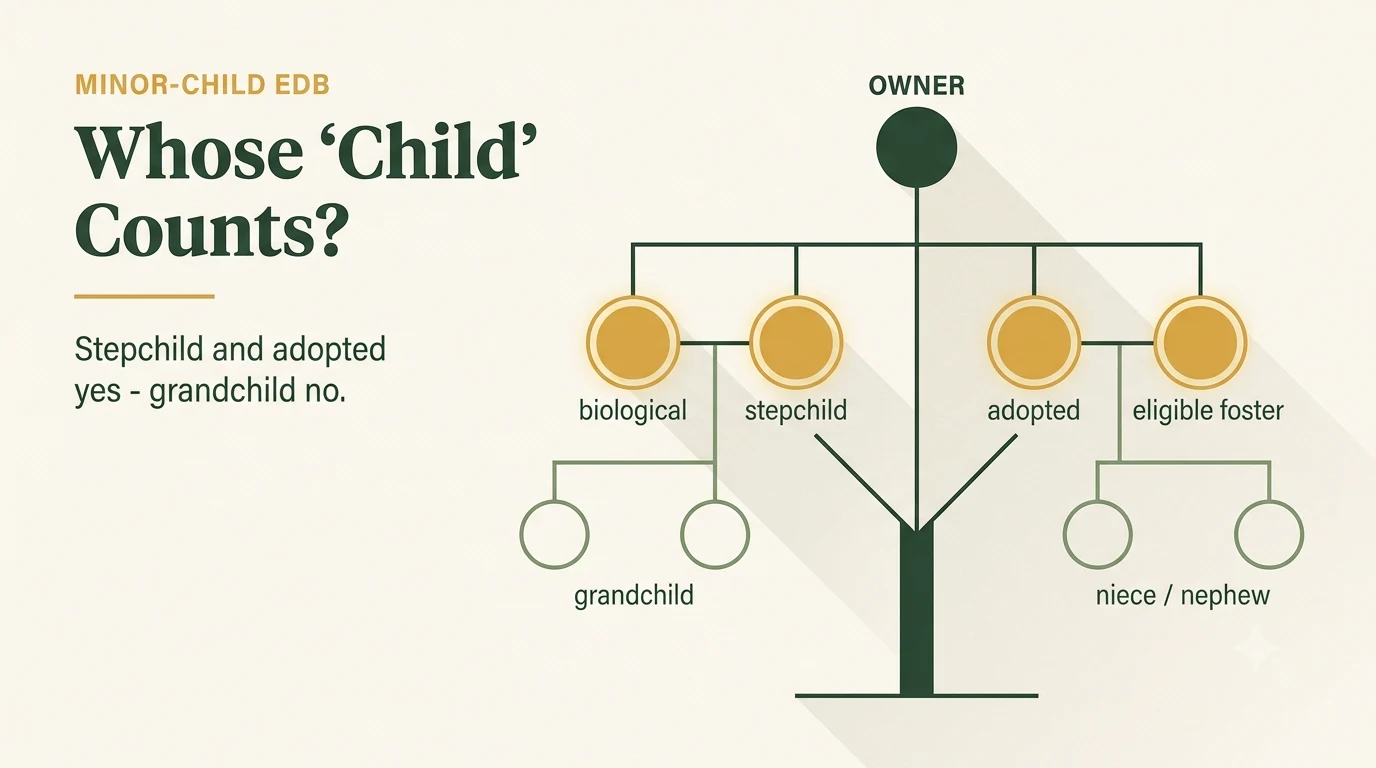
The minor-child exception uses a federal definition of “child”
For the eligible-designated-beneficiary (EDB) rule, the 2024 final regulations refer to the definition in Internal Revenue Code section 152(f)(1). That means the analysis is broader than “biological son or daughter,” but narrower than “any minor relative.” The beneficiary must fit the federal child definition and be under age 21 at the owner’s death to qualify through this specific EDB category.
Relationship matrix
| Relationship to owner | Can fit the owner’s “child” definition? | Extra point to verify |
|---|---|---|
| Biological son or daughter | Yes | Must be under 21 at the owner’s death for the minor-child EDB category |
| Stepchild | Yes | Preserve records showing the step relationship |
| Legally adopted child | Yes | Adoption records can support classification |
| Child lawfully placed for legal adoption | Generally treated as adopted for the referenced definition | Keep placement/adoption documentation |
| Eligible foster child | Potentially yes | Must satisfy the technical federal definition; an informal caregiving arrangement is not enough |
| Grandchild, niece, nephew, younger sibling | Not merely because the person is a minor relative | Test another EDB category if relevant |
Age 21 is measured at the owner’s death
The final regulations use age 21 as the age of majority for this rule. A child who is 20 on the owner’s date of death can begin as an EDB through the minor-child category. A child who already reached 21 before the owner died does not qualify through that category, even if the beneficiary was still a dependent or student.
Turning 21 changes the distribution timeline
A child who qualified solely because the child was under 21 does not remain in that EDB category forever. Once the child reaches 21, the 10-year full-distribution period begins for the remaining inherited interest. Publication 590-B describes the outer deadline as December 31 of the calendar year containing the tenth anniversary of the child’s attainment of majority.
Annual life-expectancy distributions and the age-21 transition therefore belong on the same timeline. The beneficiary should not interpret the age-21 event as permission to ignore annual amounts that were otherwise required.
- At owner's deathCheck the federal child relationship and age.
- Under age 21The owner-child EDB category may apply.
- Turns 21If relying only on the minor-child category, a 10-year period begins for the remaining interest.
A minor grandchild is a designated beneficiary, but not automatically the owner’s minor child
If a grandparent names a 12-year-old grandchild, the beneficiary’s age alone does not trigger the owner’s minor-child EDB exception. The grandchild must be classified under the ordinary designated-beneficiary rules unless another EDB category applies—for example, disability, chronic illness, or the not-more-than-10-years-younger test in an unusual fact pattern.
The section 152(f)(1) definition in plain terms
The referenced federal definition covers a son, daughter, stepson, or stepdaughter of the owner; a legally adopted child and a child lawfully placed with the owner for legal adoption; and an eligible foster child placed with the owner by an authorized placement agency or by court order. It does not reach a grandchild, a niece or nephew, a younger sibling, or a child the owner merely helped raise without a legal relationship. Those beneficiaries can still be designated beneficiaries—they just do not enter through the minor-child EDB door.
Age 21 is a federal line, not the state age of majority
State law sets the age of majority anywhere from 18 to 21. The final regulations override that variation for this rule and use 21 for every state. A 19-year-old who is already a legal adult under state law is still within the minor-child EDB window; a 21-year-old is outside it even in a state where majority is 18. Use the federal age, not the state one, when classifying the beneficiary.
The final regulations use age 21 for every state. A 19-year-old who is a legal adult under state law is still inside the minor-child window; a 21-year-old is outside it even where majority is 18.
Documentation should prove both relationship and age
- Owner’s death certificate.
- Beneficiary’s birth record.
- Beneficiary designation or plan record showing the beneficiary’s interest.
- Adoption, stepfamily, or foster-child documentation when the relationship is not obvious.
- Annual RMD worksheets and the date the beneficiary turns 21.
Classification example: stepdaughter age 19
An IRA owner dies in 2026 naming a 19-year-old stepdaughter. If the stepdaughter fits the referenced federal child definition and is an individual designated beneficiary, she can qualify as an EDB through the minor-child category. The file should then show the life-expectancy schedule and the calendar year in which she reaches 21, because that event starts the separate 10-year outer limit for the remaining balance.
Classification example: adopted son age 22
An adopted son is within the child definition, but at age 22 he is too old for the minor-child EDB category. The correct next step is to test whether he qualifies under another EDB category rather than assuming “child of the owner” is enough at any age.
The cleanest way to avoid mistakes is to treat this as a two-column test: relationship first, age second. Both must be satisfied for this particular EDB route.