This article is about the math, not the filing procedure
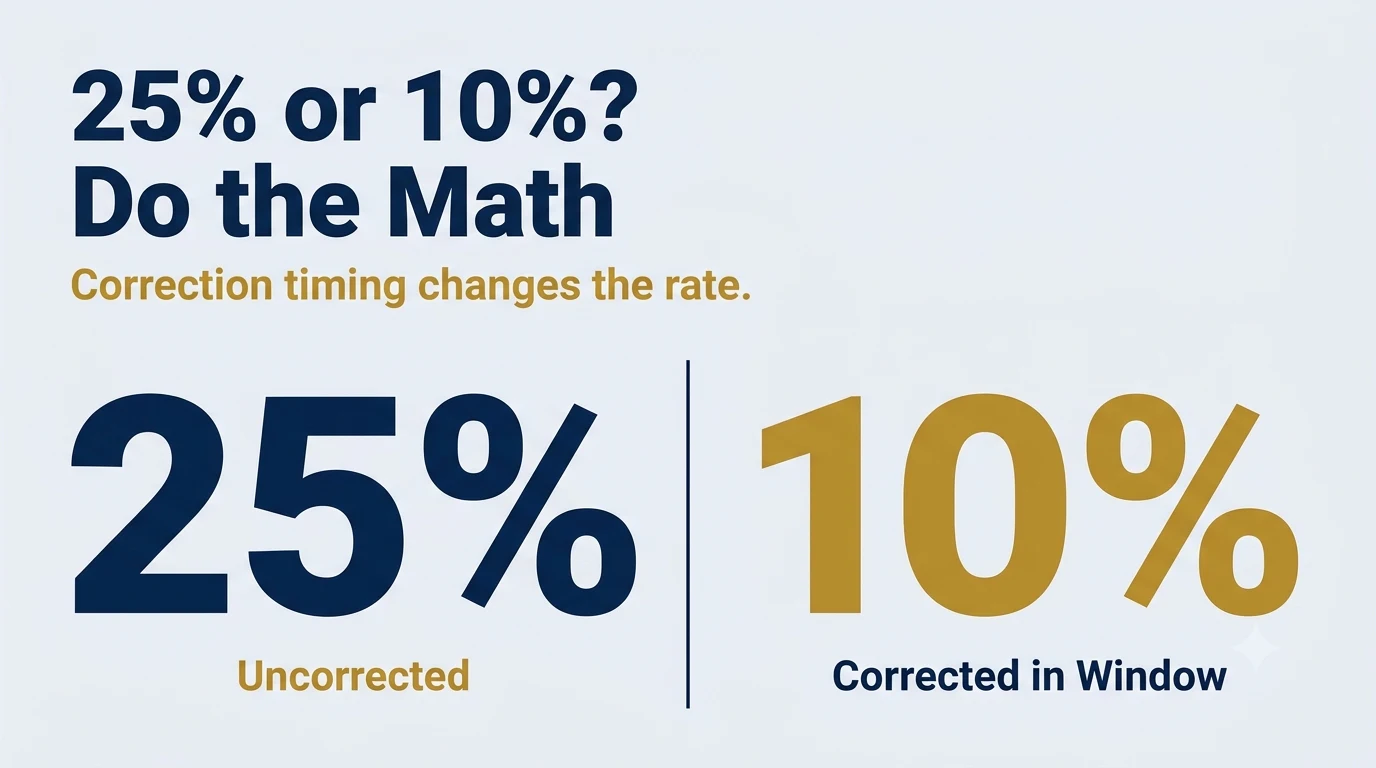
A missed-RMD problem has two separate tasks. First, determine the excess accumulation and the tax rate that applies. Second, handle the reporting and any waiver request on Form 5329. This guide focuses on the first task: what amount is exposed to the 25% rate, when the 10% reduced rate can apply, and how the correction window changes the result.
- Confirm an RMD was requiredCheck the owner's status, beneficiary class, and applicable relief.
- Subtract timely distributions from the required amountThe difference is the excess accumulation, not the full account balance.
- Check the correction windowThe window can end earlier than two years.
- Apply the possible rateThe general rate is 25%; 10% may apply when correction requirements are met.
Step 1: verify that an RMD was actually required
Before calculating any penalty, confirm the legal minimum distribution for that year. This is especially important with inherited IRAs because an ordinary designated beneficiary under the 10-year rule may have no annual RMD in years 1 through 9 if the owner died before the required beginning date.
A beneficiary should not pay an excise tax merely because a custodian dashboard says “RMD not taken” without first checking the owner’s death date, required beginning date, beneficiary class, and applicable transition relief.
Step 2: calculate the shortfall, not a percentage of the account
The Form 5329 instructions define the excess accumulation as the difference between the amount that was required to be distributed and the amount actually distributed by the deadline. The general additional tax is 25% of that shortfall.
For example, if the RMD was $18,000 and $13,500 was distributed on time, the excess accumulation is $4,500. The 25% general rate would be applied to $4,500, not to the inherited IRA’s full balance and not to the full $18,000 RMD.
Step 3: determine whether the reduced 10% rate is available
The instructions provide a reduced 10% rate when the taxpayer satisfies the requirements during the correction window. In general, that requires receiving a distribution of the amount that caused the excess accumulation from the plan or account for which the tax was imposed and submitting a return reflecting the additional tax.
Using the same $4,500 shortfall, the difference between the two rates is material: the general-rate calculation is $1,125, while the reduced-rate calculation is $450. Those numbers are illustrations of the statutory percentages; they do not decide whether the taxpayer also qualifies for a reasonable-cause waiver.
The correction window can end before “two years”
It is common to summarize the correction window as two years, but the Form 5329 instructions are more precise. The window ends on the earliest of:
- the date the IRS mails a notice of deficiency for the tax;
- the date the tax is assessed; or
- the last day of the second taxable year that begins after the taxable year in which the additional tax is imposed.
That is why a beneficiary who discovers a missed RMD should not treat “two years” as a safe waiting period.
Example A: full RMD missed, corrected during the window
Assume a required inherited-IRA RMD was $10,000 and nothing was distributed by the deadline. The excess accumulation is $10,000. If the beneficiary later withdraws the $10,000 shortfall and satisfies the reduced-rate filing requirements within the correction window, the 10% rate can be relevant. If those requirements are not satisfied and no waiver applies, the general 25% rate is the starting point.
Example B: only part of the RMD was missed
Assume the RMD was $22,000 and the beneficiary withdrew $20,500 by the deadline. The excess accumulation is $1,500. The tax-rate analysis applies only to that $1,500. A common error is to calculate the percentage on the full $22,000 because that was the “RMD amount” shown by the custodian.
A reasonable-cause waiver is a different path from the 10% rate
The IRS can waive part or all of the excise tax if the shortfall was due to reasonable error and the taxpayer is taking reasonable steps to remedy it. A waiver can therefore produce a different result from merely qualifying for the reduced 10% rate.
The facts supporting a waiver are handled through Form 5329 procedures and an explanation. Correcting the shortfall quickly, documenting what caused the error, and preserving custodian correspondence can all matter to the factual record, but the IRS decides whether to grant the waiver.
Correcting the shortfall during the correction window may allow the 10% rate. A reasonable-cause waiver is a separate request; correction alone does not guarantee either result.
Late correction does not turn the original distribution into a timely RMD
A corrective distribution taken after the original deadline can fix the account shortfall for correction-window purposes, but it was not distributed by the deadline for the original RMD year. The beneficiary should preserve both dates: the original deadline and the actual correction date.
The rate history: 50%, then 25%, then 10% for a timely fix
For tax years through 2022, the excise tax on a missed RMD was 50% of the shortfall. SECURE 2.0 cut it to 25% for tax years beginning after 2022, with a further reduction to 10% when the shortfall is distributed and the return filed within the correction window. A missed 2021 or 2022 RMD is analyzed at 50% on that year's Form 5329; a 2023-or-later miss uses the 25%/10% structure. Applying today's rate to an old year understates the exposure.
A reasonable-cause waiver is worth requesting for an honest first miss
The statutory text lets the IRS waive the tax entirely for a shortfall due to reasonable error where the taxpayer is taking reasonable steps to remedy it. In practice, a Form 5329 that reports the missed amount, marks the request RC, attaches proof that the shortfall was distributed as soon as it was discovered, and gives a short honest explanation can be granted for a first-time error. This is not a guarantee, the IRS decides each request on its facts and can deny it, but a beneficiary should not assume the 25% is automatically owed—correcting quickly and filing the waiver request is the right move.
Historical 2021–2024 cases need a transition-relief check first
The IRS issued relief for certain beneficiaries who missed annual post-death RMDs during 2021 through 2024 while the final regulations were pending. A historical inherited-IRA penalty calculation should therefore begin by checking whether the beneficiary and year fall within that relief before mechanically applying 25% or 10%.
A compact calculation worksheet
- Required distribution for the year.
- Amount actually distributed by the deadline.
- Shortfall = line 1 minus line 2.
- Correction distribution date and amount.
- Correction-window status.
- Potential rate: 25% general or 10% reduced, before considering a waiver.
- Separate note describing whether a reasonable-cause waiver is being requested.
Keeping those steps separate prevents three frequent mistakes: applying the percentage to the whole account, assuming every correction automatically gets the 10% rate, and treating a waiver as the same thing as the reduced rate.