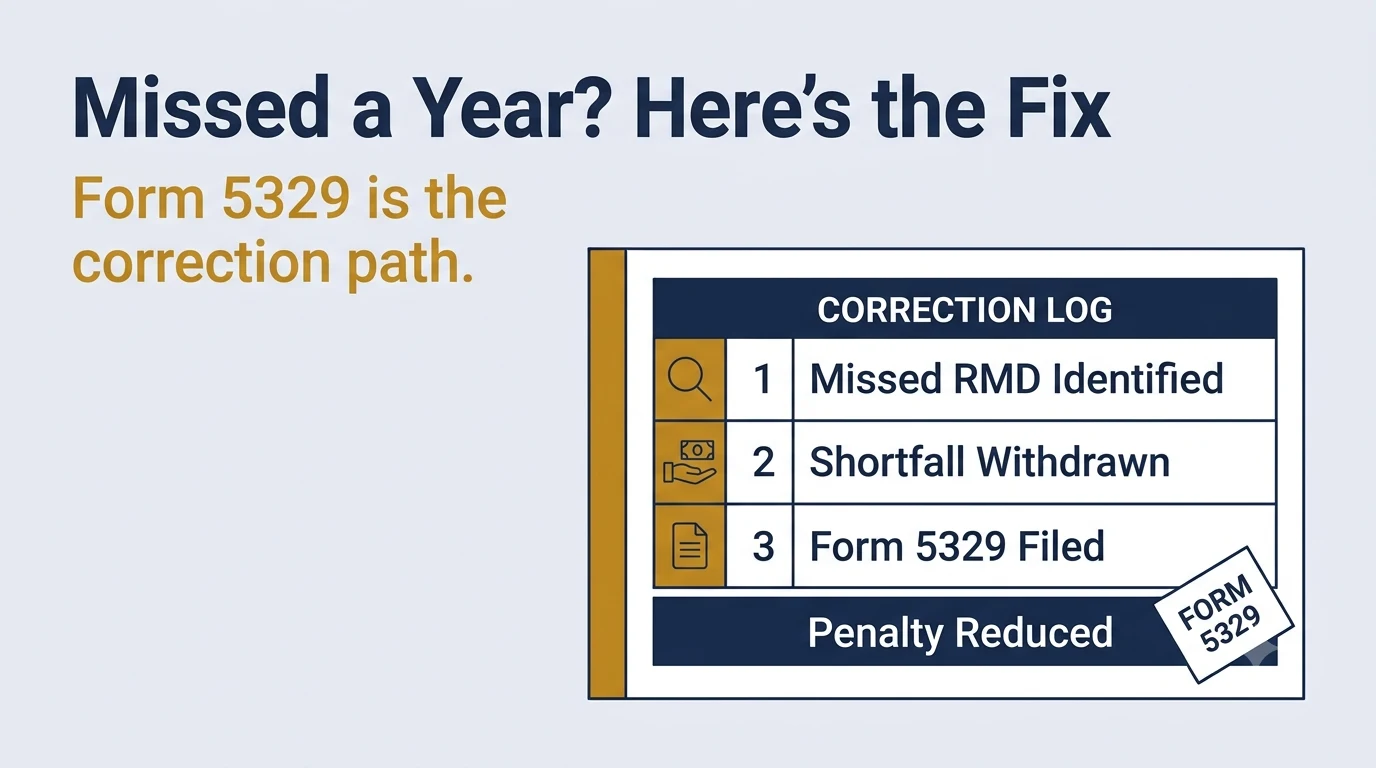
First determine whether an RMD was actually required
Before calculating a penalty, confirm that the beneficiary had a required minimum distribution for the year in question. An ordinary designated beneficiary under the 10-year rule may have annual RMDs if the owner died on or after the required beginning date. If the owner died before that date, the 10-year rule itself generally does not require annual distributions before year 10.
The additional tax is based on the shortfall
The 2025 Form 5329 instructions describe the additional tax on an “excess accumulation,” meaning the amount that should have been distributed but was not. The general rate is 25% of that shortfall. The rate can be reduced to 10% when the correction requirements are satisfied during the correction window.
The correction window has a defined end
The instructions say the correction window ends on the earliest of three events: a deficiency notice is mailed regarding the tax, the tax is assessed, or the last day of the second taxable year beginning after the taxable year in which the additional tax was imposed. The practical point is that “within two years” is a shorthand, not the complete legal definition.
Reasonable-cause waiver is a separate route
The IRS can waive part or all of the additional tax if the shortfall resulted from reasonable error and the taxpayer is taking reasonable steps to fix it. The Form 5329 instructions explain how to mark the form with “RC,” identify the amount requested for waiver, and attach a statement of explanation.
A waiver is not automatic merely because a statement is attached. The IRS reviews the explanation and can deny the request.
The rate changed in 2023, so old misses use old math
SECURE 2.0 reduced the missed-RMD excise tax from 50% to 25%, effective for tax years beginning after 2022, with the further reduction to 10% for a timely correction. A shortfall from 2022 or earlier is analyzed under the 50% rate and that year's Form 5329. Applying the current 25% figure to an old year understates the exposure, and using the current form for an old year puts the tax in the wrong place.
| Shortfall timing | 2023 or later | 2022 or earlier |
|---|---|---|
| General additional tax described | 25% of the shortfall | 50% under the old rate |
| When 10% may apply | Correction requirements met during the correction window | Use that year's rules; do not assume the current reduction |
| Form to review | Form 5329 for the year of the miss | That prior year's Form 5329 |
The current general rate differs from the rate for a shortfall from 2022 or earlier.
A separate automatic waiver covers a missed year-of-death RMD
The 2024 final regulations added an automatic excise-tax waiver specifically for the RMD that goes unpaid in the calendar year a person dies. If the owner or a beneficiary died without completing that year's required amount, the excise tax is waived when a beneficiary takes the corrective distribution by the later of their tax-return due date (including extensions) for the year that includes the date of death, or the end of the following calendar year. This relief is automatic—no reasonable-cause statement is needed—but it applies only to the death-year RMD, not to a later missed annual RMD.
Do not apply transition relief to the wrong year
Notice 2024-35 and earlier notices protected certain missed beneficiary RMDs through 2024 while the final regulatory rules were being completed. A beneficiary dealing with a 2025 or later RMD should not assume the earlier transition relief carries forward.
A careful correction sequence
- Identify the exact required amount and year.
- Determine the amount actually distributed by the deadline.
- Correct the shortfall as soon as possible if one exists.
- Use the Form 5329 instructions for that specific tax year.
- Keep the calculation, custodian statements, and explanation supporting any waiver request.
Prior-year mistakes generally require the prior year’s version of Form 5329, not the current-year form.
What to put in the reasonable-cause file
The Form 5329 instructions do not provide a magic sentence that guarantees waiver. A useful file should show what happened, why the error was reasonable, when it was discovered, how the shortfall was corrected, and what steps were taken to prevent recurrence. Supporting items can include custodian correspondence, proof of the corrective distribution, and the beneficiary’s RMD calculation.
- Write down what happened and why the error was reasonable.
- Record when the shortfall was discovered.
- Keep proof of the corrective distribution.
- Save the RMD calculation and custodian correspondence.
- Document steps taken to prevent the same mistake from happening again.
- Use the Form 5329 version for the year of the missed RMD.
Use the form for the year of the miss
If the RMD shortfall occurred in 2025 but is discovered in 2027, the beneficiary generally looks to the 2025 version of Form 5329 and its instructions for the original reporting mechanics. Filing the current-year form for an old error can put the tax in the wrong year.
Do not confuse a late distribution with a timely RMD
A corrective distribution taken after the deadline can fix the account shortfall and may qualify for a reduced tax or support a waiver request, but it was not timely for the original RMD year. The distinction matters on Form 5329, which separates amounts distributed by the deadline from later corrective distributions.
When the mistake is a custodian’s calculation
Even if an institution supplied an incorrect RMD number, the beneficiary should preserve the written calculation and the facts provided to the institution. That evidence can be relevant to a reasonable-cause explanation, but it does not automatically eliminate the beneficiary’s obligation to correct the shortfall.