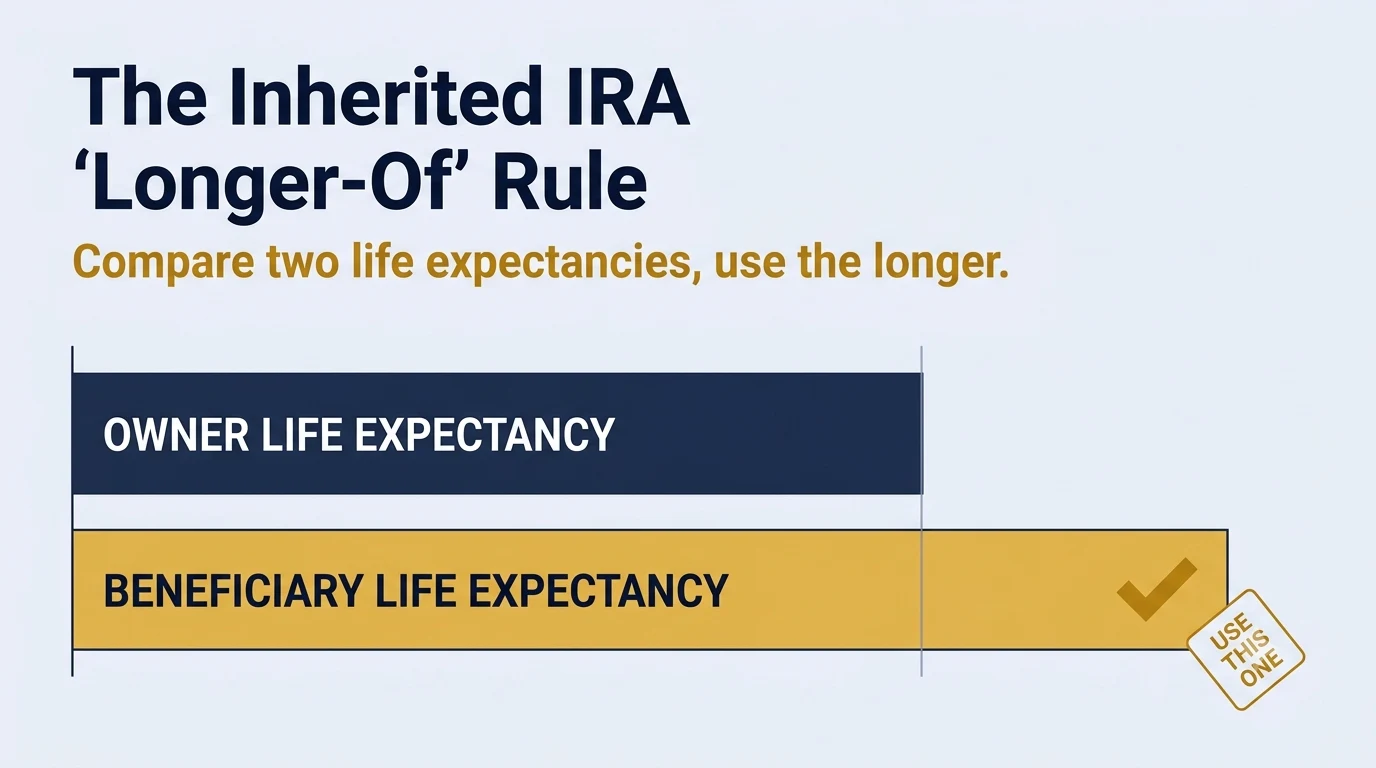
The annual RMD can require two life-expectancy calculations, not one
For a designated beneficiary who inherits from an IRA owner who died on or after the required beginning date, Publication 590-B does not simply say “use the beneficiary’s age.” The annual distribution is generally based on the longer of the beneficiary’s life expectancy or the owner’s remaining life expectancy. Because a longer life expectancy produces a larger denominator, it usually produces the smaller current-year RMD.
This calculation is separate from the 10-year deadline. An ordinary designated beneficiary can be required to take annual RMDs under the longer-of rule and still have to empty the account by the end of the tenth calendar year after the owner’s death.
Build both denominator tracks before choosing one
| Track | Starting point | What happens later |
|---|---|---|
| Beneficiary track | Single Life Table value based on the beneficiary’s age under the post-death rule | Reduce the fixed denominator by one for each succeeding distribution year |
| Owner track | Owner’s remaining life expectancy under the applicable post-death rule | Reduce that denominator by one for each succeeding distribution year |
| RMD denominator | Use the longer life expectancy—the greater applicable denominator—for that year | |
Why an older beneficiary does not automatically mean a larger RMD
Assume a 78-year-old owner dies after the required beginning date and leaves the IRA to an 82-year-old sibling. Looking only at the beneficiary’s age could suggest that the beneficiary’s life expectancy controls. The rule requires a comparison. If the deceased owner’s remaining life expectancy is longer, the owner track can supply the denominator instead. The relationship between the two ages matters more than a shortcut such as “always use the beneficiary.”
- Confirm the owner died on or after RBDThe longer-of rule applies in this branch when there is a designated beneficiary.
- Calculate the beneficiary trackUse the beneficiary's post-death life-expectancy method.
- Calculate the owner trackUse the owner's remaining life expectancy and reductions.
- Select the longer current expectancyUse the larger denominator for that year's RMD.
Do not compare dollar amounts from two custodians
The legally relevant comparison is between applicable life-expectancy denominators, not between two institutions’ final RMD dollar figures. If two custodians disagree, ask each one to show the prior December 31 balance, beneficiary denominator, owner denominator, and which denominator it selected. A different balance can produce different dollar RMDs even when both institutions use the same life-expectancy rule.
The year-10 cleanout can be much larger than the annual minimum
The longer-of rule is an annual minimum-distribution mechanism. It is not designed to amortize the account to zero by year 10. If investment returns are strong or annual minimums are small relative to the account, a material balance can remain in the final year. Beneficiaries should therefore keep an annual RMD worksheet and a separate year-10 balance tracker.
Computing the owner track step by step
Take the age the owner would have reached on their birthday in the year of death and read the Single Life Expectancy Table for that age. That is the owner track's factor for the first distribution year after death. Subtract one for each following year. Example: an owner who would have turned 76 in the year of death has a starting factor near 14.1; the first post-death year uses about 13.1, then 12.1, and so on. The beneficiary track is built the same way from the beneficiary's first-year age. Each year, divide the prior year-end balance by whichever of the two current factors is larger.
The comparison applies only in one specific situation
The longer-of rule is for a death on or after the required beginning date where there is a designated beneficiary. If the owner died before that date, there is no owner track to compare—an eligible designated beneficiary simply uses their own single life expectancy, and an ordinary designated beneficiary uses the 10-year rule with no annual minimum. If the owner died on or after the required beginning date but there is no designated beneficiary, the account uses the owner's remaining life expectancy alone, with no comparison.
Records that make the calculation auditable
- Owner date of birth and date of death.
- Evidence that the owner had reached the required beginning date.
- Beneficiary date of birth and beneficiary classification.
- Prior-year December 31 account balance.
- Both starting life-expectancy denominators and the annual reductions applied.
- The separate December 31 year-10 deadline.
Keeping both tracks is particularly useful after a custodian transfer, because a receiving institution may not have the original denominator workpaper.
Worked example: the two-track comparison
Assume an inherited IRA has a $420,000 prior-year-end balance. After applying the correct regulatory method, the beneficiary track for the year is 24.0 while the owner track is 27.0. The applicable denominator is 27.0 because it represents the longer life expectancy. The resulting annual minimum is about $15,555.56 ($420,000 ÷ 27.0), before considering any other required adjustments. Using 24.0 would produce $17,500 and would not reflect the longer-of rule.
The comparison can change the size of the minimum but not the final 10-year date
For an ordinary designated beneficiary under the 10-year rule, a favorable larger denominator may keep annual minimums relatively small. That does not extend the account beyond year 10. A beneficiary who focuses only on the annual calculation can therefore be compliant each year and still approach the final year with a large remaining balance.
What to challenge when a custodian provides only one factor
If the owner died on or after the required beginning date and the institution provides a single denominator without showing how it was selected, ask whether it compared the beneficiary’s Single Life Table track with the owner’s remaining life expectancy. A written calculation is especially important when the beneficiary is older than the owner or when the ages are close.
- Request the prior December 31 balance.
- Ask for the beneficiary denominator and its source.
- Ask for the owner's remaining-life denominator.
- Confirm which denominator is longer and selected.
- Save the annual calculation separately from the year-10 balance tracker.