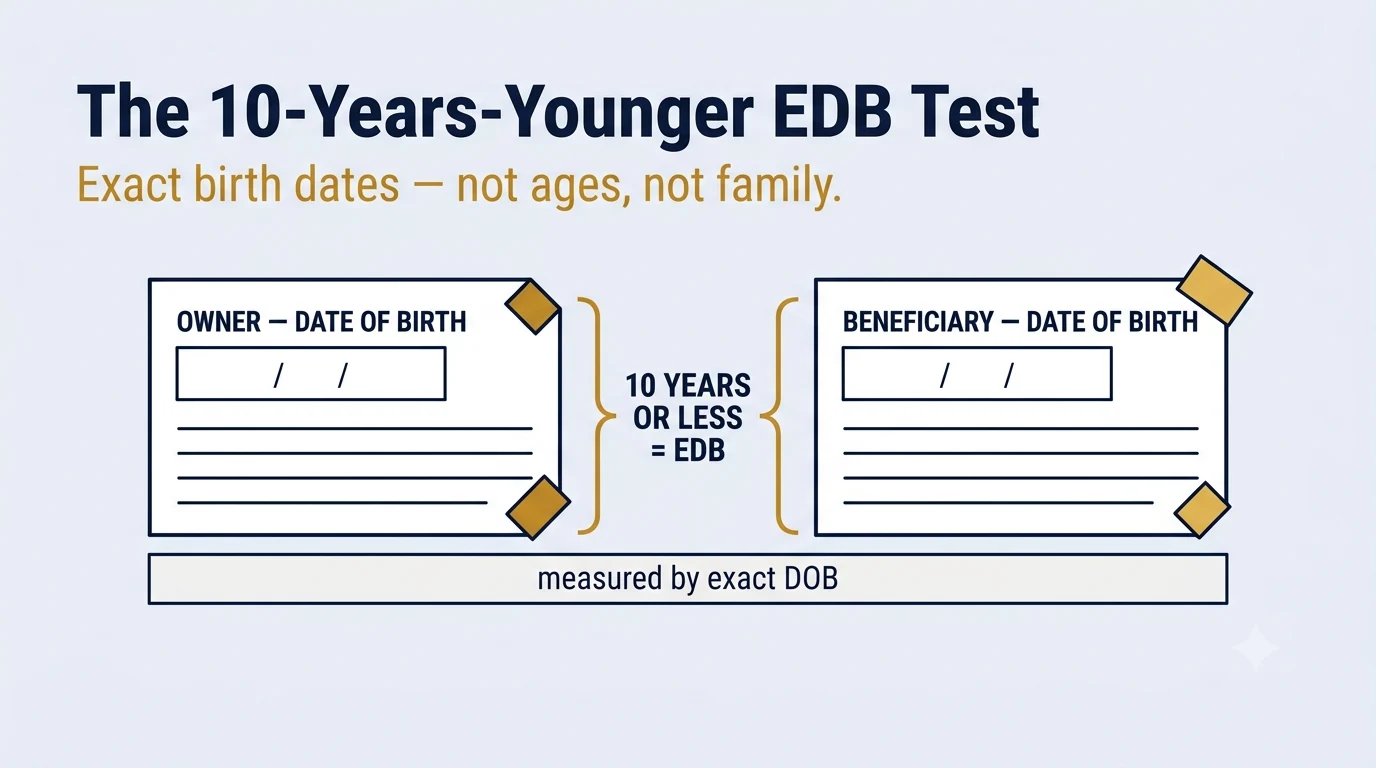
The test is a date-of-birth test, not a family-relationship test
One eligible designated beneficiary (EDB) category covers an individual who is not more than 10 years younger than the deceased IRA owner or plan participant. The 2024 final RMD regulations say to compare the owner’s and beneficiary’s actual dates of birth. The rule is not limited to siblings or relatives: a friend, unmarried partner, cousin, adult child close in age, or an older beneficiary can qualify if the date test is met.
Use the regulatory boundary exactly once
The final regulations give a useful boundary example. If the owner was born October 1, 1953, a beneficiary born on or before October 1, 1963 is not more than 10 years younger. A beneficiary born October 2, 1963 is more than 10 years younger and does not qualify through this EDB category.
That one-day difference is why rounded ages such as “73 and 63” are not enough when the birthdays are close to the ten-year line.
- October 1, 1953Owner's birth date in the regulation example.
- October 1, 1963Beneficiary born on this date is not more than 10 years younger.
- October 2, 1963One day later falls outside this age-gap EDB category.
A quick three-step test
- Confirm the beneficiary is an individual designated beneficiary under the inherited-account rules.
- Write down the owner’s exact date of birth and the beneficiary’s exact date of birth.
- Ask whether the beneficiary was born no later than the date exactly 10 years after the owner’s birth date.
If yes, the age-gap EDB category can apply. If no, test the other EDB categories—surviving spouse, owner’s child under age 21, disabled beneficiary, or chronically ill beneficiary—before classifying the person as an ordinary designated beneficiary.
What qualifying as an EDB actually changes
EDB status matters because an EDB can qualify for life-expectancy treatment that is unavailable to an ordinary designated beneficiary. It does not mean the beneficiary has no annual RMDs, no final deadline, or a denominator equal to the age gap. The age-gap test answers only the classification question.
After classification, the RMD method still depends on facts such as whether the owner died before or on/after the required beginning date. If the owner died on or after that date, the post-death calculation can require the longer-of comparison between the beneficiary’s remaining life expectancy and the owner’s remaining life expectancy.
Example: an eight-year-younger sibling
An IRA owner dies in 2026 and names a sibling who is eight years younger. The sibling is not a spouse and is not relying on disability, chronic illness, or the minor-child rule. The sibling can still be an EDB through the age-gap category. The next step is not to start a 10-year-rule worksheet automatically; it is to determine which life-expectancy branch applies to the inherited account.
Example: an adult child can qualify, but only if the dates fit
An adult child age 21 or older no longer qualifies merely because the beneficiary is the owner’s minor child. But an adult child who is no more than 10 years younger can independently qualify through the age-gap category. That fact pattern is uncommon in a typical parent-child age gap, but the law tests dates rather than assumptions about family roles.
Why this category is most valuable when the owner died before the required beginning date
If the owner died before the required beginning date, an eligible designated beneficiary can generally take distributions over the beneficiary's own single life expectancy—entered once from the Single Life Table for the first distribution year, then reduced by one each year afterward. For a beneficiary who is, say, seven years younger than an owner who died at 68, that can stretch the account well beyond a decade instead of forcing a 10-year cleanout. The age-gap classification is what unlocks that longer schedule; it is not itself the schedule.
The category does not pass to a successor beneficiary
If the age-gap EDB later dies with a balance remaining, the successor beneficiary does not inherit EDB treatment. The remaining interest generally has to be distributed within 10 years of the EDB's death, and any annual distributions that had already begun continue during that period. The successor's own age relative to the original owner is irrelevant.
If the age-gap EDB dies with a balance remaining, the successor does not inherit EDB treatment. The remaining interest generally must be distributed within 10 years of the EDB's death.
Keep the age-gap evidence with the inherited-account file
| Record | Why it matters |
|---|---|
| Owner date of birth | Sets the ten-year boundary date |
| Beneficiary date of birth | Determines whether the boundary is met |
| Owner date of death | Fixes beneficiary classification and the post-death timeline |
| Required-beginning-date status | Determines which RMD calculation branch applies next |
When the age gap is close to 10 years, save documentary proof rather than a note that says only “about ten years apart.” A later custodian transfer or tax-preparer change should not force the beneficiary to reconstruct the classification from memory.