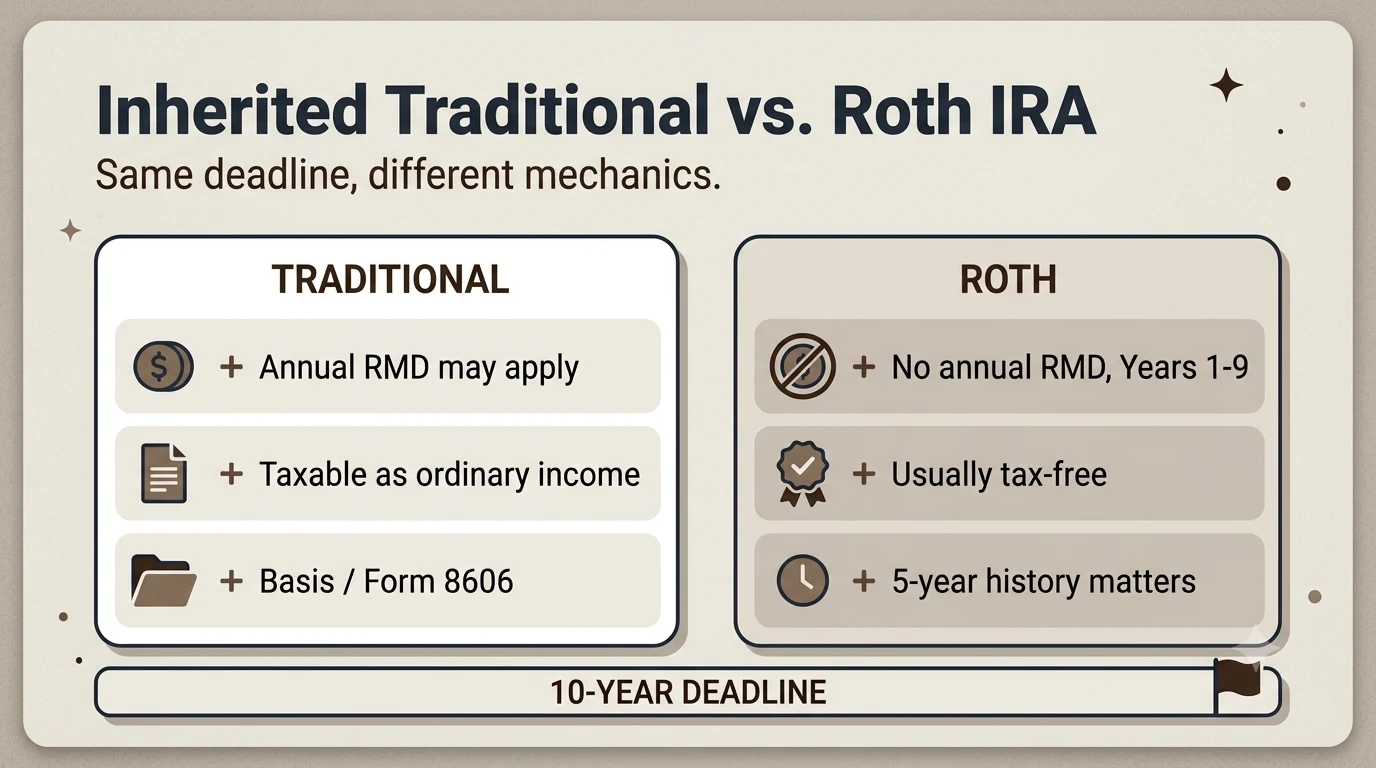
Traditional and Roth inherited IRAs can share a deadline but behave differently inside it
An ordinary non-spouse designated beneficiary can be subject to the 10-year full-distribution rule for either a traditional IRA or a Roth IRA. That similarity often hides the differences that matter most: whether annual RMDs can apply before year 10, how withdrawals are taxed, and what historical records the beneficiary needs.
Side-by-side rule comparison
| Issue | Inherited traditional IRA | Inherited Roth IRA |
|---|---|---|
| Owner had lifetime RMDs? | Potentially yes, depending on required beginning date | No lifetime Roth IRA RMD for the original owner |
| Ordinary beneficiary annual RMDs during 10-year period? | Generally yes if owner died on/after RBD; generally no solely under 10-year rule if owner died before RBD | Generally no in years 1–9 under the 10-year rule because Roth owner is treated as dying before RBD |
| Year-10 full distribution? | Generally yes for ordinary designated beneficiary | Generally yes for ordinary designated beneficiary |
| Typical tax character | Pre-tax amounts are generally ordinary income; inherited basis can make part nontaxable | Qualified distributions are tax-free; earnings can be taxable if the owner’s Roth 5-year period was not satisfied |
| Key historical record | Owner’s Form 8606 if nondeductible basis existed | Owner’s first Roth contribution year and conversion history |
| Can non-spouse beneficiary merge with own IRA? | No | No |
The required-beginning-date branch matters mainly on the traditional side
A traditional IRA owner may die before, on, or after the required beginning date. If an ordinary designated beneficiary inherits from an owner who died on or after that date, annual beneficiary RMDs generally continue while the 10-year clock runs. Publication 590-B bases those post-death RMDs on the longer of the beneficiary’s single life expectancy and the owner’s remaining life expectancy.
For an original Roth IRA owner, there is no lifetime Roth RMD. Publication 590-B therefore applies the beneficiary rules as though the Roth owner died before the required beginning date. That usually removes annual RMDs in years 1 through 9 for an ordinary beneficiary who is simply following the 10-year rule.
The tax difference is not simply “traditional taxable, Roth tax-free”
A traditional inherited IRA distribution is generally taxable to the extent it would have been taxable to the owner. If the owner had nondeductible basis, the basis remains with the inherited IRA and can make part of a distribution nontaxable under Form 8606.
Roth distributions are often tax-free, but the owner’s five-tax-year qualification period matters. If a beneficiary distribution is not qualified, the portion allocable to earnings can be included in income. Publication 590-B’s beneficiary example also shows that the death exception can remove the 10% early-distribution additional tax even when earnings are taxable.
Two $200,000 inheritances can create very different cash-flow questions
Assume two adult siblings inherit separate $200,000 IRAs from the same parent: one receives a traditional IRA and one receives a Roth IRA. If the parent died before the required beginning date, both accounts can have the same December 31 year-10 deadline and no annual distribution required solely by the 10-year rule.
The traditional-IRA sibling, however, generally adds pre-tax withdrawals to ordinary income. The Roth-IRA sibling may have tax-free qualified distributions and may care more about the owner’s Roth five-year history than about tax brackets. Same deadline; different tax mechanics.
If the traditional owner died after the required beginning date, the schedules diverge further
In that case, the traditional inherited IRA can require annual beneficiary RMDs plus full distribution by year 10. The inherited Roth generally remains in the no-annual-RMD branch for an ordinary beneficiary because the original Roth owner is treated as dying before the required beginning date.
This is why a beneficiary should not build one generic “10-year withdrawal schedule” and apply it to both accounts.
Basis records and Roth history solve different tax questions
For the traditional IRA, the critical historical document may be the decedent’s Form 8606 showing nondeductible basis. The Form 8606 instructions require separate inherited-basis reporting when IRAs came from different decedents.
For the Roth IRA, the critical record can be the first tax year for which the owner contributed to any Roth IRA and the history of conversion or rollover amounts. The current custodian may not possess that entire history if the owner moved accounts.
Neither account becomes the non-spouse beneficiary’s personal IRA
Publication 590-B says a non-spouse beneficiary cannot treat a traditional inherited IRA as the beneficiary’s own and cannot make ordinary contributions to it. Inherited Roth accounts likewise retain inherited status. Trustee-to-trustee transfers can preserve the inherited registration, but the beneficiary should not merge the inherited account into a personal IRA as though the beneficiary were the original owner.
The 10-year rule takes more away from an inherited Roth
This is counterintuitive. A forced 10-year payout of a traditional IRA accelerates a tax bill the beneficiary would eventually owe anyway. A forced 10-year payout of a Roth ends decades of tax-free compounding that a longer stretch would have preserved. In that sense the SECURE Act hurt inherited Roth holders more, even though Roth withdrawals are tax-free. It does not mean a Roth is a bad inheritance—tax-free money is still better than taxable money of the same size—only that the value lost to the shorter window is larger on the Roth side.
Drawdown order when both are inherited from one person
The common sequence is: satisfy any required annual RMD on the traditional account, then take additional traditional withdrawals up to the top of the beneficiary's current tax bracket, and leave the inherited Roth invested until the final year. The traditional account's built-in future tax liability shrinks the real cost of drawing it down sooner; the Roth's entire balance belongs to the beneficiary and is worth sheltering as long as the rules allow.
- Request the owner's final Form 8606 if traditional IRA basis may exist.
- Find the owner's earliest Roth contribution year across accounts.
- Collect Roth conversion and rollover records.
- Keep the owner's death date and beneficiary classification with each account.
- Save transfer statements that preserve the inherited account history.
A better annual review uses two separate columns
For a person who inherits both account types, keep one column for legal distribution obligations and a second for tax character. The legal column asks whether an annual RMD is due and what the year-10 deadline is. The tax column asks how much of the planned distribution is included in income and what records support that result.
That layout prevents a common mistake: assuming that because a Roth withdrawal may be tax-free it is not subject to an inherited-account deadline, or assuming that because a traditional withdrawal is taxable it must be taken in equal installments.