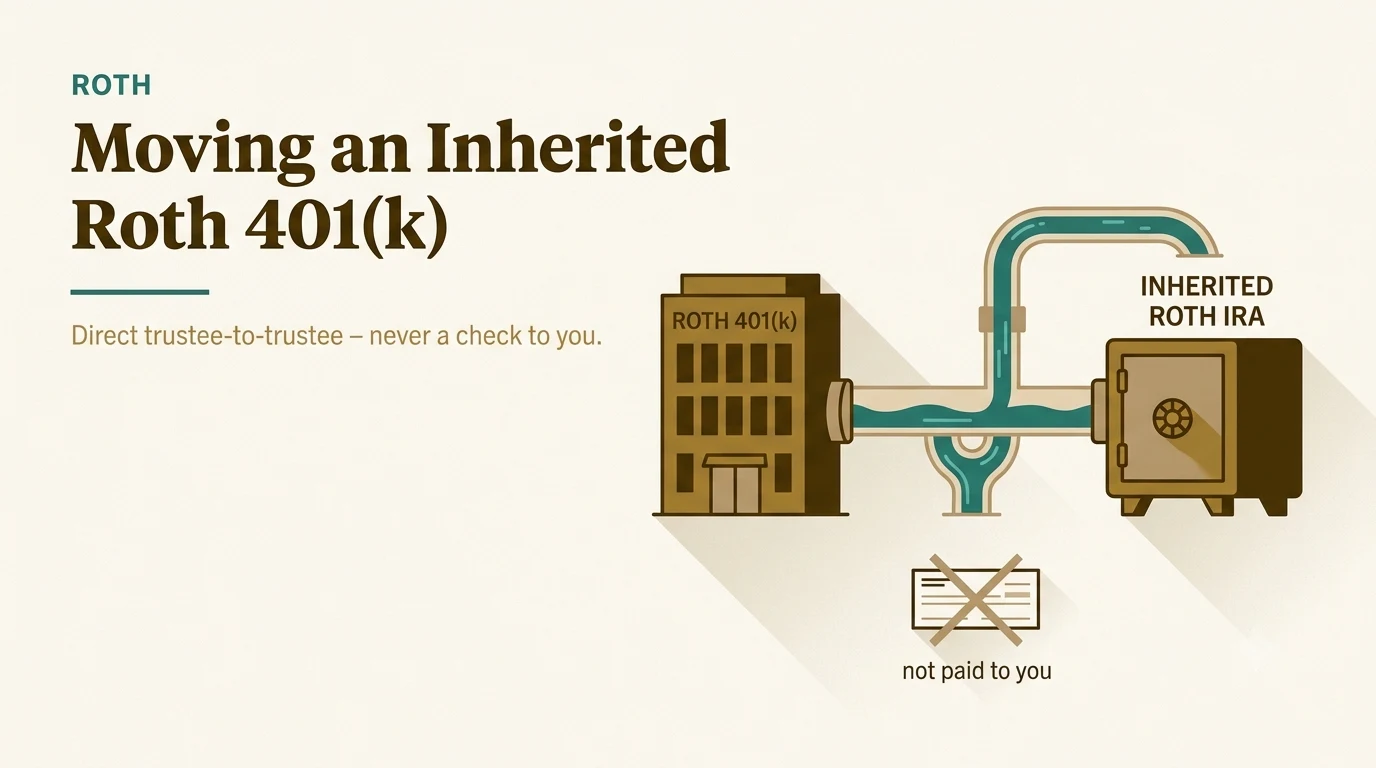
A Roth 401(k) and a Roth IRA are not identical after death
A designated Roth account inside a 401(k) is an employer-plan account. Although qualified distributions can be tax-free, beneficiaries are still subject to post-death required-minimum-distribution rules. Do not apply the “Roth IRA owner has no lifetime RMD” statement to an employer plan without checking the beneficiary rules.
Non-spouse beneficiaries can have a direct-rollover route
Publication 575 describes a direct trustee-to-trustee rollover by a non-spouse designated beneficiary from an employer plan to an inherited IRA. For designated Roth money, the receiving account generally needs to be an inherited Roth IRA to preserve Roth character. The account remains inherited and keeps the post-death timeline.
Do not take the check personally if the goal is a direct rollover
The plan should make the transfer directly to the receiving trustee under the non-spouse beneficiary rules. A payment made personally to the beneficiary is not the same as a direct rollover and can create a current distribution.
Current-year RMD must be handled before eligible rollover money
Required minimum distributions are not eligible rollover distributions. If an RMD is due for the transfer year, coordinate with the plan so the required amount is distributed appropriately and only eligible remaining assets are sent to the inherited Roth IRA.
- Separate designated Roth and pre-tax sourcesA plan statement may show both types of money.
- Identify the current-year RMDRemove any required amount before eligible assets move.
- Arrange a direct trustee-to-trustee rolloverUse an inherited Roth IRA for eligible designated Roth assets.
- Carry over Roth and death recordsPreserve first contribution year and original owner timeline.
The Roth 5-tax-year rule still matters for earnings
Whether a Roth distribution is qualified can depend on the designated Roth account’s qualified-distribution rules and the history carried into the receiving inherited Roth IRA. Preserve the date of the decedent’s first Roth contribution and plan records rather than assuming every beneficiary withdrawal is tax-free solely because the account says “Roth.”
Transfer file checklist
- Plan statement separating designated Roth and pre-tax sources.
- Owner date of death.
- Current-year RMD determination.
- Direct-rollover confirmation.
- Inherited Roth IRA registration showing the decedent and beneficiary.
- Roth 5-tax-year history supplied by the plan if available.
Preserve the plan’s Roth history, but do not assume the plan’s five-year clock becomes the Roth IRA clock
The employee’s first designated-Roth contribution year is important for deciding whether a distribution from the employer plan is a qualified designated-Roth distribution. If assets are rolled to an inherited Roth IRA, Roth IRA qualified-distribution rules apply to later IRA withdrawals and the five-tax-year analysis is not simply copied from the plan. Request the plan’s basis and qualification information before the plan account closes, then apply the receiving inherited Roth IRA rules separately.
Pre-tax employer contributions may sit beside Roth deferrals
A 401(k) statement can show a large “Roth” balance while employer match remains in a pre-tax source. A beneficiary planning a rollover should obtain a source breakdown so pre-tax and Roth dollars are not sent to the wrong inherited IRA type or reported as though the entire plan were Roth.
The 10-year rule can continue after the rollover
Moving designated Roth plan assets to an inherited Roth IRA changes the custodian and account form, not the original participant’s date of death. The receiving inherited Roth IRA should preserve the same applicable post-death deadline rather than starting a fresh ten-year period on the rollover date.
Example: inherited Roth 401(k) moved in the second year after death
A daughter inherits her father’s designated Roth 401(k) and, after the plan handles any required current-year distribution, directs the eligible balance to an inherited Roth IRA. The receiving IRA should remain titled for the father for the daughter’s benefit. The transfer does not make the daughter the Roth IRA owner in her own right, and it does not restart the post-death distribution period.
Pre-death RMDs on Roth 401(k)s ended in 2024
Before 2024, designated Roth accounts in employer plans were subject to lifetime required minimum distributions, unlike Roth IRAs. SECURE 2.0 removed that rule for tax years beginning after 2022. For a beneficiary, the practical effect is that a participant who died in 2024 or later had no lifetime Roth 401(k) RMD, so the post-death analysis treats the account like a Roth IRA owner who died before the required beginning date.
That usually means 10 years with no annual minimum
Because the participant is treated as dying before the required beginning date, an ordinary non-spouse designated beneficiary generally faces the 10-year rule with no required annual distribution in years 1 through 9—whether the money stays in the plan or is rolled to an inherited Roth IRA. The whole remaining balance simply has to be out by the end of the tenth year after death. An eligible designated beneficiary can instead use life-expectancy treatment.
Keep plan tax character separate from the inherited IRA payout schedule
Two questions must be answered independently: whether a plan or Roth IRA distribution is taxable under the applicable five-year/qualified-distribution rules, and when the inherited balance must be distributed under post-death RMD rules. A distribution can be required even when its tax character is favorable.
| Question | What it determines | What to check |
|---|---|---|
| Roth five-tax-year history | Whether a distribution is qualified for tax purposes | Contribution history and receiving IRA rules |
| Post-death RMD schedule | When the inherited balance must be distributed | Owner's death year and beneficiary classification |
| Transfer-year RMD | What must leave before eligible rollover assets move | Plan's current-year calculation |