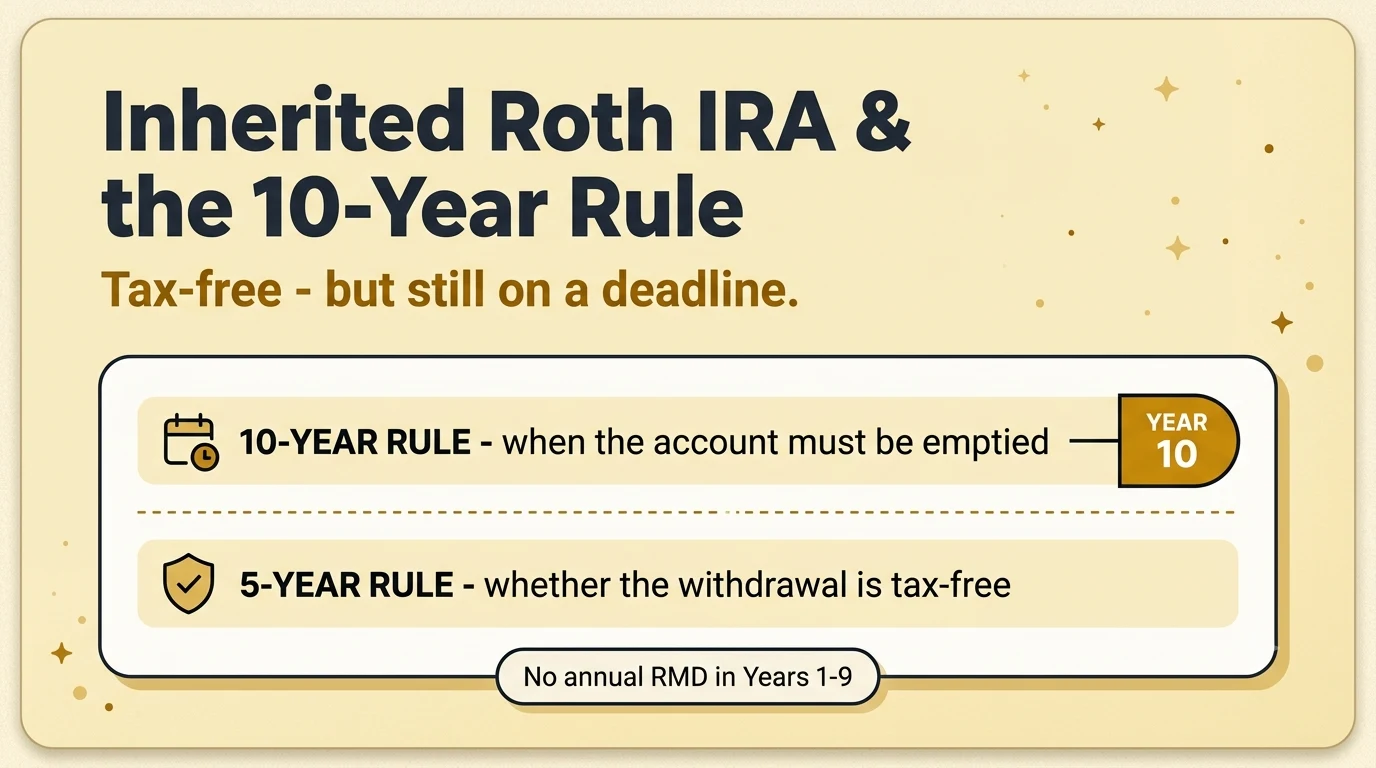
An inherited Roth can have a 10-year deadline even though the owner had no lifetime RMD
Roth IRA owners are not required to take lifetime RMDs. After death, however, beneficiary distribution rules apply. Publication 590-B treats a Roth IRA owner as having died before the required beginning date for post-death distribution purposes.
For an ordinary non-spouse designated beneficiary who is not an eligible designated beneficiary, that generally means the inherited Roth IRA must be fully distributed by the end of the calendar year containing the tenth anniversary of the owner’s death, while the 10-year rule itself does not require annual withdrawals in years 1 through 9.
The 10-year distribution rule and the Roth 5-year tax rule answer different questions
The 10-year rule asks when the inherited account must be emptied. The Roth 5-year rule asks whether a distribution is a qualified distribution for income-tax purposes. Mixing those rules creates statements such as “an inherited Roth is tax-free for ten years,” which is not how the law works.
A distribution made to the owner’s beneficiary after death satisfies the death-event condition for a qualified Roth distribution, but it is fully qualified only if the owner’s Roth has also satisfied the applicable five-tax-year holding period.
| Question | 10-year distribution rule | Roth 5-year tax rule |
|---|---|---|
| What it answers | When the inherited account must be fully distributed | Whether a distribution is qualified for income-tax purposes |
| What to check | The owner's death year and beneficiary category | The first tax year with a contribution to a Roth IRA for the owner |
| Potential issue | A final year-end distribution deadline | Earnings can be taxable if the period is incomplete |
One rule sets when the account must be emptied; the other affects whether earnings are qualified.
How the main Roth 5-year period is measured
Publication 590-B defines the qualified-distribution five-year period as beginning with the first tax year for which a contribution was made to a Roth IRA set up for the owner’s benefit. It is measured by tax years, not by counting 60 months from a deposit date.
If the owner’s first Roth contribution was for tax year 2021, the five-year period begins January 1, 2021. A beneficiary trying to establish whether earnings are qualified should therefore look for the owner’s earliest Roth contribution history, not merely the opening date shown by the current custodian after a later transfer.
- Tax year 2021Example: the owner's first contribution is for this tax year.
- January 1, 2021The five-tax-year period begins for this example.
- Before period endsA nonqualified distribution can include taxable earnings.
Count tax years from the first contribution year, not 60 months from a deposit date.
If the five-year period is not complete, earnings can be taxable
Publication 590-B says a beneficiary distribution that is not qualified is generally included in the beneficiary’s gross income in the same manner it would have been included in the owner’s income. The ordering rules matter because an inherited Roth can contain regular contributions, conversion or rollover amounts, and earnings.
In the IRS beneficiary example, when the owner died before the five-year period ended, each child’s share of earnings was taxable. The example also makes an important distinction: the 10% additional tax on early distributions did not apply because the distribution was made to beneficiaries as a result of the owner’s death.
Conversion records still matter, but death changes the early-distribution analysis
Roth conversion and rollover history can matter because nonqualified Roth distributions follow ordering rules: regular contributions come out first, then conversion and rollover amounts, then earnings. Forms 8606 and older account records can therefore be important when the owner’s Roth has not yet produced a qualified distribution.
Conversion-specific five-year recapture rules are separate from the five-tax-year period used to determine whether a Roth distribution is qualified. For a beneficiary distribution made because of the owner’s death, Publication 590-B’s beneficiary example shows that the 10% additional tax on early distributions does not apply even though the earnings portion can still be taxable. The practical recordkeeping goal is therefore to establish contribution, conversion, and earnings history accurately—not to assume that every five-year rule produces the same tax consequence.
Form 8606 can matter for a nonqualified inherited Roth distribution
The 2025 Form 8606 instructions state that a beneficiary who receives a distribution from an inherited Roth IRA that was not a qualified distribution may need to file Form 8606. Part III is used to determine the taxable portion of Roth IRA distributions under the ordering and basis rules.
A Form 1099-R from the custodian may report the gross distribution without supplying the decedent’s entire historical Roth basis. That is why beneficiary tax reporting can depend on records that predate the inheritance.
- Find the owner's earliest Roth contribution year across accounts.
- Keep contribution, conversion, and rollover records.
- Look for older Forms 8606 and account records from prior custodians.
- Save the inherited account's Form 1099-R and distribution details.
- Check whether a nonqualified inherited Roth distribution requires Form 8606.
Example: owner’s first Roth contribution was only two years before death
Assume a parent first contributed to any Roth IRA for tax year 2024, died in 2025, and left the account to an adult child who is an ordinary designated beneficiary. The child’s inherited Roth generally has a final 10-year deadline of December 31, 2035. But a distribution taken before the owner’s qualified-distribution five-year period is complete can include taxable earnings.
The account therefore can have no annual RMD in years 1–9 under the 10-year rule and still have a tax-reporting issue if money is withdrawn early in the Roth’s five-year history.
Usually leave an inherited Roth alone until year 10
An inherited Roth is the one account where deferral is generally the right instinct. Qualified withdrawals are tax-free, there is no annual RMD for an ordinary beneficiary in years 1 through 9, and every year the money stays invested is another year of tax-free growth the beneficiary keeps. Pulling money out early to spend or reinvest in a taxable account gives up that shelter for no tax benefit. The main reason to withdraw sooner is a genuine cash need or a concern that the owner's five-year clock is not yet met and earnings could be taxable.
If you also inherit a traditional IRA, draw that down first
When a beneficiary inherits both types from the same person, the inherited Roth is generally the last account to touch. Spend down the traditional account over the 10 years to manage brackets, and let the Roth run untouched to the final year. The traditional vs. Roth comparison works through the full ordering logic and why the traditional account is the cheaper one to accelerate.
Combining inherited Roth IRAs is limited
Publication 590-B says an inherited Roth IRA can generally be combined with another Roth IRA maintained by the beneficiary only if the other Roth IRA was inherited from the same decedent, or if a surviving spouse qualifies and elects to treat the account as the spouse’s own. A non-spouse beneficiary should not merge the inherited Roth into the beneficiary’s personal Roth IRA.
Year 10 remains a hard operational deadline
Tax-free treatment does not extend the distribution deadline. A beneficiary who intentionally preserves an inherited Roth late into the 10-year period should still set an internal liquidation and transfer date before December 31 of the final year. Trade settlement, bank-link verification, address changes, transfer holds, and holiday processing can all matter when the entire remaining account must leave by year-end.