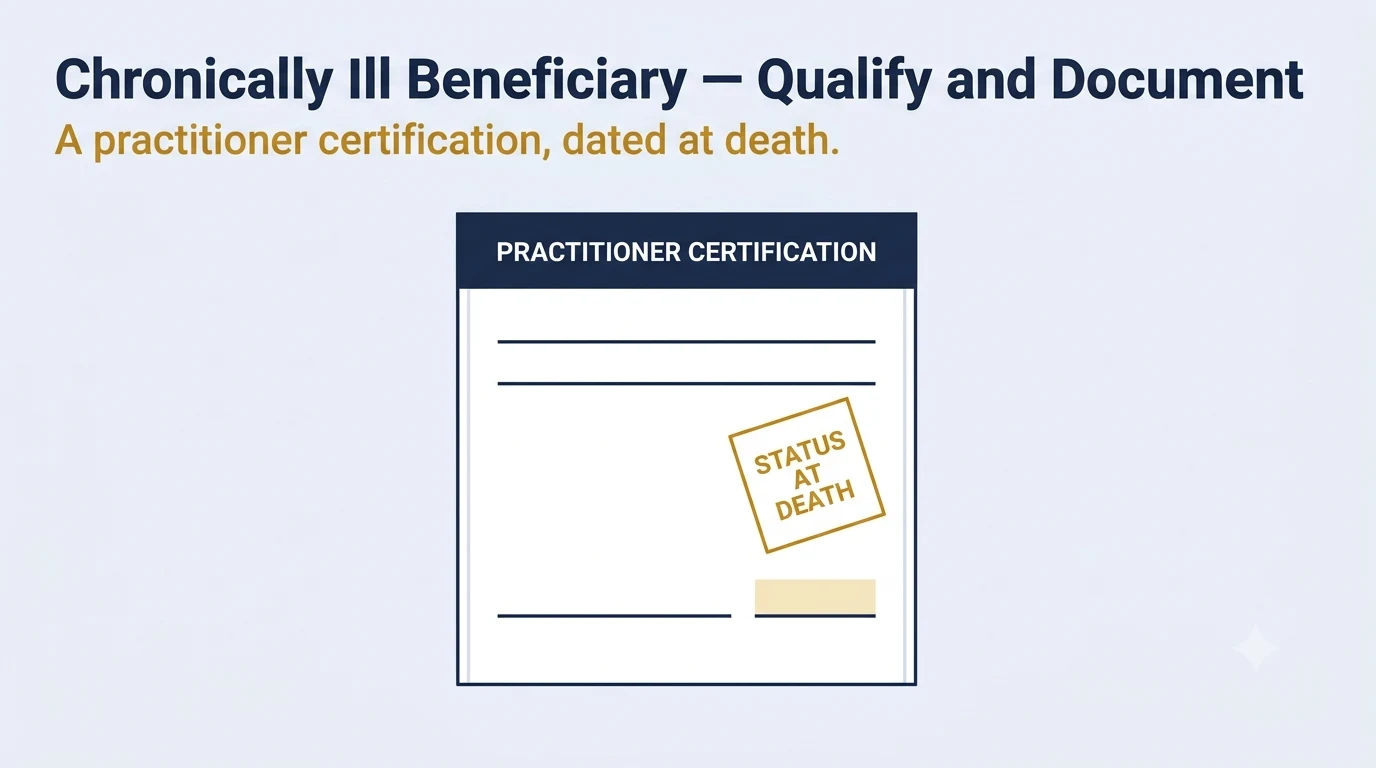
Chronic illness is a defined EDB category, not a general medical label
A designated beneficiary who is chronically ill can qualify as an eligible designated beneficiary and therefore may receive life-expectancy treatment that an ordinary designated beneficiary cannot. The final regulations tie the definition to Internal Revenue Code section 7702B(c)(2) and add specific documentation requirements.
Because the rule can materially extend the distribution period, it is worth separating the tax definition from ordinary language. A person can have a long-term diagnosis without necessarily satisfying this particular federal test.
The status must exist when the employee or IRA owner dies
The key classification date is the owner’s date of death. Later deterioration does not generally convert an ordinary designated beneficiary into an EDB for that owner’s account. The final regulations emphasize contemporaneous medical assessment because a determination made a decade later would be less reliable.
One path focuses on inability to perform at least two activities of daily living
For the activity-of-daily-living branch, the final regulations require certification by a licensed health care practitioner that the beneficiary cannot perform at least two activities of daily living without substantial assistance and that the period of inability is indefinite and reasonably expected to be lengthy. The tax rule therefore looks beyond a temporary recovery period.
Section 7702B also contains a cognitive-impairment branch, so the analysis should use the actual statutory category rather than assuming every case must be framed as two physical activities of daily living.
Employer plans require timely documentation
For employer retirement plans, documentation generally must reach the plan administrator by October 31 of the calendar year following the year of the employee’s death, subject to the transition rule in the final regulations. The documentation must include the required licensed-health-care-practitioner certification for a chronically ill beneficiary.
A beneficiary who waits until the first large distribution years later can create an avoidable problem. The status may have existed, but the federal delivery deadline for the plan can already have passed.
An IRA custodian does not receive the same federally mandated documentation
The final regulations specifically relieve IRA custodians, issuers, and trustees from the requirement to receive this disability/chronic-illness documentation for the RMD determination. That distinction is easy to miss when an inherited 401(k) is later moved to an inherited IRA.
If the account began in an employer plan, preserve the plan submission even after a direct transfer. The receiving IRA custodian may not need the same certification, but the historical beneficiary classification still affects the distribution schedule.
| Account setting | Employer plan | IRA custodian |
|---|---|---|
| Federal documentation delivery | Documentation generally must reach the plan administrator by the applicable October 31 deadline | Specified documentation is not federally required to be furnished to the IRA custodian |
| Why keep records | Prove timely submission and EDB classification | Preserve the status history, especially after a plan transfer |
| Certification | Practitioner certification is required for chronic illness | Underlying status still needs support |
Minor child plus chronic illness can produce overlapping EDB status
A child under 21 may qualify as the owner’s minor child and also as chronically ill. The final regulations allow the chronic-illness status to matter after the child reaches age 21 if the requirements were satisfied. That can prevent the beneficiary from being forced into the ordinary age-21 transition solely because the minor-child category ended.
The certification should describe the condition as of the death date
A practitioner certification obtained years later that describes the beneficiary's current condition is weaker evidence than one that addresses status as of the owner's date of death. Where possible, the certification should be dated near the death and should state that the qualifying inability existed then and is indefinite. The regulations do not require an exhaustive medical file, but they do require the certification to support the statutory standard on the date that controls classification.
Trust drafting: conduit versus accumulation for a chronically ill beneficiary
If the IRA is left to a trust for a chronically ill beneficiary, the trust type matters. A conduit trust must pass every IRA distribution straight through to the beneficiary, which can disrupt means-tested public benefits. An accumulation trust can retain distributions, but to preserve the chronically ill beneficiary's EDB treatment it generally has to meet the applicable multi-beneficiary trust conditions. That is a drafting decision to make before the owner's death, not after.
Do not turn EDB status into “no year-10 deadline ever”
Life-expectancy treatment can apply while the chronically ill beneficiary is alive, but the account still has a succession rule. If the EDB dies before the inherited interest is fully distributed, the remaining balance generally becomes subject to a 10-year full-distribution period measured from that beneficiary’s death.
Life-expectancy treatment may apply while the chronically ill beneficiary is alive. If the beneficiary dies before full distribution, the remaining balance generally enters a 10-year period measured from that beneficiary's death.
A practical employer-plan checklist
- Confirm the beneficiary was chronically ill as of the employee’s death.
- Identify which statutory branch supports the status.
- Obtain the required practitioner certification.
- Submit it to the plan administrator by the applicable October 31 deadline.
- Keep the submission receipt with the inherited-account records.
- Calculate annual beneficiary RMDs under the correct life-expectancy method.
This is a good example of why an inherited-account workflow should start with beneficiary classification, not with the balance or a desired withdrawal amount.