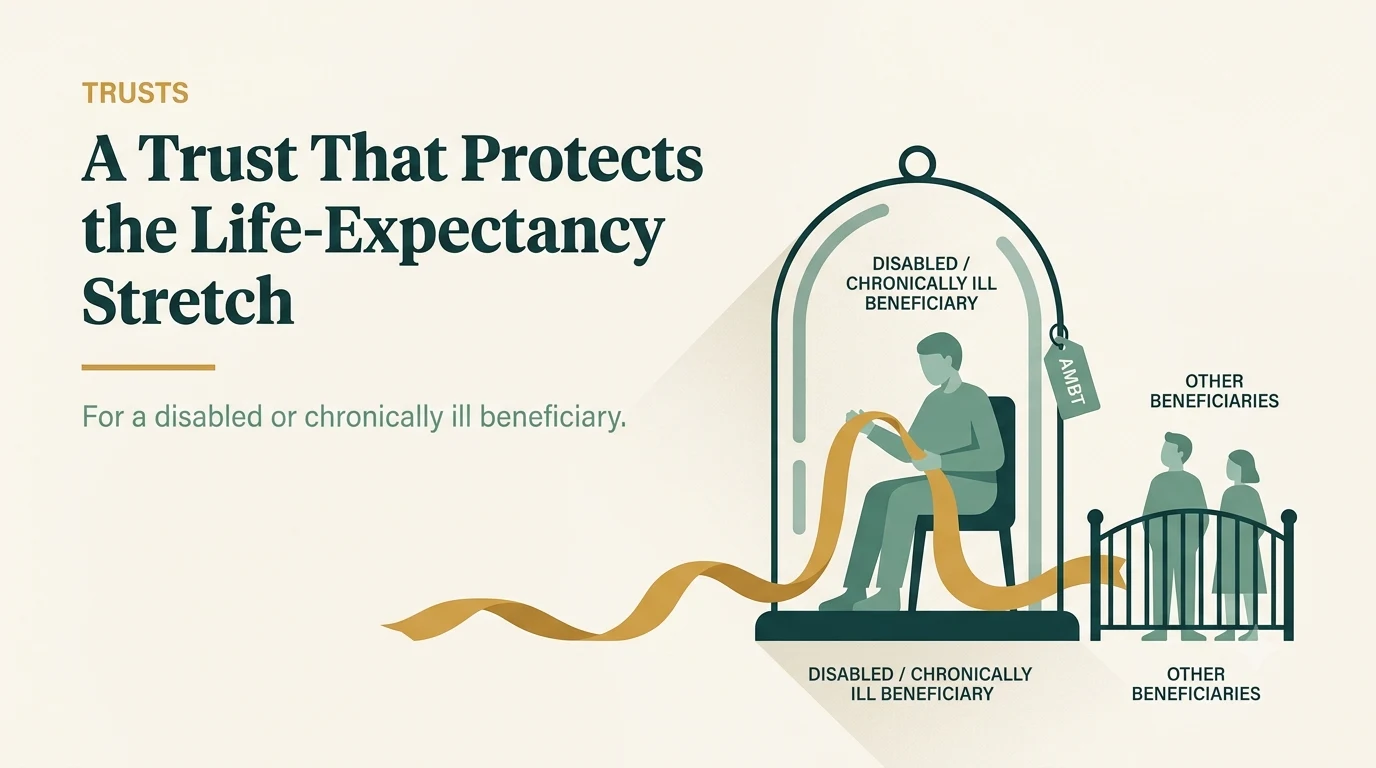
This is a narrow statutory exception, not a label any family trust can choose
The SECURE Act and final RMD regulations created special treatment for an “applicable multi-beneficiary trust” (AMBT). The rules are designed in part for trusts benefiting disabled or chronically ill eligible designated beneficiaries. They can allow treatment that would not follow from the ordinary multiple-beneficiary rules.
Two AMBT structures appear in the regulations
One category involves a trust whose beneficiaries are all eligible designated beneficiaries. Another important category is a trust under which one or more beneficiaries are disabled or chronically ill and the trust terms restrict distributions so that, during the disabled or chronically ill beneficiary’s lifetime, the retirement-plan interest is protected for that beneficiary under the statutory conditions.
Why the trust terms matter more than the trust’s marketing name
A document titled “special needs trust” does not automatically satisfy the AMBT rules. Review who can receive retirement benefits during the relevant beneficiary’s lifetime, who receives them later, and whether the trust meets the see-through requirements.
Example: disabled adult child and remainder siblings
An IRA owner leaves the account to a properly drafted accumulation trust for a disabled adult child. Two nondisabled siblings are remainder beneficiaries after the child’s death. Under the AMBT provisions, the disabled child’s status can receive special treatment if the trust satisfies the statutory and regulatory requirements. Without that exception, the presence of additional beneficiaries could change the RMD result.
Disability/chronic-illness qualification still has to be established
The AMBT rule does not waive the definition of disabled or chronically ill. The beneficiary must meet the eligible-designated-beneficiary standard. For employer plans, the final regulations also contain documentation rules for proving those statuses.
Document checklist
- Executed trust and all amendments.
- IRA or plan beneficiary designation naming the trust.
- Proof the trust meets the see-through requirements.
- Evidence supporting disabled or chronically ill status.
- A beneficiary chart showing who can receive retirement-plan amounts during and after the EDB’s lifetime.
- Any documentation submitted to the plan administrator by the regulatory deadline.
The lifetime-restriction requirement, stated more precisely
For the AMBT structure built around a disabled or chronically ill beneficiary, the trust must be divided immediately upon the owner's death into separate trusts for each beneficiary, or its terms must provide that no beneficiary other than the disabled or chronically ill beneficiary has any right to the retirement-plan interest until that beneficiary dies. A clause letting a healthy remainder beneficiary reach IRA money during the protected beneficiary's lifetime generally breaks the exception.
Documentation timing for disability and chronic illness
For employer plans, the final regulations set an October 31 deadline in the year after the owner's death for providing the trustee documentation and, where required, certification of disabled or chronically ill status. IRA custodians apply their own procedures, but the same information should be gathered on that timeline. A chronically ill certification from a licensed health-care practitioner generally has to be in hand, not merely obtainable later.
Do not generalize the result to every trust with an EDB
A trust can have a disabled beneficiary and still fail AMBT requirements. Because the result depends on both tax definitions and exact trust language, this is one of the inherited-IRA situations where a specialized trust-and-tax review can materially affect the payout period.
The protected beneficiary’s lifetime access rules are central
For the special AMBT structure involving a disabled or chronically ill beneficiary, the trust must satisfy limits on who can receive the retirement-plan interest during that beneficiary’s lifetime. A drafting clause that lets nondisabled remainder beneficiaries receive IRA amounts immediately can defeat the intended special treatment.
Successor treatment after the protected beneficiary dies is a separate clock question
When the disabled or chronically ill beneficiary later dies, the successor distribution rule can shift to a 10-year period. The trust file should therefore track both the original owner’s death and the EDB’s later death rather than treating the trust as having one permanent payout formula.
- By October 31 of the following yearFor an employer plan, provide required trust and status documentation under the stated rules.
- During protected beneficiary's lifetimeConfirm trust terms continue to protect the retirement interest as required.
- After the protected beneficiary diesReview the successor distribution rule; a 10-year period may apply.
Why the trust route is used even when the disabled person could inherit directly
A disabled or chronically ill individual can be an eligible designated beneficiary in their own name, so a trust is not required for the RMD stretch. The trust is used for two other reasons. First, means-tested public benefits—Medicaid, SSI—can be lost if the beneficiary receives IRA money outright, and a properly drafted special needs trust holds the funds without counting as the beneficiary's resource. Second, an inherited IRA left outright is generally not protected from the beneficiary's creditors under Clark v. Rameker (2014), while an accumulation trust can shield it. The applicable multi-beneficiary trust rules exist so families can pursue those goals without forfeiting the life-expectancy payout.
SSA disability status can support—but does not replace—the full trust review
The final regulations provide a disability safe harbor tied to a Social Security disability determination in qualifying circumstances. That can help establish EDB status, but it does not establish that the trust itself satisfies the AMBT and see-through requirements.