A trust is not an individual, but certain trusts can look through to individual beneficiaries
For RMD purposes, a trust itself is generally not an individual designated beneficiary. Treasury regulations permit certain trusts to be treated as “see-through” trusts so the underlying trust beneficiaries can be considered when applying the post-death distribution rules.
The core requirements
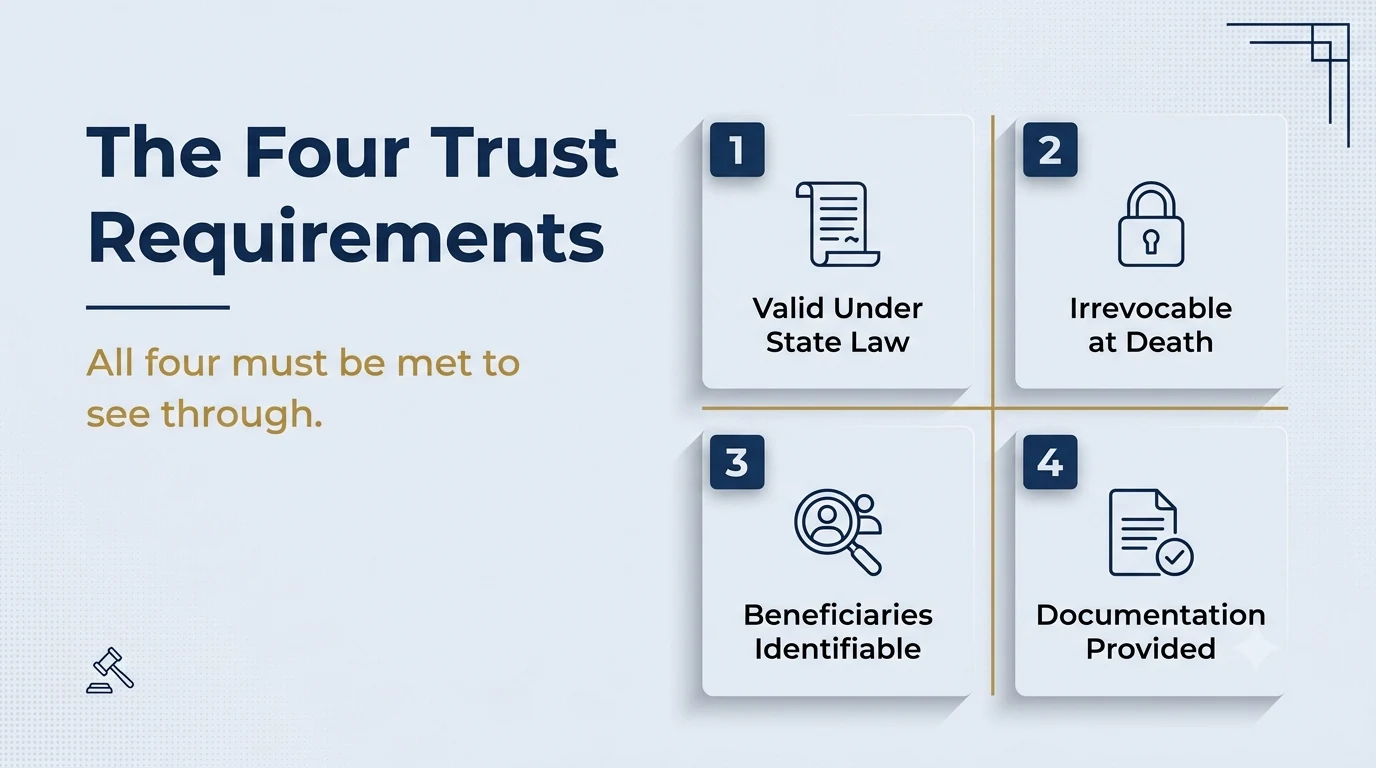
Publication 590-B and the final regulations describe four central conditions:
- The trust is valid under state law, or would be valid but for the fact that there is no corpus.
- The trust is irrevocable, or becomes irrevocable upon the owner’s death.
- The beneficiaries who are relevant under the regulations are identifiable from the trust instrument.
- The required trust documentation is provided to the plan administrator or custodian under the applicable timing rules.
Identifiable does not mean “named on page one”
RMD analysis can require tracing contingent beneficiaries through the trust terms, not just reading the current income beneficiary’s name. The regulations distinguish conduit and accumulation trust structures and determine which beneficiaries count based on who can receive retirement-plan amounts under the trust.
Example: parent names a revocable trust
A parent names a revocable living trust as IRA beneficiary. The trust becomes irrevocable at death and directs all retirement-account distributions received by the trust to an adult child. If the trust satisfies the other see-through requirements and documentation rules, the child may be taken into account for RMD classification. If the documentation requirement is missed, the trust may fail to receive see-through treatment.
Documentation is not an afterthought
For employer plans, the regulations contain specific deadlines and acceptable documentation methods. IRA custodians can also require trust documents under their procedures. Beneficiaries should obtain the complete executed trust and amendments rather than relying only on a certificate of trust unless the applicable rule and institution accept it.
The documentation deadline is October 31 of the year after death
For an employer plan, the trustee generally must give the plan administrator either a final list of all trust beneficiaries with a description of the conditions on their entitlement, or a copy of the trust instrument, by October 31 of the calendar year following the owner's death. IRA custodians set their own procedures, but the same package should be assembled on that timeline. Missing the deadline for a plan can cause the trust to be treated as a non-designated beneficiary, which usually means the 5-year rule or the owner's remaining life expectancy instead of a 10-year or life-expectancy result.
- At the owner’s deathConfirm the trust terms, irrevocability, and identifiable beneficiaries.
- By October 31 of the following yearFor an employer plan, provide the required beneficiary list or trust instrument.
- If documentation is lateThe plan trust may fail see-through treatment and be treated as a non-designated beneficiary.
Creditor protection is a common reason to use a trust at all
Under Clark v. Rameker (2014), a non-spouse inherited IRA left outright to an individual is generally not exempt from that beneficiary's creditors in bankruptcy. Leaving the IRA to a properly drafted see-through accumulation trust can keep the retirement assets outside the beneficiary's bankruptcy estate while still qualifying for the post-death RMD rules. A conduit trust gives up much of that protection because it must pass every distribution straight through to the beneficiary. If asset protection or a spendthrift concern is the goal, the accumulation structure and the see-through requirements have to be coordinated in the drafting.
Do not assume “see-through” means life-expectancy payouts
Qualifying as a see-through trust only determines whose status can be considered. The underlying beneficiary may still be an ordinary designated beneficiary subject to the 10-year rule. A trust for an adult child does not become an eligible designated beneficiary merely because the trust qualifies for look-through treatment.
Questions for a trust-RMD review
| Question | Why it matters |
|---|---|
| Is the trust valid and irrevocable at death? | Threshold see-through requirement |
| Who can receive IRA amounts? | Determines which beneficiaries count |
| Are any charities or estates possible recipients? | Can affect designated-beneficiary treatment |
| Was documentation supplied on time? | Procedural requirement |
| Is an underlying individual an EDB? | Determines whether special life-expectancy rules may apply |
Conduit and accumulation trusts can count beneficiaries differently
A conduit trust requires retirement distributions received by the trust to be paid through to a specified individual, while an accumulation trust can retain distributions. Because retained amounts can later pass to remainder beneficiaries, accumulation trusts can require a wider beneficiary search for RMD purposes.
| Trust feature | Conduit trust | Accumulation trust |
|---|---|---|
| IRA distribution received by trust | Must pass through to a specified individual | Can be retained by the trust |
| Beneficiary tracing | Focus on the individual receiving the passed-through distribution | May require tracing remainder beneficiaries who could receive retained amounts |
| Potential complication | Pass-through structure shapes who counts | A charity in a remainder clause may matter |
A charity hidden in the remainder clause can matter
Suppose the current beneficiary is an adult child but the trust permits accumulated IRA distributions to pass to a charity at the child’s later death. Depending on the trust type and regulatory beneficiary-identification rules, that non-individual remainder interest may matter. Reading only the first current-beneficiary paragraph is not enough.
Create a trust-specific RMD memo
The memo should identify the trust type, every beneficiary counted under the regulations, whether any beneficiary is an EDB, the documentation supplied and date supplied, and the resulting payout rule. Attach the relevant trust pages. This is far more useful than a custodian note saying only “trust accepted.”