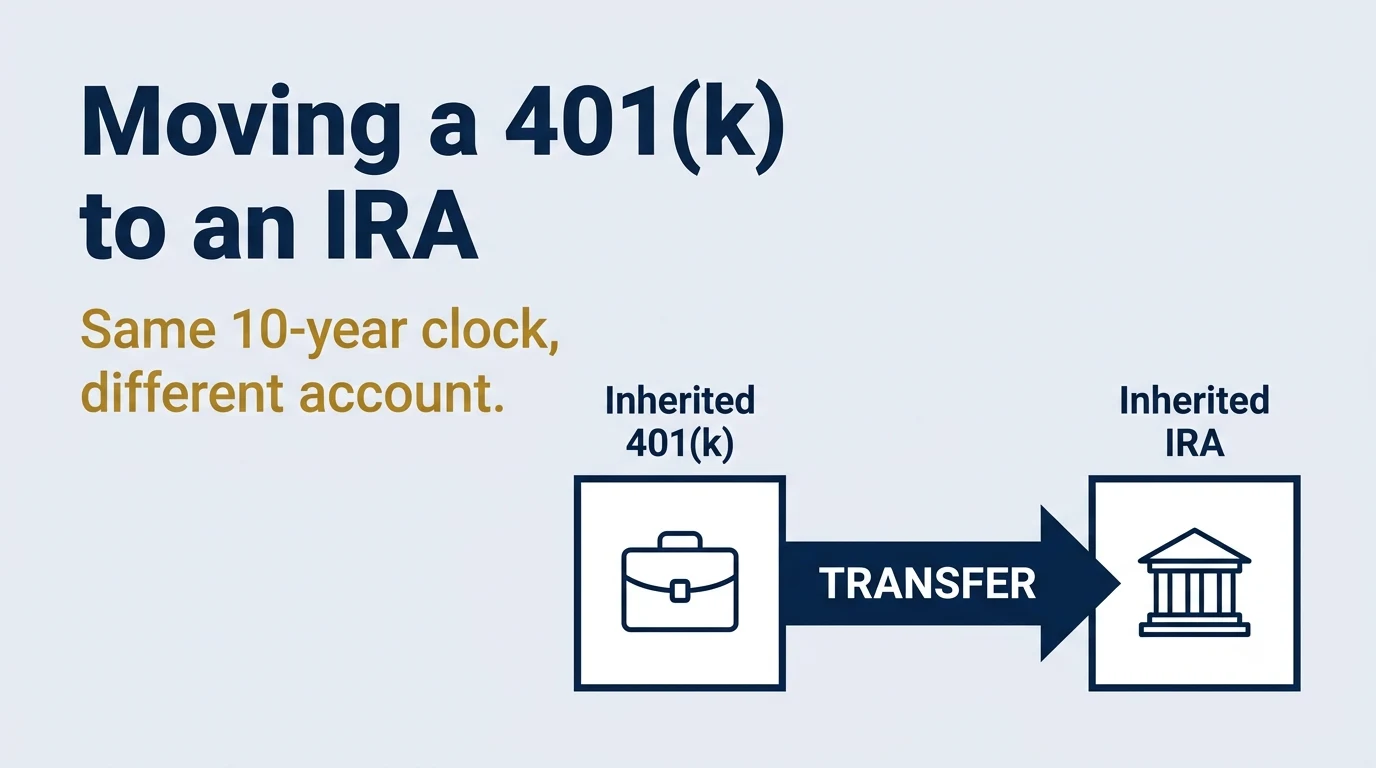
A non-spouse beneficiary may be able to use a direct transfer
IRS Publication 575 explains that a designated beneficiary other than a surviving spouse may be able to transfer an eligible distribution from a deceased employee’s retirement plan directly to an IRA established to receive it. The transfer must be made as a direct trustee-to-trustee transfer, and the receiving IRA is treated as an inherited IRA.
This is not a normal 60-day rollover
The distinction is crucial. A non-spouse beneficiary generally cannot take possession of a distribution from the inherited employer plan and then use the same rollover freedom that a plan participant or surviving spouse may have. The tax-favored route described by the IRS is the direct trustee-to-trustee transfer to a properly titled inherited IRA.
Some plans force a lump-sum payout, which makes the transfer time-sensitive
A number of employer plans do not let a non-spouse beneficiary keep money in the plan. They cash out the account and issue a check within a set period after death. If that check is payable to the beneficiary, the opportunity for a tax-favored direct transfer to an inherited IRA can be lost, because a non-spouse beneficiary cannot complete a 60-day rollover of a plan distribution paid personally. A beneficiary should confirm the plan's payout policy quickly and, if a forced distribution is coming, arrange the direct trustee-to-trustee transfer before the plan processes it.
- Get the plan's written payout optionsThe plan document determines which distribution options are available.
- Check for a forced payoutSome plans set a period for cashing out the account.
- Identify any unpaid year-of-death RMDThat amount is generally not an eligible rollover distribution.
- Arrange a direct transfer if availableSend the eligible distribution to a properly titled inherited IRA.
- Confirm the transfer paperworkDo not take possession and assume a 60-day rollover is available.
A non-spouse beneficiary's tax-favored route is a direct trustee-to-trustee transfer to an inherited IRA.
SECURE 2.0 removed the pre-2024 gap for a non-spouse Roth 401(k) beneficiary
Before 2024, designated Roth accounts in employer plans were subject to pre-death RMDs; that rule was repealed, so a Roth 401(k) is now treated more like a Roth IRA for the original participant. For a non-spouse beneficiary, a direct rollover of an inherited designated Roth account to an inherited Roth IRA generally moves it into the no-annual-RMD-until-year-10 pattern that applies to inherited Roth IRAs.
The plan document can limit what happens before the transfer
IRS beneficiary guidance says the qualified plan document establishes the distribution options available to satisfy the RMD rules. Some plans allow beneficiaries to remain in the plan for a period; others may provide narrower choices. The beneficiary should ask the plan administrator for the written distribution options before assuming a transfer is mandatory.
A transfer does not reset the inherited distribution schedule
The inherited IRA continues to be governed by the deceased employee’s death date, the beneficiary’s classification, and whether the employee died before or after the required beginning date. Moving assets out of the 401(k) does not create a new ten-year period.
Watch for an unpaid year-of-death RMD
If the participant died after the required beginning date and had not completed the RMD for the year of death, that required amount is generally not an eligible rollover distribution. The beneficiary and plan administrator should identify the year-of-death RMD before moving the remaining eligible balance.
Questions to ask the plan administrator
- What beneficiary distribution options does the plan document allow?
- Is a direct transfer to an inherited traditional or Roth IRA available for this balance?
- Has the owner’s year-of-death RMD been completed?
- How will the plan report the transfer and any taxable distribution?
Traditional and Roth plan money may need separate destinations
An employer plan can contain both pre-tax and designated Roth amounts. A direct transfer should preserve the tax character of those assets. The beneficiary should ask the plan administrator and receiving custodian how each source will be reported and whether separate inherited traditional and inherited Roth IRAs are needed.
Creditor protection can be a reason not to roll out
An inherited 401(k) left inside the employer plan generally keeps the plan's ERISA anti-alienation protection from the beneficiary's creditors. Once the money is rolled into an inherited IRA, that protection is largely gone: under Clark v. Rameker (2014), a non-spouse inherited IRA is not exempt in bankruptcy, and only a few states protect it by their own statute. A beneficiary with real creditor exposure, a pending lawsuit, or a bankruptcy on the horizon should weigh keeping the account in the plan (if the plan allows it) against the investment and flexibility advantages of an inherited IRA.
| Consideration | Keep in employer plan | Move to inherited IRA |
|---|---|---|
| Availability | Depends on the plan's written options | A direct transfer may be available for an eligible distribution |
| Creditor protection | Generally keeps the plan's ERISA anti-alienation protection | That protection is largely gone after transfer |
| Distribution schedule | The plan document sets the options available to satisfy the RMD rules | Transfer does not reset the inherited schedule |
The plan document controls transfer availability; creditor protection can also matter to the choice.
Plan fees and investment choices are not the legal transfer test
A beneficiary may prefer an inherited IRA because of investment flexibility or administrative convenience, but those preferences do not determine whether a transfer is legally available. The plan document and federal rollover rules determine the available options. The decision to transfer can then consider fees and investments without confusing those considerations with tax eligibility.
Confirm withholding before any payment leaves the plan
A direct eligible rollover distribution to an inherited IRA is treated differently from a taxable distribution paid to the beneficiary. If a plan proposes to issue a check to the beneficiary with withholding, stop and confirm whether the transaction is being processed as a distribution rather than a direct transfer.
Save the plan’s beneficiary package
Employer plans can later merge, terminate, or change recordkeepers. The beneficiary should keep the plan’s written options, the direct-transfer election, year-of-death RMD information, and the final plan statement with the inherited IRA opening statement. Those records create a traceable chain if the RMD history is questioned years later.
- Obtain the plan's written beneficiary options and direct-transfer terms.
- Get written confirmation of whether the year-of-death RMD is complete.
- Request written details on how the plan will report the transfer and any taxable payment.
- Confirm in writing how pre-tax and designated Roth amounts will be preserved and reported.
- Save the completed transfer election, final plan statement, and inherited IRA opening statement.