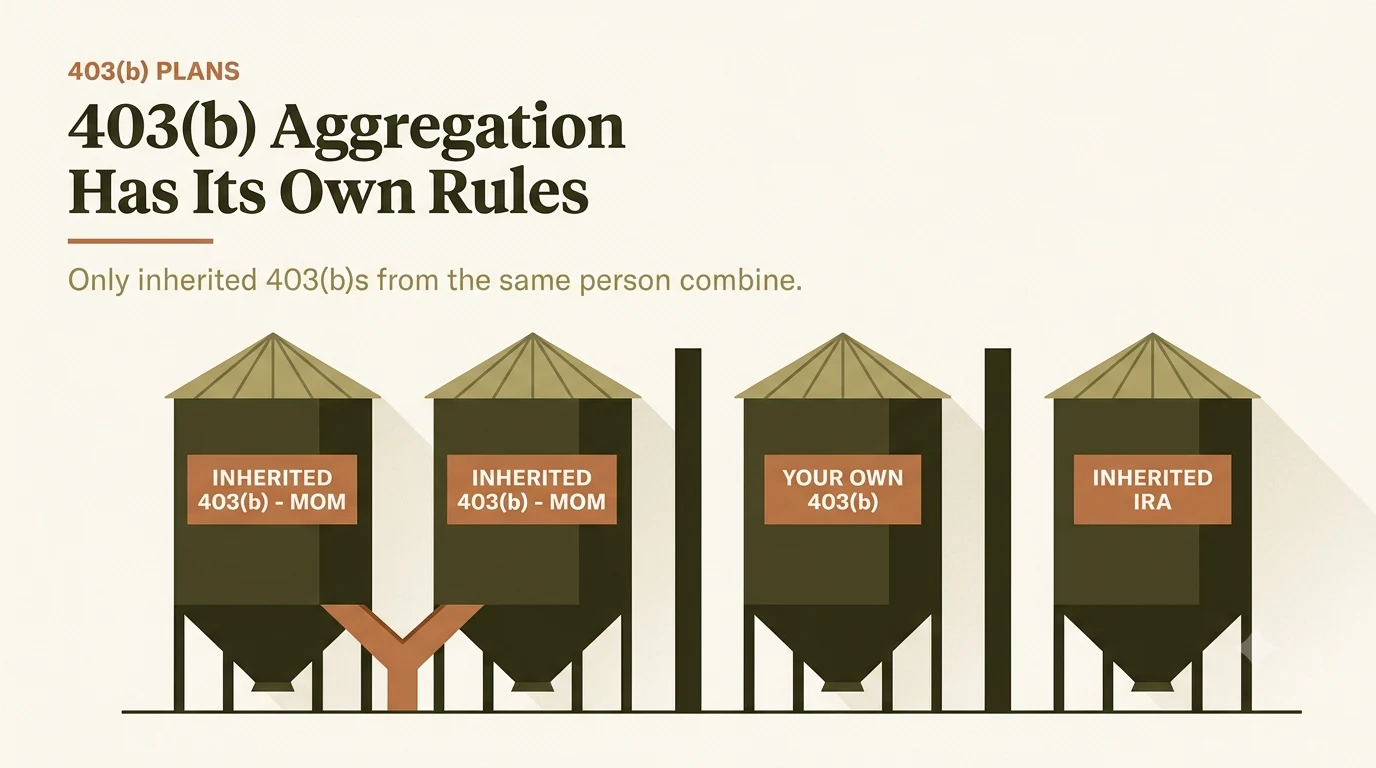
403(b) aggregation has its own beneficiary rule
The 2024 final RMD regulations provide a specific aggregation framework for section 403(b) contracts. Each contract’s RMD is determined separately, but certain 403(b) amounts can be totaled and paid from one or more eligible 403(b) contracts. For a beneficiary, the critical boundary is whose 403(b) interest the person holds.
Inherited 403(b)s from the same decedent can be aggregated with each other
The final regulations state that amounts a person holds in 403(b) contracts as beneficiary of a decedent may be aggregated. But they may not be aggregated with 403(b) amounts the person holds as the employee or with 403(b) amounts inherited as beneficiary of another decedent.
So a beneficiary who inherits two 403(b) contracts from the same parent can have aggregation flexibility within that inherited 403(b) group, while a 403(b) inherited from another person belongs in a separate group.
Three boundaries to remember
| Combination | Aggregation result |
|---|---|
| Two inherited 403(b) contracts from the same decedent | May be aggregated under the 403(b) beneficiary rule, subject to the applicable requirements |
| Inherited 403(b) + beneficiary’s own employee 403(b) | Do not aggregate |
| Inherited 403(b) from Parent A + inherited 403(b) from Parent B | Do not aggregate |
| Inherited 403(b) + inherited IRA | Do not cross-aggregate |
| Inherited 403(b) + inherited 401(k) | Do not assume aggregation; qualified-plan RMDs generally stay plan-specific |
403(b) distributions do not satisfy IRA RMDs
The final regulations are explicit that distributions from 403(b) contracts do not satisfy the minimum-distribution requirements for IRAs, and IRA distributions do not satisfy the minimum-distribution requirements for 403(b) contracts. This remains true even if the same person died and the same beneficiary owns both inherited accounts.
Example: two 403(b)s and one IRA from the same parent
A parent dies leaving the beneficiary 403(b) Contract A, 403(b) Contract B, and a traditional IRA. Suppose A has a $3,000 RMD, B has a $2,000 RMD, and the IRA has a $4,000 RMD. The beneficiary may be able to satisfy the $5,000 inherited-403(b) total from one or both inherited 403(b) contracts. The separate $4,000 IRA obligation must be satisfied under the inherited-IRA rules; extra money from the 403(b) group does not satisfy it.
401(k)s are not another version of the 403(b) exception
Qualified retirement plans such as 401(k)s generally require the RMD to be calculated and paid from the specific plan. Do not carry the 403(b) aggregation rule over to 401(k)s merely because both are employer retirement accounts.
A direct rollover can change future account administration, but not erase the current-year RMD
A nonspouse beneficiary may be able to use a direct trustee-to-trustee rollover from an eligible employer plan to a properly titled inherited IRA. Publication 575 describes that option. An amount that is an RMD is not an eligible rollover distribution, so the transfer-year RMD must be identified before the plan balance is moved.
- Calculate each 403(b) contract's RMD separatelyKeep the contract balances visible before any permitted aggregation.
- Identify the current-year RMDAn RMD is not eligible rollover money.
- Move only eligible assets by direct transferUse a properly titled inherited IRA if the plan route is available.
- Start a separate inherited-IRA recordLater RMDs follow inherited-IRA grouping rules.
Once a 403(b) death benefit moves to an inherited IRA, the rulebook switches
If a non-spouse beneficiary directly rolls an inherited 403(b) into a properly titled inherited IRA, later RMDs come out of that inherited IRA under the inherited-IRA rules. From that point the account can be aggregated only with other inherited IRAs from the same decedent, not with any 403(b) contract that stayed in place. The transfer is a one-way change in which aggregation group the money belongs to.
Governmental and church 403(b) plans can set their own terms
A 403(b) plan sponsored by a public school system, a governmental employer, or a church can have plan-specific distribution options and timelines layered on top of the federal minimums. The plan document and administrator control what a beneficiary may do and by when. Confirm the plan's own beneficiary distribution rules before assuming the general 403(b) framework is the whole picture.
Transfer-year records to preserve
- December 31 balance for each 403(b) contract.
- Separate RMD calculation for each contract.
- Which contracts belong to the same decedent-beneficiary group.
- Gross distributions used to satisfy the aggregated 403(b) amount.
- Any amount retained and distributed as the current-year RMD before a direct rollover.
- Opening inherited-IRA statement after the transfer.
The practical rule is simple: aggregate only inside the permitted 403(b) beneficiary group. Same owner login, same beneficiary, or same decedent across different account types is not enough.