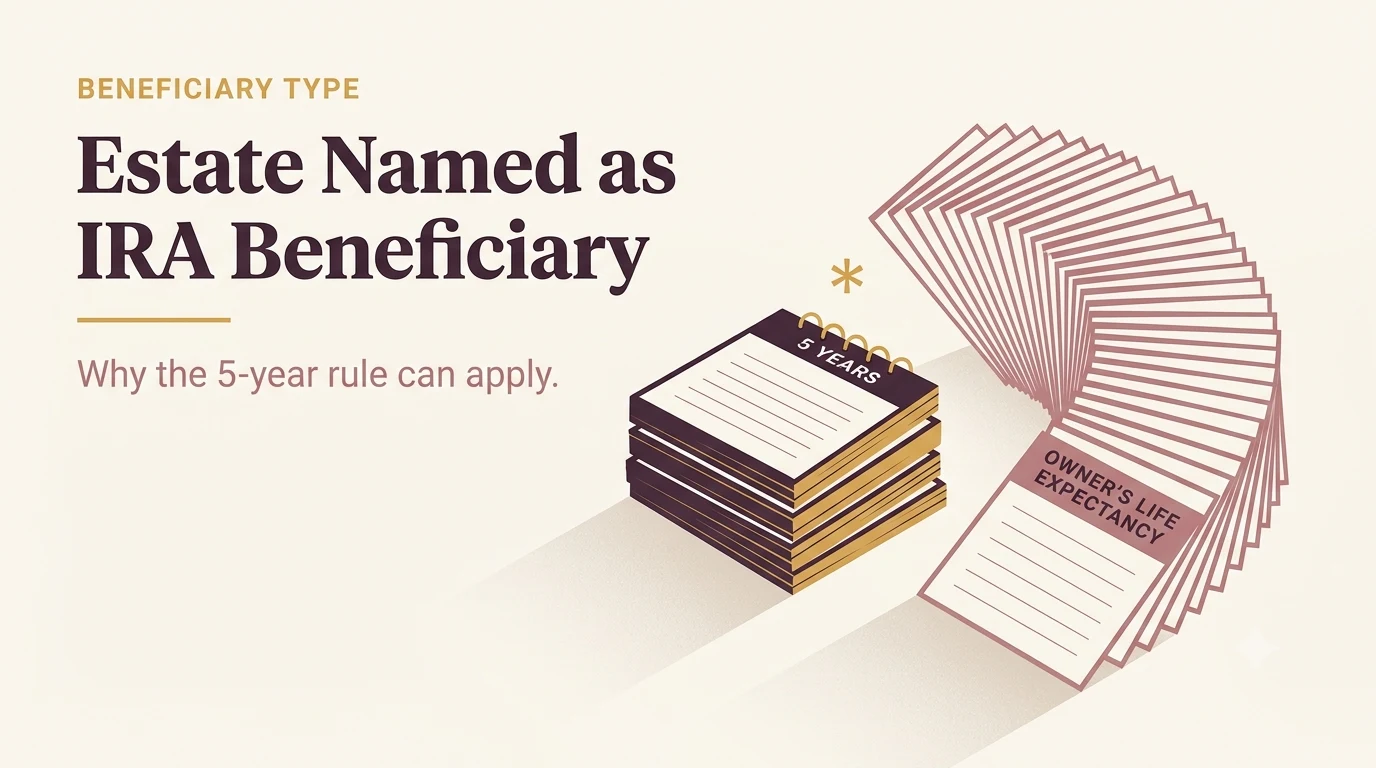
An estate is not a designated beneficiary
The SECURE Act’s 10-year rule is built around designated beneficiaries. An estate is not an individual designated beneficiary. Publication 590-B therefore directs non-individual beneficiaries into different rules, depending on whether the owner died before or after the required beginning date.
If the owner died before the required beginning date
Publication 590-B says the 5-year rule applies when the owner died before the required beginning date and the beneficiary is not an individual, such as an estate. Under the 5-year rule, the entire account generally must be distributed by December 31 of the calendar year containing the fifth anniversary of the owner’s death.
If the owner died after the required beginning date
The post-required-beginning-date framework can instead use the deceased owner’s remaining life expectancy when there is no designated beneficiary. This is one reason the statement “an estate always has five years” is incomplete.
The five-year rule applies in the before-date branch; the after-date branch can use remaining life expectancy.
The beneficiary form can matter more than the will
Retirement accounts ordinarily pass according to the account’s beneficiary designation, not simply according to a will. If no valid individual beneficiary is in place and the estate becomes the recipient under the account terms, the tax distribution rules can be materially less flexible.
Trusts require a separate analysis
A trust is also not itself an individual, but certain trust beneficiaries can be treated as designated beneficiaries if the trust satisfies the see-through trust requirements. An estate and a qualifying see-through trust should not be treated as interchangeable.
The remaining-life-expectancy path, in numbers
When the owner died on or after the required beginning date with no designated beneficiary, the account is generally paid out over the owner's remaining single life expectancy. The denominator is the owner's age in the year of death from the Single Life Expectancy Table, reduced by one for each year afterward. An owner who died at 74 has a factor near 15.6, so the account can be stretched roughly 15 years rather than emptied in 5. Whether that is better than the 5-year rule depends entirely on the owner's age at death.
| Owner's status at death | Before required beginning date | On or after required beginning date |
|---|---|---|
| Distribution framework | Five-year rule | Owner's remaining single life expectancy may apply |
| Article example | Owner dies in 2025; deadline generally December 31, 2030 | Owner age 74; factor near 15.6, roughly 15 years |
| Calculation detail | The entire account is generally due by December 31 of the calendar year containing the fifth anniversary of death | Use the owner's age in the year of death; reduce the denominator by one for each later year |
These are different paths for a non-individual beneficiary, based on the owner's status at death.
An estate can sometimes pass the IRA through to heirs without changing the schedule
Custodians and IRS private rulings have permitted an executor to transfer an IRA payable to the estate into separate inherited IRAs titled for the individual estate beneficiaries. That can simplify administration and let each heir manage their share, but it does not upgrade anyone to designated-beneficiary status. The 5-year or remaining-life-expectancy schedule established when the estate became the beneficiary continues to control.
Why executors should avoid guessing
An executor dealing with an IRA payable to the estate is coordinating income-tax rules, estate administration, and beneficiary distributions. The account’s required beginning date, the estate’s tax year, and the eventual recipients can all matter. That situation is a strong candidate for professional tax guidance rather than a generic ten-year-rule checklist.
Example: owner dies before the required beginning date with no valid individual beneficiary
If the account terms make the estate the beneficiary and the owner dies before the required beginning date, the five-year rule can require the account to be emptied by the end of the fifth calendar year after death. If the owner died in 2025, that generally points to December 31, 2030—not 2035.
Why distributing the IRA to estate beneficiaries may not restart the clock
Once the estate is the beneficiary for RMD purposes, later passing assets to heirs under a will does not ordinarily transform those heirs into designated beneficiaries of the original IRA. The retirement-account beneficiary status was determined under the account arrangement. Executors should therefore avoid assuming that a later estate distribution creates a new ten-year period.
Income-tax reporting can be split between the estate and recipients
An IRA distribution payable to an estate can create income in respect of a decedent and fiduciary-income-tax issues. Depending on how and when amounts are distributed through the estate, income can be reported at the estate or beneficiary level under separate tax rules. Those rules go beyond the basic RMD deadline and are a reason to coordinate the executor and tax preparer.
Compressed estate and trust tax brackets can make the estate route expensive
Estates and non-grantor trusts reach the top 37% federal income-tax bracket at a very low income level—only a few thousand dollars—far faster than an individual. If the estate retains a large inherited-IRA distribution rather than passing the income out to the estate's beneficiaries in the same year, that income can be taxed at the highest rate. Executors often distribute the IRA proceeds to the residuary beneficiaries within the fiduciary tax year specifically so the income is carried out and taxed at the individuals' lower rates.
State inheritance tax can apply on top
A few states, notably Pennsylvania and New Jersey, impose an inheritance tax on assets passing at death, including IRAs, based on the beneficiary's relationship to the owner. That tax is measured on the account value at death and is generally due within months, separate from the income tax on later distributions and separate from the federal estate tax. An estate administering an IRA in one of those states should budget for it early.
Beneficiary forms deserve periodic review during the owner’s life
From a planning perspective, one of the simplest ways to avoid unintended estate-beneficiary treatment is to keep retirement-account beneficiary forms current. A will does not usually substitute for a missing or outdated beneficiary designation on the retirement account itself.
- Confirm the account's beneficiary designation and whether the estate is the recipient.
- Determine whether the owner died before or after the required beginning date.
- Keep the custodian's distribution schedule with the estate account records.
- If the IRA passes to heirs, preserve the original schedule and beneficiary status.
- Keep current beneficiary forms with the owner's retirement-account records.
- Coordinate IRA distributions with the executor's tax preparer and estate records.