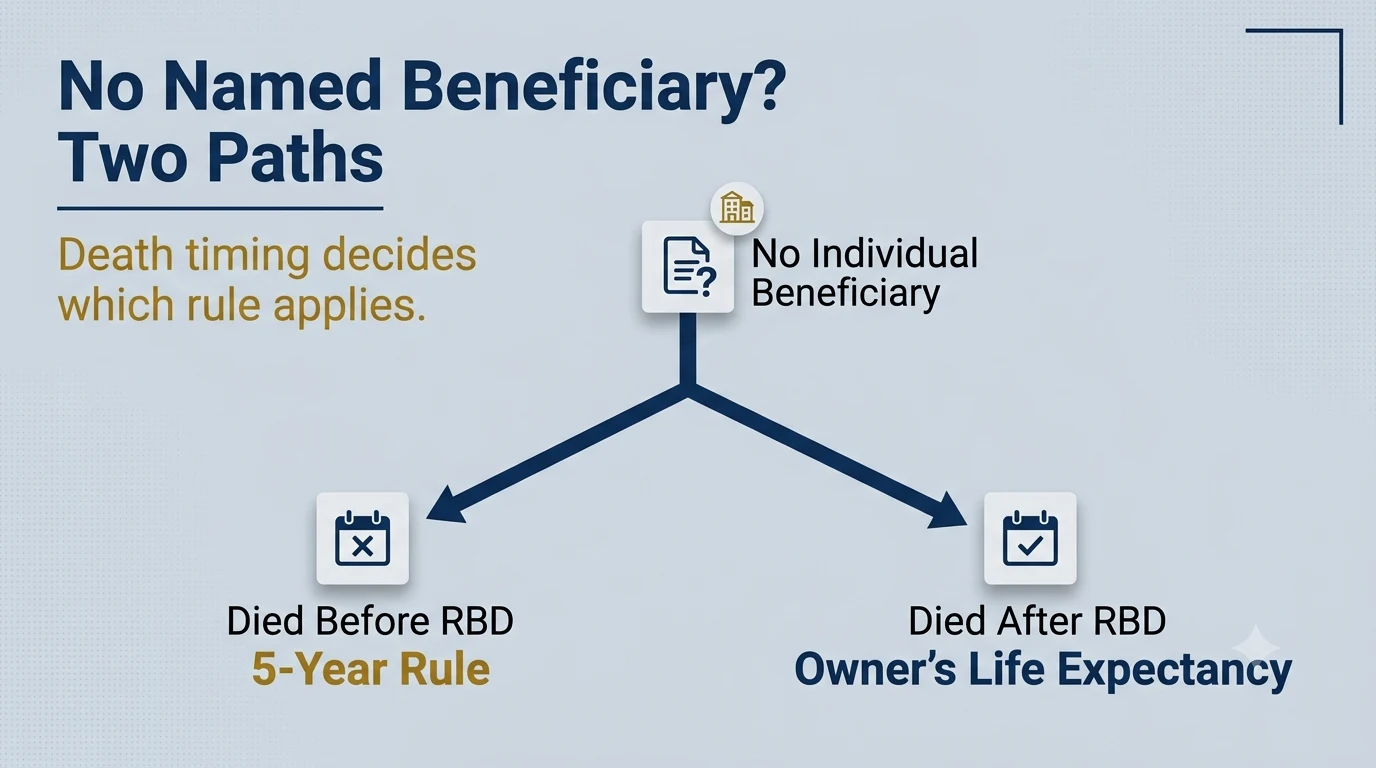
Start with the September 30 beneficiary result, not the account title
The “no designated beneficiary” branch applies when there is no qualifying designated beneficiary for the post-death RMD rules as of the beneficiary-determination date. An estate is the classic example. A charity or a trust that does not qualify for see-through treatment can also produce a non-designated-beneficiary result. A trust named on the IRA is therefore not automatically in this branch; first determine whether its beneficiaries can be treated as designated beneficiaries.
Decision tree
| Step | Question | If yes | If no |
|---|---|---|---|
| 1 | Is an individual directly treated as designated beneficiary? | Use designated-beneficiary rules | Go to step 2 |
| 2 | Is a trust named and does it satisfy the see-through requirements? | Analyze the trust beneficiaries under the designated-beneficiary rules | Go to step 3 |
| 3 | Is the remaining beneficiary an estate, charity, or other non-individual interest? | No designated beneficiary branch | Review the beneficiary documents again |
If the owner died before the required beginning date: the 5-year rule generally applies
Publication 590-B states that when the owner dies before the required beginning date and there is no designated beneficiary, the 5-year rule applies. The entire inherited interest must be distributed by December 31 of the year containing the fifth anniversary of death. There is no life-expectancy denominator in this branch.
Example: an owner dies in 2026 before RBD with the estate as beneficiary. The 5-year deadline is December 31, 2031.
If the owner died on or after the required beginning date: use the owner’s remaining life expectancy
When the owner dies on or after RBD and there is no designated beneficiary, Publication 590-B directs the post-death RMD calculation to the owner’s remaining life expectancy. The owner’s age in the year of death establishes the starting life-expectancy track, and the denominator is reduced by one in subsequent years.
This is why “estate beneficiary always means five years” is wrong. The owner’s RBD status changes the branch.
| Owner's status | Before required beginning date | On or after required beginning date |
|---|---|---|
| Distribution framework | 5-year rule | Owner's remaining life expectancy |
| Example | Owner dies in 2026; deadline December 31, 2031 | Use age in year of death as the starting track |
| Annual calculation | No annual denominator in this branch | Reduce denominator by one in later years |
Estate beneficiary: separate the payout rule from estate income-tax reporting
If the estate is the beneficiary, retirement distributions can also create estate/fiduciary income-tax issues. Publication 559 discusses income in respect of a decedent (IRD) and how retirement distributions can affect estate and beneficiary reporting. Those income-tax questions are separate from deciding whether the retirement account follows the 5-year rule or owner-life-expectancy rule.
Charity plus individual: September 30 can change the result
If a charity and an individual are both beneficiaries at death, the charity is not an individual designated beneficiary. Publication 590-B explains that a beneficiary who receives the entire benefit or is otherwise disregarded by September 30 of the year following death may no longer be counted in the beneficiary determination. That timing can materially affect which branch applies and should be resolved before making assumptions from the original beneficiary form.
Trust beneficiary: test see-through status before calling it “no designated beneficiary”
A trust itself is not an individual, but its beneficiaries can be treated as designated beneficiaries if the trust meets the applicable requirements. A valid trust under state law, irrevocability, identifiable beneficiaries, and required documentation are central parts of the see-through analysis. If those requirements are not satisfied, the account can fall back into the no-designated-beneficiary branch.
The 10-year rule does not apply in this branch
A common post-SECURE assumption is that every inherited retirement account now runs on a 10-year clock. That is not true here. The 10-year rule is a rule for designated beneficiaries. A non-designated beneficiary—an estate, a non-qualifying trust, a charity that was not disregarded—stays on the pre-SECURE framework: the 5-year rule for a death before the required beginning date, or the owner's remaining life expectancy for a death on or after it. There is no 10-year option to elect.
The 5-year rule is mechanically simpler, and that can be an advantage
The 5-year rule has no annual minimum, no denominator, and no life-expectancy table—just one deadline to empty the account by December 31 of the fifth year after death. For a modest account, that simplicity can outweigh the value of a longer stretch, especially if the beneficiaries would spend the money within a few years anyway. The owner's remaining-life-expectancy branch, by contrast, requires an annual RMD calculation every year.
A branch-specific checklist
- Owner date of death.
- Owner required-beginning-date status.
- Beneficiary designation in force at death.
- Any disclaimer or full payout completed before the September 30 determination date.
- Trust see-through status if a trust is named.
- If no designated beneficiary and death before RBD: calendar the 5-year endpoint.
- If no designated beneficiary and death on/after RBD: calculate annual RMDs using the owner’s remaining life expectancy.
- Estate/fiduciary tax reporting tracked separately from the retirement-account payout rule.