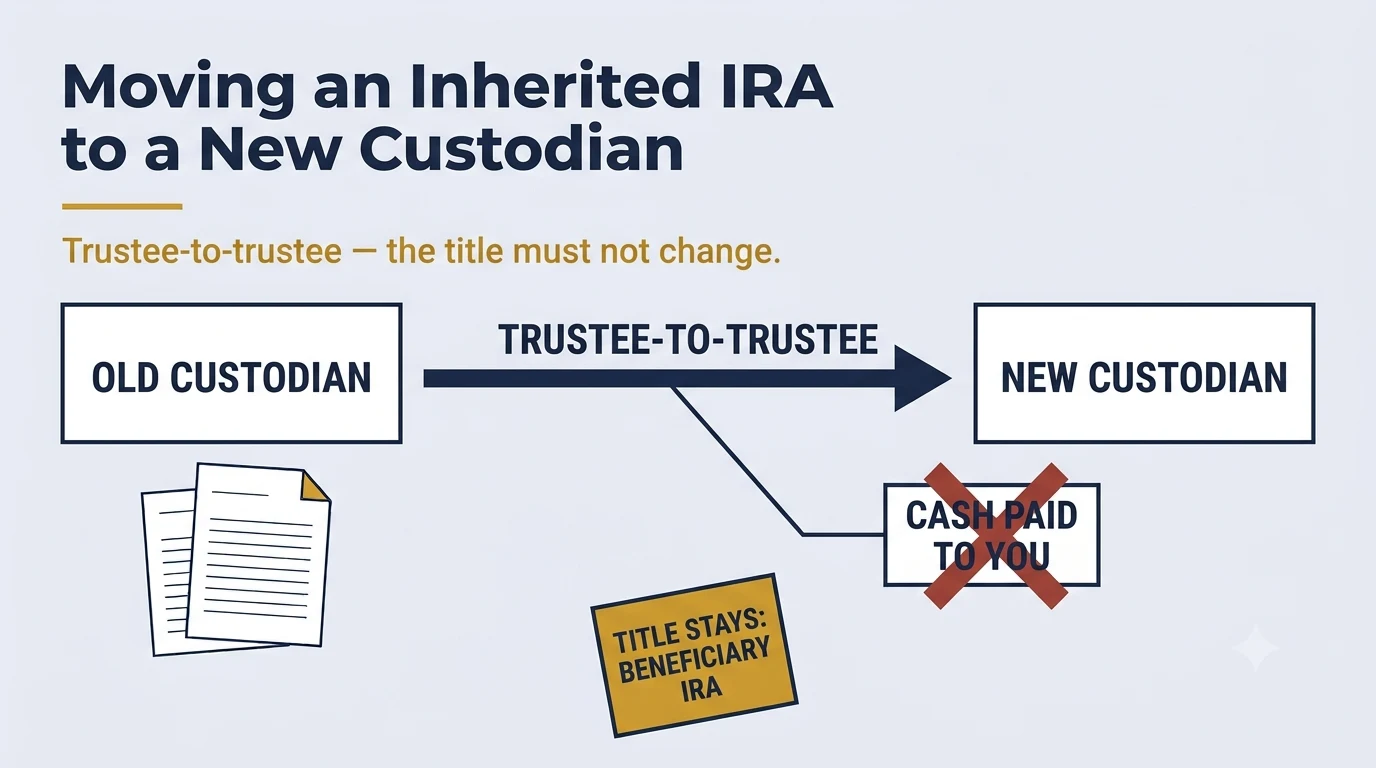
A non-spouse beneficiary can change custodians, but should use the inherited-IRA transfer route
Publication 590-A permits a non-spouse beneficiary to transfer an inherited IRA directly from one trustee to another, provided the receiving IRA is established and maintained in the deceased owner’s name for the benefit of the beneficiary. This is not the same as treating the inherited account as the beneficiary’s own IRA.
Why direct movement matters
A normal IRA owner often hears about a 60-day rollover after receiving a distribution personally. Non-spouse inherited IRAs do not have the same rollover freedom. A beneficiary who wants to change institutions should arrange a trustee-to-trustee transfer rather than taking possession of the money and assuming it can be redeposited later.
Before the transfer, capture five pieces of history
- Original owner’s date of death.
- Whether the owner died before or on/after the required beginning date.
- The beneficiary classification and applicable 10-year or life-expectancy rule.
- The prior December 31 balance and current-year RMD status.
- Gross distributions already paid in the current year.
Example: moving the account in June
Assume the beneficiary has a $14,000 annual RMD and has already received $4,000 before a June transfer. The new custodian needs to know that history so the remaining $10,000 is not overlooked. The transfer does not make the current year disappear and does not restart the life-expectancy denominator or 10-year clock.
Do not commingle the inherited assets with a personal IRA
The receiving account should remain an inherited IRA tied to the same decedent. Sending the balance into the beneficiary’s own traditional IRA can create a problem because a non-spouse beneficiary is not allowed to treat the inherited IRA as his or her own.
What to verify after the transfer settles
| Item | Verification |
|---|---|
| Registration | Decedent + beneficiary status preserved |
| Tax character | Traditional remains traditional; Roth remains Roth unless a distinct employer-plan rule applies |
| RMD history | Current-year amount and prior distributions recorded |
| Deadline | Original year-10 date preserved |
| Cost/basis records | Any inherited basis documentation retained |
Automated transfer vs. liquidate-and-mail-a-check
Many custodians move accounts through the automated brokerage transfer system, which keeps positions intact and sends assets directly between institutions. Others liquidate certain proprietary funds and send a check. The safe version is a check payable to the receiving trustee for the benefit of the inherited account, not a check payable to the beneficiary personally. If the paperwork or the check names the beneficiary as payee, pause and confirm whether the old custodian processed a transfer or a distribution.
- Open and verify the receiving inherited IRAConfirm the decedent and beneficiary appear in the registration.
- Confirm the transfer route and payeeA check, if used, should be payable to the receiving trustee for the inherited account.
- Carry current-year distribution historyTell the new custodian what gross amount has already left the account.
- Match account type and recordsPreserve traditional or Roth character, deadline, basis, and RMD history.
Tax character has to match on the receiving side
A traditional inherited IRA must transfer into a traditional inherited IRA, and a Roth inherited IRA into a Roth inherited IRA. A non-spouse beneficiary cannot use a transfer to move a traditional inherited IRA into a Roth account, because that would be a conversion the beneficiary is not permitted to make. Confirm the receiving account's tax type on the opening paperwork before releasing assets.
The transfer is administrative, not a new inheritance
Changing custodians should be thought of as moving the same inherited account history to a different service provider. The tax timeline continues from the original owner’s death.
Ask the receiving custodian to confirm it accepts inherited accounts before sending assets
Not every brokerage uses the same paperwork or accepts every inherited plan source. Open and verify the receiving inherited IRA first, including the exact registration, before authorizing the old custodian to release assets. A failed or misdirected transfer is harder to repair after money has been paid to the beneficiary.
In-kind transfer vs liquidation is an investment-operation question, not an RMD rule
Some custodians can move securities in kind; others require liquidation of certain proprietary funds. Either way, the inherited account’s death date, RMD history, and 10-year deadline continue. Selling investments during transfer does not itself satisfy an RMD unless cash is actually distributed from the retirement account to the beneficiary.
Do a 30-day post-transfer audit
After the assets arrive, compare the old closing statement with the new opening statement, confirm the inherited title, verify beneficiary tax forms are enabled, and confirm any scheduled RMD payments survived the move. Resolve missing cost/basis or Roth-history records while the old custodian still has accessible files.
- Compare the old closing statement with the new opening statement.
- Confirm the inherited title and tax character on the receiving account.
- Check that scheduled RMD payments and beneficiary tax forms are in place.
- Locate any missing basis or Roth-history records while the old files are available.