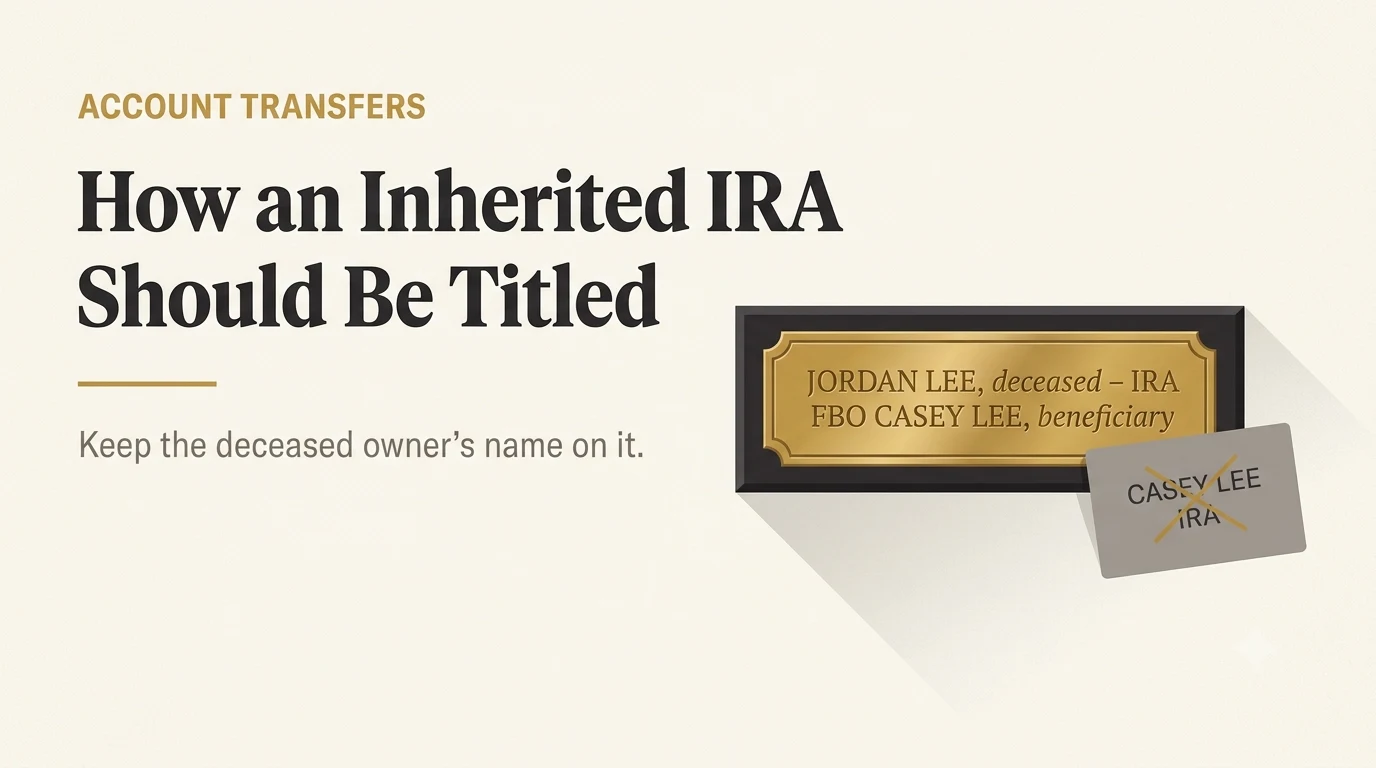
The title should show that the account is inherited
A non-spouse beneficiary does not treat an inherited IRA as his or her own IRA. IRS guidance for trustee-to-trustee transfers requires the receiving IRA to be established in a manner that identifies the deceased individual and the beneficiary—for example, an account maintained in the deceased owner’s name for the benefit of the beneficiary.
Financial institutions use different display formats, so the exact punctuation is not the issue. The account registration should preserve the beneficiary character rather than making the account look like an ordinary IRA owned outright by the beneficiary.
Example of the information the title needs to preserve
A custodian might display something similar to “Jordan Lee, deceased, IRA FBO Casey Lee, beneficiary.” Another institution may use “Inherited IRA of Jordan Lee for benefit of Casey Lee.” Both formats communicate the two essential identities: the deceased owner and the beneficiary.
Why the title matters beyond appearance
- It helps prevent accidental contributions to the inherited account.
- It preserves the source decedent for RMD aggregation analysis.
- It helps a receiving custodian retain the original 10-year clock after a transfer.
- It distinguishes inherited distributions from the beneficiary’s own IRA activity.
Do not retitle it only in the beneficiary’s name
A surviving spouse can have special options, including in some cases treating an inherited IRA as the spouse’s own. A non-spouse beneficiary does not have that same election. If an institution proposes to register a non-spouse inherited IRA as an ordinary personal IRA, stop and clarify the beneficiary status before funding the account.
Transfers should preserve the same inherited status
Publication 590-A permits a non-spouse beneficiary to move an inherited IRA by trustee-to-trustee transfer to another inherited IRA that continues to identify the decedent and beneficiary. The transfer should not create a new death date or restart the 10-year period.
Registration checklist after the new account opens
- Deceased owner’s name appears in the inherited registration.
- Beneficiary is identified as beneficiary/FBO rather than sole original owner.
- Traditional or Roth tax character matches the transferred account.
- Original owner’s date of death is in the custodian records.
- Prior RMD history and year-10 deadline have been carried forward.
Account title and tax identification are related but not the same field
The beneficiary generally reports taxable inherited-IRA distributions under the beneficiary’s taxpayer identification information, while the account registration still identifies the deceased owner for beneficiary status. Do not remove the decedent from the title merely because the beneficiary’s Social Security number appears on tax forms.
What the IRS says a non-spouse beneficiary must not do with the account
Publication 590-B is direct: a beneficiary who is not the surviving spouse cannot treat an inherited IRA as their own. That means no contributions to the account, and no rolling amounts into or out of it under the ordinary rollover rules. The account title is the everyday reminder of that limitation. An account labeled only in the beneficiary's name, with the decedent removed, invites exactly the transactions the rule prohibits.
Employer-plan-sourced inherited IRAs keep the participant as the named decedent
When a non-spouse beneficiary moves a 401(k) or 403(b) death benefit into an inherited IRA by direct rollover, the receiving IRA is still an inherited IRA and should still name the deceased plan participant as the decedent. The fact that the money came from an employer plan rather than the decedent's own IRA does not change the titling requirement. Keep the plan name and the participant's date of death in the account records.
The inherited title is also a creditor-protection marker
A regular IRA carries a large federal bankruptcy exemption. Under Clark v. Rameker (2014), a non-spouse inherited IRA does not—the Supreme Court treated it as available cash rather than retirement funds. A surviving spouse who validly rolls an inherited IRA into their own IRA moves back under the owner exemption; a non-spouse who mistakenly retitles the account as a personal IRA does not gain that protection and instead creates the other problems described above. The registration is the everyday record of which set of rules, including creditor rules, applies.
What a bad retitle can obscure
If the account is displayed only as “Casey Lee Traditional IRA,” a future representative may assume it is Casey’s own IRA, accept a new contribution, aggregate it with personal IRA RMDs, or apply the wrong rollover rule. Clear inherited registration is a practical control against those errors.
| Keeps the status visible | Hides it | |
|---|---|---|
| Example title | Jordan Lee, deceased, IRA FBO Casey Lee, beneficiary | Casey Lee Traditional IRA |
| Decedent | Named in the registration | Missing from the registration |
| What a later representative may do | Treat it as an inherited account and apply the inherited rules | Assume it is Casey's own IRA, accept a contribution, aggregate it with personal RMDs, or apply the wrong rollover rule |
Successor beneficiaries should preserve both generations of history
If the original beneficiary later dies, the successor beneficiary should keep records showing the original owner as the source decedent, the original beneficiary, and the successor relationship. The account name may change operationally, but the tax timeline does not become a brand-new personal IRA.