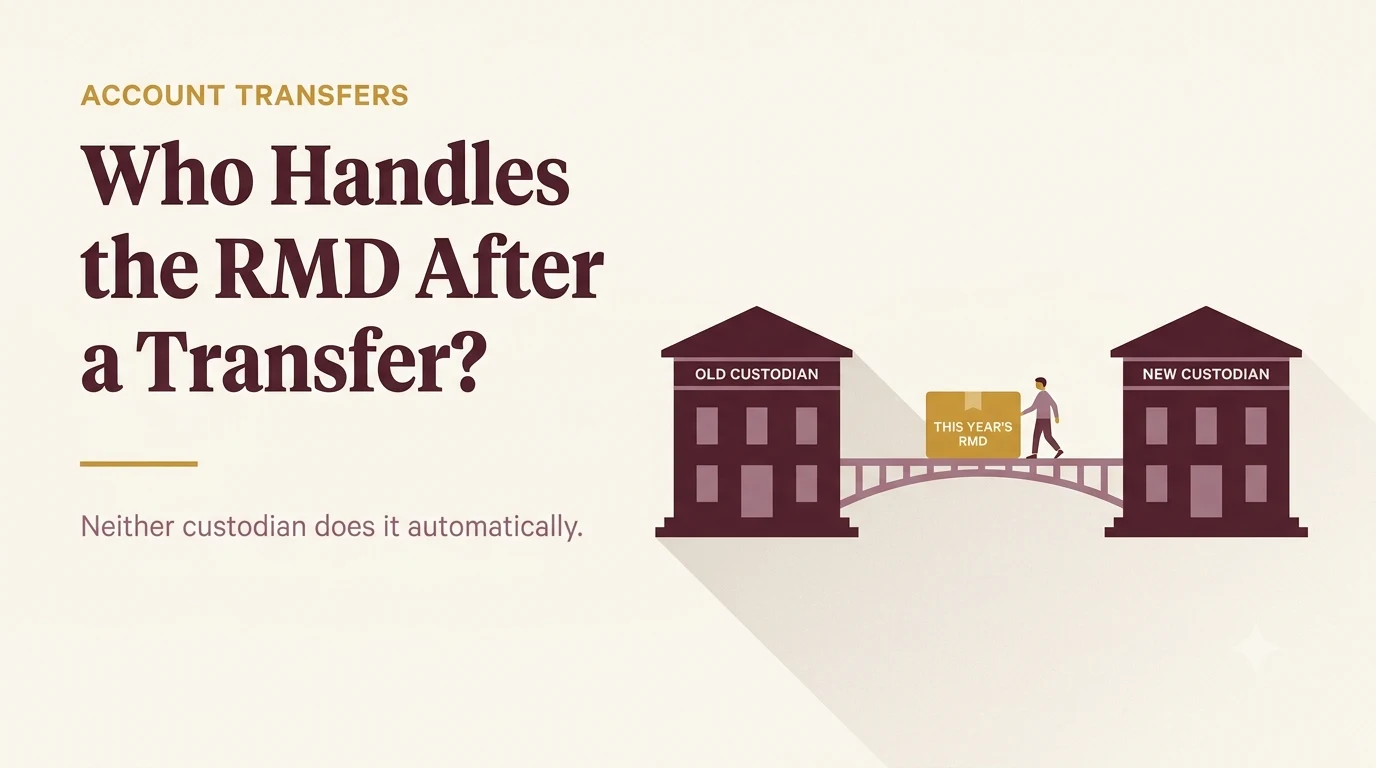
A custodian transfer changes where the account sits, not the tax-year obligation
If an inherited IRA requiring an annual RMD moves from one financial institution to another during the year, the beneficiary still has one calendar-year distribution obligation. The receiving custodian may help calculate or distribute the amount, but the beneficiary should not assume either institution automatically reconciles the full year.
Three numbers must cross the transfer
- The relevant prior December 31 balance.
- The applicable RMD denominator and how it was established.
- Gross distributions already taken earlier in the current year.
Without all three, a new institution can know the current balance and still lack enough information to determine the remaining RMD accurately.
Example: part of the RMD was paid before transfer
Suppose the 2027 RMD is $18,000. Custodian A pays $5,000 in March, and the account transfers directly to Custodian B in May. The remaining annual requirement is $13,000, assuming no other qualifying distribution. If Custodian B calculates from scratch without being told about the March payment, it could distribute too much; if it assumes Custodian A satisfied the full amount, it could distribute too little.
Use trustee-to-trustee movement for a non-spouse inherited IRA
Non-spouse inherited IRAs have rollover restrictions. Publication 590-A permits a trustee-to-trustee transfer to another IRA established and maintained in the deceased owner’s name for the benefit of the beneficiary. A beneficiary should not casually take possession of the funds and assume the normal 60-day rollover rules available to an IRA owner will apply.
Ask both institutions for written records
| Former custodian | Receiving custodian |
|---|---|
| Prior Dec. 31 statement | Inherited-account registration |
| Year-to-date gross distributions | RMD calculation it intends to use |
| Tax withholding already taken | Scheduled remaining distributions |
| Transfer confirmation | Year-end statement |
The once-per-year rollover limit does not restrict direct transfers
The IRS one-rollover-per-12-months rule applies to 60-day rollovers, not to trustee-to-trustee transfers. A non-spouse beneficiary generally cannot use a 60-day rollover for an inherited IRA at all, but the flip side is useful: there is no annual cap on the number of direct inherited-IRA transfers between custodians. A beneficiary can consolidate several inherited accounts by direct transfer in the same year without triggering that limit, as long as each movement is custodian-to-custodian and the receiving account keeps the inherited registration.
If a transfer is rejected or returned, treat it as a possible distribution
Transfers occasionally fail—a registration mismatch, a rejected asset, or a check returned to the wrong party. If funds come back as a check payable to the beneficiary rather than to a trustee, the transaction may have been processed as a beneficiary distribution rather than a transfer. Do not deposit it into a personal account and assume it can be redone later. Contact both custodians in writing, confirm how each coded the event, and get tax advice before the next step.
If funds come back as a check payable to the beneficiary rather than a trustee, the event may have been processed as a distribution. Contact both custodians in writing, confirm how each coded it, and get tax advice before the next step.
Do not let an account transfer hide the year-10 deadline
The receiving custodian’s records may begin on the transfer date, while the 10-year clock began with the original owner’s death. Save the death year and final distribution year in the beneficiary file so a change of institution does not accidentally create a new clock.
Neither custodian’s automated RMD tool sees the whole year by default
The old institution may calculate from the correct December 31 balance but stop tracking after the transfer. The new institution may know the remaining balance but not distributions paid before arrival. The beneficiary is the only party positioned to reconcile the full calendar year unless the institutions explicitly exchange that history.
Do not transfer an RMD shortfall into next year
If the transfer closes in December, complete the current-year minimum before the calendar turns. The fact that the new custodian received the assets late does not generally move a December 31 RMD deadline into January. If processing time is tight, ask both institutions which one can complete the required distribution before the deadline.
If the transfer closes in December, complete the current-year minimum before the year ends. If processing time is tight, ask both institutions which one can complete the required distribution before the deadline.
Tax withholding follows the distribution, not the transfer
A trustee-to-trustee transfer is not the same as a beneficiary cash distribution. If federal withholding is needed for a taxable RMD, it must be elected on the actual distribution payment rather than assumed to occur during the transfer of custodians.